On this page
Most of us first meet photosynthesis as 6CO₂ + 6H₂O → C₆H₁₂O₆ + 6O₂. Then the Class 11 textbook shows 12 water molecules on the left and 6 more on the right. It looks like someone forgot to cancel. They didn't. The longer version shows where each oxygen atom actually goes.
Why does the photosynthesis equation have 12 water molecules?
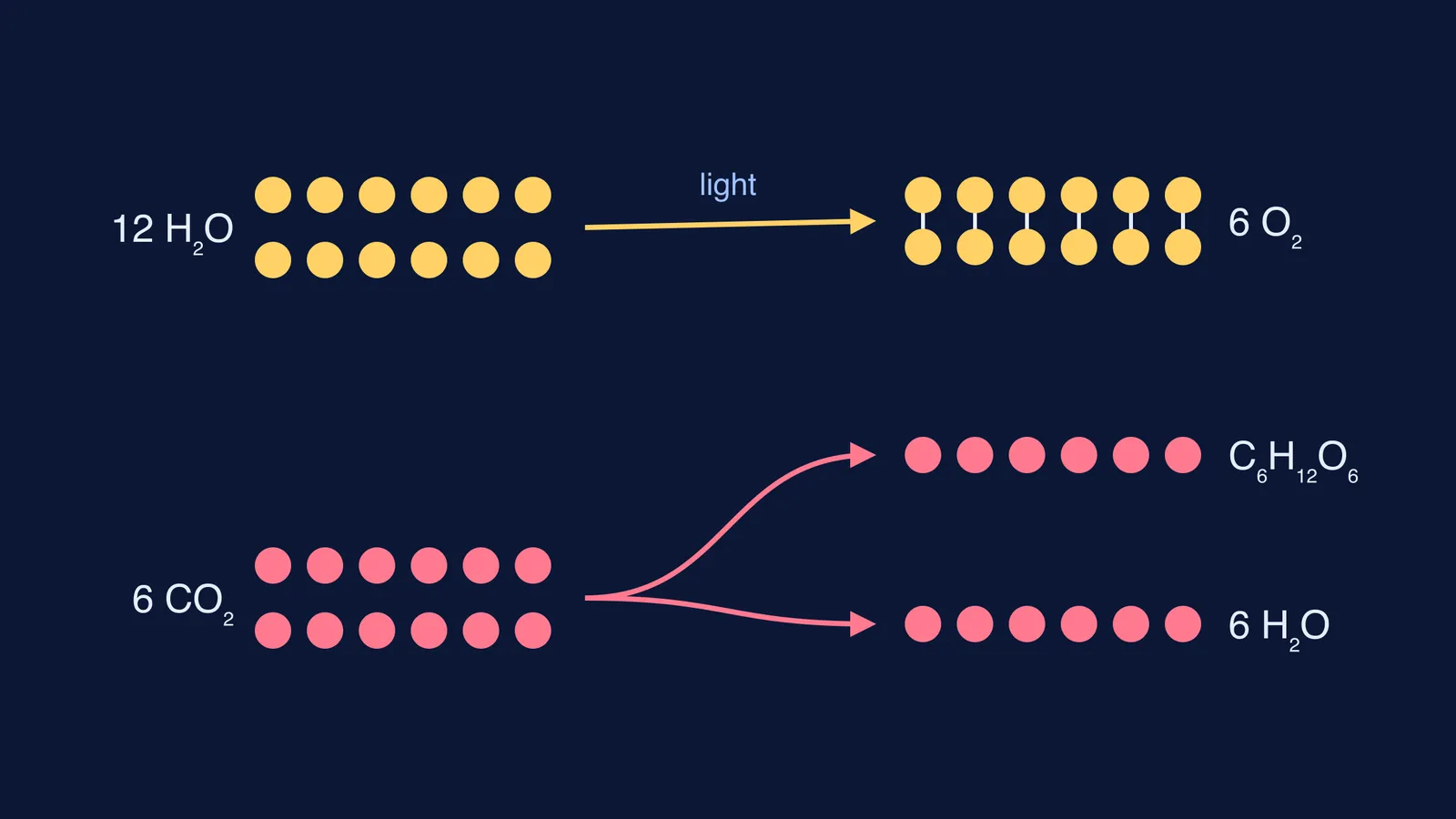
NCERT's Class 11 Biology chapter, Photosynthesis in Higher Plants, gives the overall process as 6CO₂ + 12H₂O → C₆H₁₂O₆ + 6H₂O + 6O₂. The same page says plainly: "The O₂ released is from water."
That one sentence fixes the number of water molecules. Six O₂ molecules contain 12 oxygen atoms. Each water molecule has only one oxygen atom. So the plant has to split 12 water molecules to release 6 O₂. No smaller number works.
The 6H₂O on the right is not the same water coming back out. It is new water, made later in the process. Its oxygen comes from carbon dioxide, as the atom count below shows.
Where does the oxygen in photosynthesis come from?
For a long time, scientists assumed the oxygen came from splitting CO₂. NCERT's chapter credits the microbiologist Cornelius van Niel (1897-1985) with the key idea. He studied purple and green sulphur bacteria, which use H₂S instead of water and release sulphur or sulphate, not O₂. From this he inferred that in green plants the O₂ comes from H₂O, the hydrogen donor, and not from carbon dioxide (NCERT).
The test came in 1941. Samuel Ruben, Merle Randall, Martin Kamen and James Hyde used water labelled with the heavy isotope oxygen-18, so they could follow its oxygen through photosynthesis (Ruben et al., Journal of the American Chemical Society, 1941). A 2021 history in Photosynthesis Research says this experiment showed that the oxygen evolved in photosynthesis came from water, not CO₂, challenging the earlier view of Nobel laureates Richard Willstätter and Otto Warburg; it adds that many later experiments have supported the idea (Govindjee and Blankenship, 2021). A teaching note from UC Berkeley's Lawrence Hall of Science adds the other half: the oxygen in the sugar did not come from water (Lawrence Hall of Science).
We tell the full story of the experiment in how Ruben and Kamen proved photosynthesis oxygen comes from water.
How do you track every oxygen atom in the equation?
Take the NCERT equation and audit it like an account book. Write down the oxygen atoms on each side, then decide where each one goes.
Left side: 6 CO₂ hold 12 oxygen atoms, and 12 H₂O hold 12 more. Total: 24.
Right side: 6 O₂ hold 12, one glucose holds 6, and 6 H₂O hold 6. Total: 24. The equation balances.
The 12 oxygen atoms in O₂ all come from water. That uses up every one of the 12 water oxygens.
Glucose's 6 oxygen atoms did not come from water, so they must come from CO₂. That leaves 6 of CO₂'s 12 oxygen atoms.
Those last 6 go into the 6 new water molecules on the right.
Now check hydrogen: 12 H₂O supply 24 hydrogen atoms. Glucose takes 12, and the 6 new water molecules take 12. Balanced again.
Why can't you just cancel the water on both sides?
As arithmetic, you can. Subtract 6H₂O from both sides and you get the familiar 6CO₂ + 6H₂O → C₆H₁₂O₆ + 6O₂, which still balances. But try the audit on it. Six water molecules carry only 6 oxygen atoms, while 6 O₂ need 12. The short form quietly says half the oxygen gas came from CO₂, which is what the oxygen-18 work contradicted.
So think of the short form as a net equation: fine for counting atoms, wrong for tracing them. When a question asks where the oxygen comes from, what photolysis does, or why water appears on both sides, write the 12-water version and say why.
The water-splitting step itself happens in Photosystem II. Our post on photolysis of water in Photosystem II covers it, and the Calvin cycle in numbers shows where the CO₂ goes next.
A two-minute check before your biology exam
Can you write 6CO₂ + 12H₂O → C₆H₁₂O₆ + 6H₂O + 6O₂ from memory?
Can you say in one sentence why there are 12 water molecules, not 6?
Can you name van Niel and say what bacteria taught him?
Can you say what oxygen-18 labelling showed, and what the short equation wrongly implies?
Can you redo the 24-oxygen audit on rough paper in under a minute?
If balancing still feels like guesswork, the Fermi Problem Library has worked problems with a step-by-step solver that explains the reasoning rather than printing an answer. To see how photolysis, the light reactions and the Calvin cycle connect, the Fermi Concept Library gives each concept its own lesson and its place in the map.