

On this page
In plants, algae, and cyanobacteria, the process of photosynthesis depends on a continuous flow of electrons. When the reaction centre of Photosystem II (P680) absorbs a photon of light, it becomes excited and loses an electron. To keep the process running, this lost electron must be replaced immediately. The plant achieves this by splitting water, a process known as photolysis.
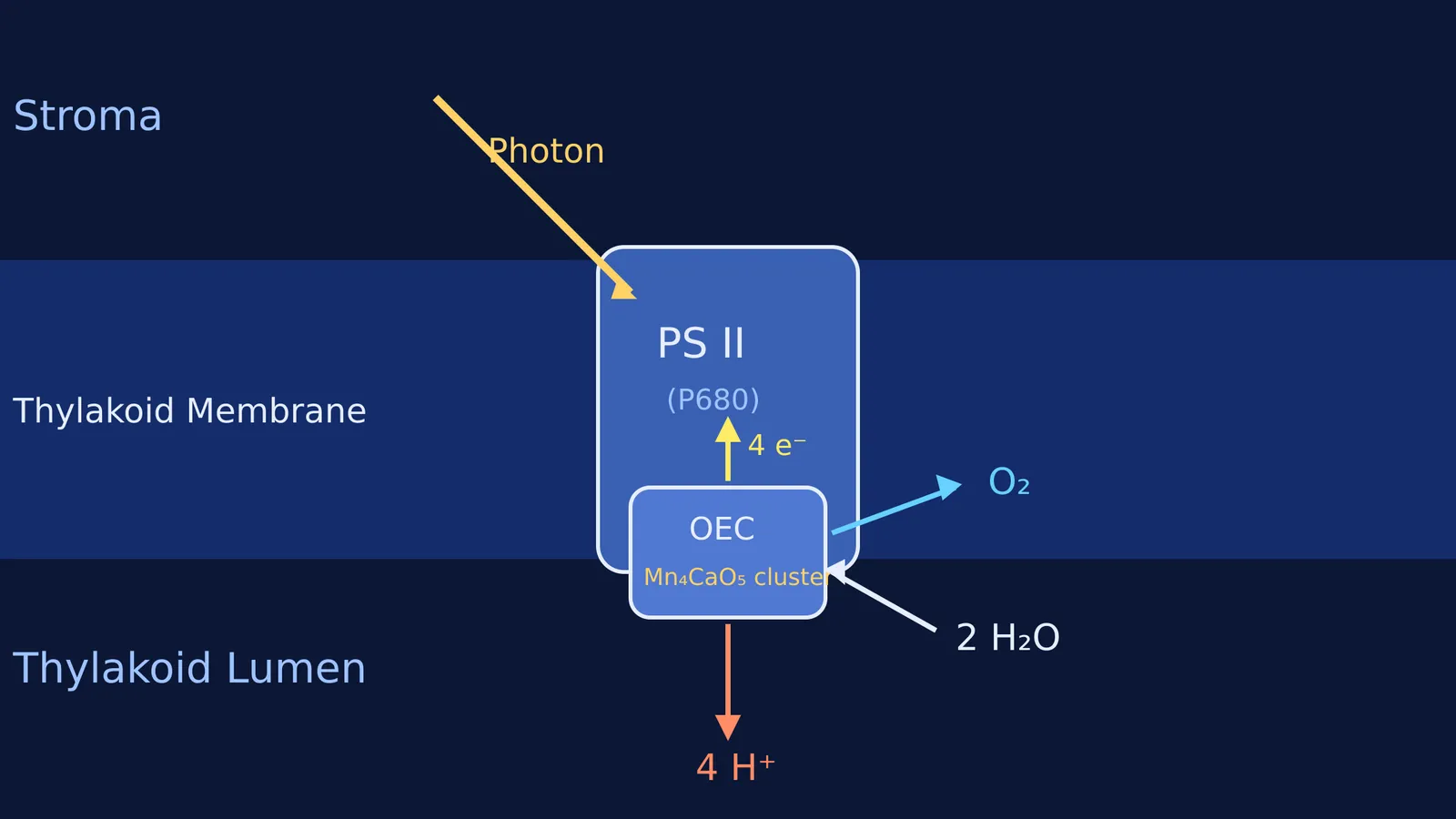
The overall chemical reaction extracts four electrons from two water molecules: 2H₂O → 4H⁺ + 4e⁻ + O₂.
This reaction takes place exclusively on the inner side of the thylakoid membrane, facing the thylakoid lumen. Because the splitting occurs on the lumen side, the protons (H⁺) are deposited directly into this inner space. This accumulation creates the proton gradient required for the chemiosmotic synthesis of ATP.
Where does the released oxygen come from?
The oxygen gas (O₂) that we breathe is a metabolic by-product of this water-splitting reaction at Photosystem II.
For decades, the exact atomic arrangement that allowed plants to form an O–O bond from two separate water molecules was a mystery. In 2011, a landmark study mapped the crystal structure of the oxygen-evolving complex at a resolution of 1.9 Å (Umena et al., 2011). They found that four water molecules bind tightly to a specific cluster of metal ions, perfectly positioning two of them to fuse into dioxygen once enough oxidizing power has been built up.
If you struggle to picture how electrons move through these membrane proteins, the Fermi Concept Library holds a lesson for every concept in biology, mapping out the electron transport chain step by step.
Which elements are involved in the photolysis of water?
The catalytic heart of the water-splitting machinery is the Oxygen-Evolving Complex (OEC). The 2011 high-resolution mapping confirmed that its core is an inorganic cluster with the formula Mn₄CaO₅. This "distorted chair" structure relies on three specific elements:
Manganese (Mn): The cluster contains four manganese ions. Manganese acts as a charge accumulator. Because splitting two water molecules requires stripping away four electrons simultaneously, the four manganese ions absorb the energy of four successive photon strikes (a sequence known as the Kok cycle), stepping up their oxidation states until they are powerful enough to pull electrons from water.
Calcium (Ca): A single calcium ion is locked into the cluster. It holds the substrate water molecules in the exact geometrical position required to form the final O–O bond. If calcium is removed, the cycle stalls and oxygen is not produced.
Chloride (Cl⁻): Present as chloride ions, this element does not sit inside the central cluster but binds nearby. Chloride helps neutralize the massive positive charge that builds up on the manganese ions during the cycle, and it regulates the channels through which protons exit into the lumen.
When memorizing the elements for multiple-choice questions, students often forget chlorine. If you are reviewing this material and keep missing minor details, Fermi's AI tutor works out what you already know and builds a plan for the session, checking your understanding of the cofactors before you move on.
How should you prepare this topic for exams?
To consolidate your active learning, check that you can confidently answer these four standard question types before your next biology test:
The location: Where does photolysis occur? You must specify the inner side of the thylakoid membrane, not just "the chloroplast."
The photosystem: Which photosystem is it associated with? Remember it is Photosystem II, which contains the P680 reaction centre.
The by-products: Where do the protons go, and what happens to the oxygen? Protons stay in the lumen to build the gradient, while oxygen diffuses out of the cell.
The mineral requirements: Which three ions are essential? You need manganese, calcium, and chloride for the complex to function.
Understanding the precise flow of energy and matter here makes it much easier to tackle related topics in plant physiology. For instance, the efficiency of these light reactions directly impacts how plants handle stress, such as during photorespiration when RuBisCO wastes energy. It also provides a useful contrast when you map the chloroplast's synthetic pathways against respiration as an amphibolic pathway in the mitochondria.


