On this page
The names of the Calvin cycle's three stages are easy to remember. The counts are where answers tend to slip: 9 ATP written where 18 was asked, or NADPH charged to the wrong stage. This post lays the whole cycle out as one tally you can rebuild from memory, using the numbers in your NCERT textbook and the open college textbook OpenStax Biology 2e, which gives the same counts.
What are the three stages of the Calvin cycle?
NCERT's Class 11 chapter Photosynthesis in Higher Plants describes the Calvin cycle in three stages: carboxylation, reduction and regeneration. It also says the Calvin pathway runs in all photosynthetic plants, whether they are C3 or C4.
Carboxylation is the fixation of CO2 into a stable organic intermediate: CO2 joins the 5-carbon sugar RuBP, catalysed by RuBisCO, giving two molecules of 3-PGA (NCERT).
Reduction turns 3-PGA into a 3-carbon sugar, glyceraldehyde 3-phosphate (G3P), using ATP and NADPH (OpenStax Biology 2e).
Regeneration rebuilds RuBP, the CO2 acceptor, so the cycle can keep turning; this step needs ATP but no NADPH (NCERT).
The ATP and NADPH come from the light reactions. If you want to follow them from the thylakoid into the stroma first, our post on tracking ATP and NADPH from the light reactions to the Calvin cycle does that step by step.
How many ATP and NADPH does each stage of the Calvin cycle use?
NCERT gives the cost per CO2: "for every CO2 molecule entering the Calvin cycle, 3 molecules of ATP and 2 of NADPH are required" (NCERT, Chapter 11). Two of those ATP and both NADPH are spent in reduction; the third ATP is spent in regeneration. NCERT also says 6 turns of the cycle are needed for one glucose.
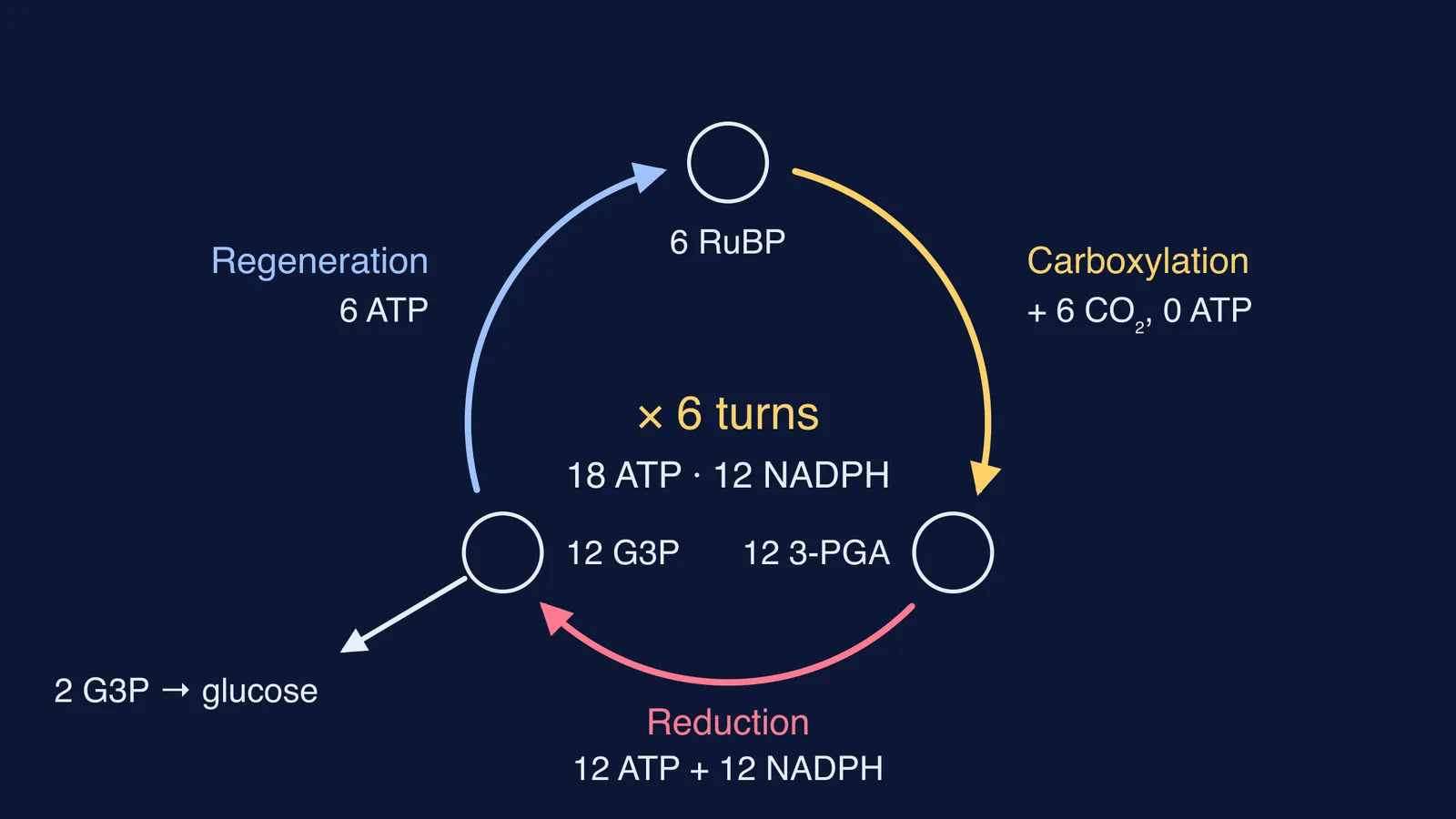
Here is the counting table for one glucose, that is, six turns:
Start: 6 RuBP (6 x 5 = 30 carbons) + 6 CO2 (6 carbons) = 36 carbons in.
Carboxylation: 6 RuBP + 6 CO2 give 12 molecules of 3-PGA (12 x 3 = 36 carbons). ATP used: 0. NADPH used: 0.
Reduction: 12 3-PGA become 12 G3P. ATP used: 12. NADPH used: 12.
Exit: 2 G3P (6 carbons) leave the cycle and make one glucose.
Regeneration: the other 10 G3P (30 carbons) are rebuilt into 6 RuBP. ATP used: 6. NADPH used: 0.
Total: 12 + 0 + 6 = 18 ATP and 12 + 0 + 0 = 12 NADPH.
The carbon check is your safety net: 30 carbons go back as RuBP and 6 leave as sugar, which is exactly the 6 that came in as CO2. This matches NCERT's In/Out box: six CO2, 18 ATP and 12 NADPH go in; one glucose, 18 ADP and 12 NADP come out.
Why is it 18 ATP and not 9?
The number 9 is real, but it belongs to a different product. OpenStax explains that three turns of the cycle fix enough carbon to export one G3P, and that the cycle must run six times to make a six-carbon glucose (OpenStax Biology 2e, section 8.3). For three turns it counts six ATP and six NADPH in reduction and three more ATP in regeneration: 9 ATP and 6 NADPH per G3P.
So 9 ATP and 6 NADPH is the cost of one G3P (3 CO2). Double it for glucose (6 CO2) and you are back at 18 and 12. When a question asks for "ATP per glucose", always check whether the options were written per CO2, per G3P or per glucose.
The ratio is also worth knowing. The cycle needs ATP and NADPH in a 3:2 ratio, and NCERT notes that cyclic photophosphorylation, which makes ATP but no NADPH, probably takes place to meet this difference (NCERT).
How do you check your Calvin cycle count in an exam?
Use this three-line check before you mark an answer:
Which unit? Per CO2 is 3 ATP and 2 NADPH; per G3P is 9 and 6; per glucose is 18 and 12.
Which stage? Carboxylation uses no ATP or NADPH. Reduction uses both. Regeneration uses ATP only.
Do the carbons balance? Carbons in as RuBP plus CO2 must equal carbons out as RuBP plus sugar.
Respiration has its own, different count, and students often mix the two in the same week. Our explainer on how many ATP one glucose gives in aerobic respiration keeps that tally separate. For the diagram itself, see what the NCERT photosynthesis figures show and the traps in them.
If a step in the table still feels like a rule you memorised rather than understood, the Fermi Concept Library has a lesson for every concept in biology, each with its place in the map. When you want to test the count on real questions, the Fermi Problem Library has worked problems with a step-by-step solver that explains the reasoning rather than printing an answer.