On this page
Photosynthesis questions often turn on one count: how many ATP and NADPH the Calvin cycle needs for one glucose, and where they come from. With an AI chatbot, the useful part is making it show the whole ledger so you can check each line.
How many ATP and NADPH does the Calvin cycle use per glucose?
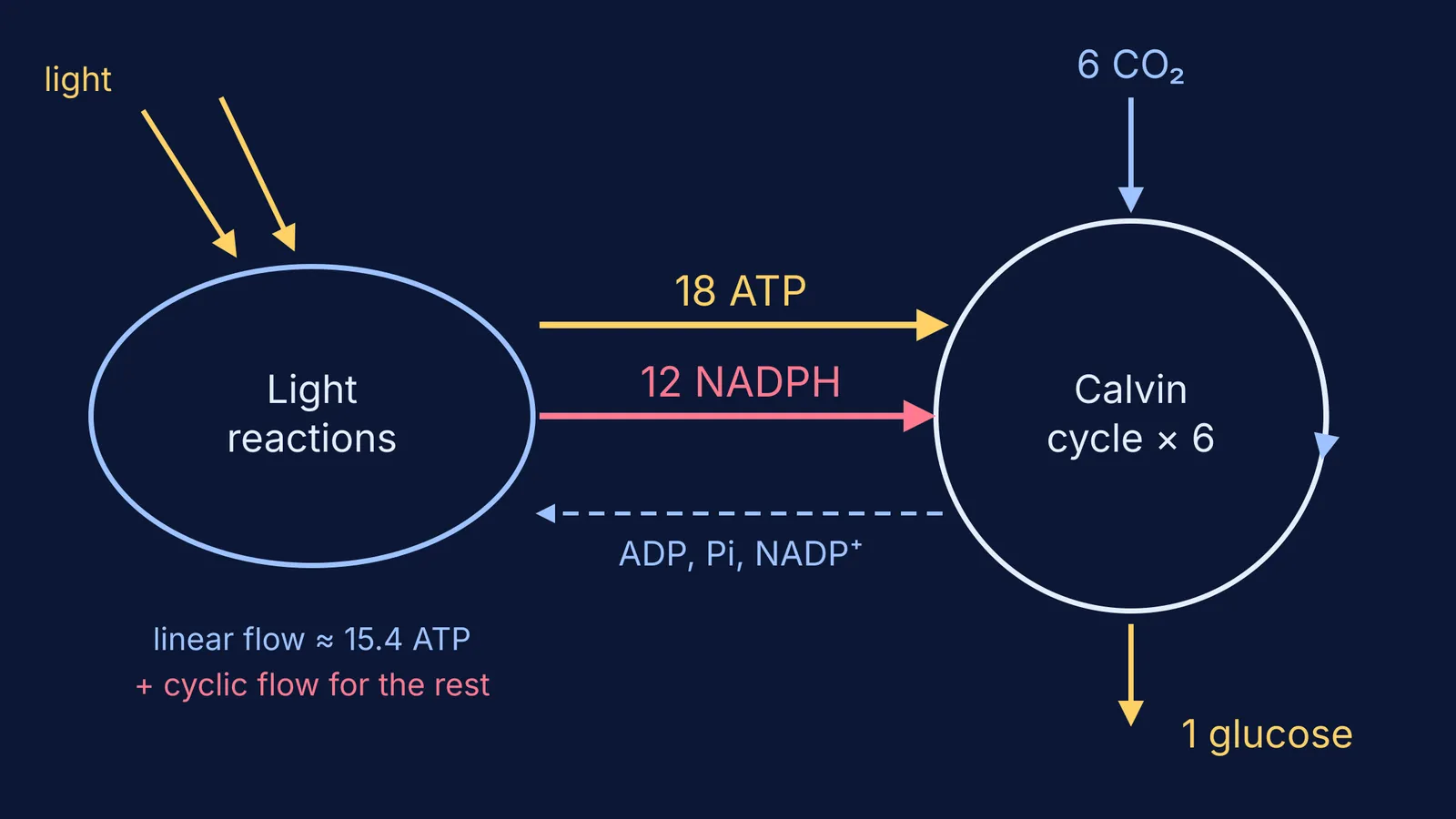
The Calvin cycle fixes one CO2 per turn, so it has to turn six times to make one six-carbon glucose, as OpenStax Biology 2e explains. The same chapter says that for every three turns, six ATP and six NADPH are used in the reduction stage and three more ATP are used to regenerate RuBP.
Double that for six turns and you get the textbook answer: 18 ATP and 12 NADPH per glucose.
That works out to 3 ATP and 2 NADPH per CO2. In a review in Plant Physiology, plant biologists David Kramer and John Evans note that three ATP for every two NADPH exactly matches what the Calvin-Benson cycle consumes: 1.5 ATP per NADPH.
How do you ask AI to track ATP and NADPH through the light reactions and Calvin cycle?
Don't ask "how many ATP are needed?" Ask for a ledger that you can check line by line. Here is a script you can paste:
"Track ATP and NADPH for making one glucose in a C3 plant. Use six CO2."
"For the Calvin cycle, give one line per stage: fixation, reduction, regeneration. On each line, write the molecules in and out, and the ATP and NADPH used."
"Then add up the totals. Then say where in the light reactions each ATP and NADPH comes from."
"Don't give me the final total first. Stop after the reduction stage and ask me to predict the regeneration line."
Predicting before you look shows what you actually know.
What should a correct ledger look like?
Here is the worked count for six CO2, built from the OpenStax figures. Check the AI's version against it line by line.
Fixation: 6 CO2 + 6 RuBP give 12 molecules of 3-PGA. No ATP or NADPH used.
Reduction: 12 3-PGA become 12 G3P, using 12 ATP and 12 NADPH.
Regeneration: 10 G3P are rearranged into 6 RuBP, using 6 ATP.
Net output: 2 G3P, which together make one glucose.
Totals: 12 + 6 = 18 ATP and 12 NADPH.
Now check the light-reaction side. Kramer and Evans estimate that eight absorbed light quanta driving linear electron flow make two NADPH and about 2.57 ATP, assuming the chloroplast ATP synthase needs 14 protons for every three ATP. That is about 1.29 ATP per NADPH, short of the 1.5 the Calvin cycle needs. They note that older estimates of four protons per ATP would balance exactly, so the gap depends on the proton count.
On that estimate, 12 NADPH from linear flow takes 48 quanta and gives about 15.4 ATP, roughly 2.6 short of 18. The paper lists ways plants can make up the gap, including cyclic electron flow around photosystem I, which makes ATP without making NADPH.
Where do AI explanations usually go wrong?
Slips to look for, checked against the OpenStax count:
Per turn vs per glucose. "3 ATP and 2 NADPH" is per CO2. If the AI attaches those numbers to glucose, it is off by a factor of six.
Forgetting regeneration ATP. A ledger that ends at 12 ATP has dropped the 6 ATP used to rebuild RuBP.
Gross vs net G3P. Twelve G3P are made, but only two leave the cycle. If it says twelve G3P make six glucose, it has skipped regeneration.
Assuming the light reactions balance perfectly. If the AI says linear electron flow alone supplies all 18 ATP, ask it to show the proton count.
Mixing in respiration. ATP made in mitochondria doesn't pay for the Calvin cycle in this ledger. Our post on the respiration ATP count with an AI tutor covers that other ledger.
A smooth explanation that skips a stage is a warning sign; see our guide to spotting oversimplified AI explanations.
How should you revise this after the AI session?
Draw the cycle yourself with the numbers on each arrow, then compare it with the textbook figure. Our walk-through of NCERT photosynthesis figures and their exam traps shows which labels examiners like to test.
If the ledger keeps breaking at one stage, the gap is usually a concept, such as what RuBP is. The Fermi Concept Library gives each biology concept its own lesson and shows its place in the map. Fermi's AI tutor decides whether to explain, ask or show, notices where you get stuck and checks your understanding as it goes.
Tonight, write the five ledger lines, then ask an AI to check them. Don't ask it to write them for you.