

On this page
You ask an AI why electrons do not fall into the nucleus, and it tells you they orbit like planets around the Sun. It is neat, and for a real atom it is wrong. The trouble starts when the simple version loses the line that says where it stops working. Here is how to spot that, and what to type next.
Why do AI explanations oversimplify?
In a 2025 study in Royal Society Open Science, Uwe Peters and Benjamin Chin-Yee tested 10 large language models and compared 4,900 AI-written summaries with the scientific texts they summarised. Even when told to be accurate, most models stated results more broadly than the original did. DeepSeek, ChatGPT-4o and LLaMA 3.3 70B overgeneralised in 26 to 73% of cases, depending on the model.
In a direct comparison, AI summaries were nearly five times more likely than human-written science summaries to contain broad generalisations (Peters and Chin-Yee, 2025). The authors also found that newer models tended to do worse than earlier ones.
The study looked at research summaries, not school physics, but the same risk applies to your doubts. The qualifier ("in this sample", "in this model", "for one electron") is easy to drop. And when you type "explain in simple words", you are asking for details to be dropped. The AI cannot always tell which of those details were holding the idea up.
What does an oversimplified explanation look like?
The electron orbit is the classic case. Section 2.4.2 of NCERT Class 11 Chemistry, Unit 2 says Bohr's model "was too simple to account for" several things. It could not explain the closely spaced doublets in the hydrogen spectrum or the spectrum of helium, which has only two electrons. It also missed the splitting of spectral lines in a magnetic field (Zeeman effect) or an electric field (Stark effect), and how atoms form chemical bonds.
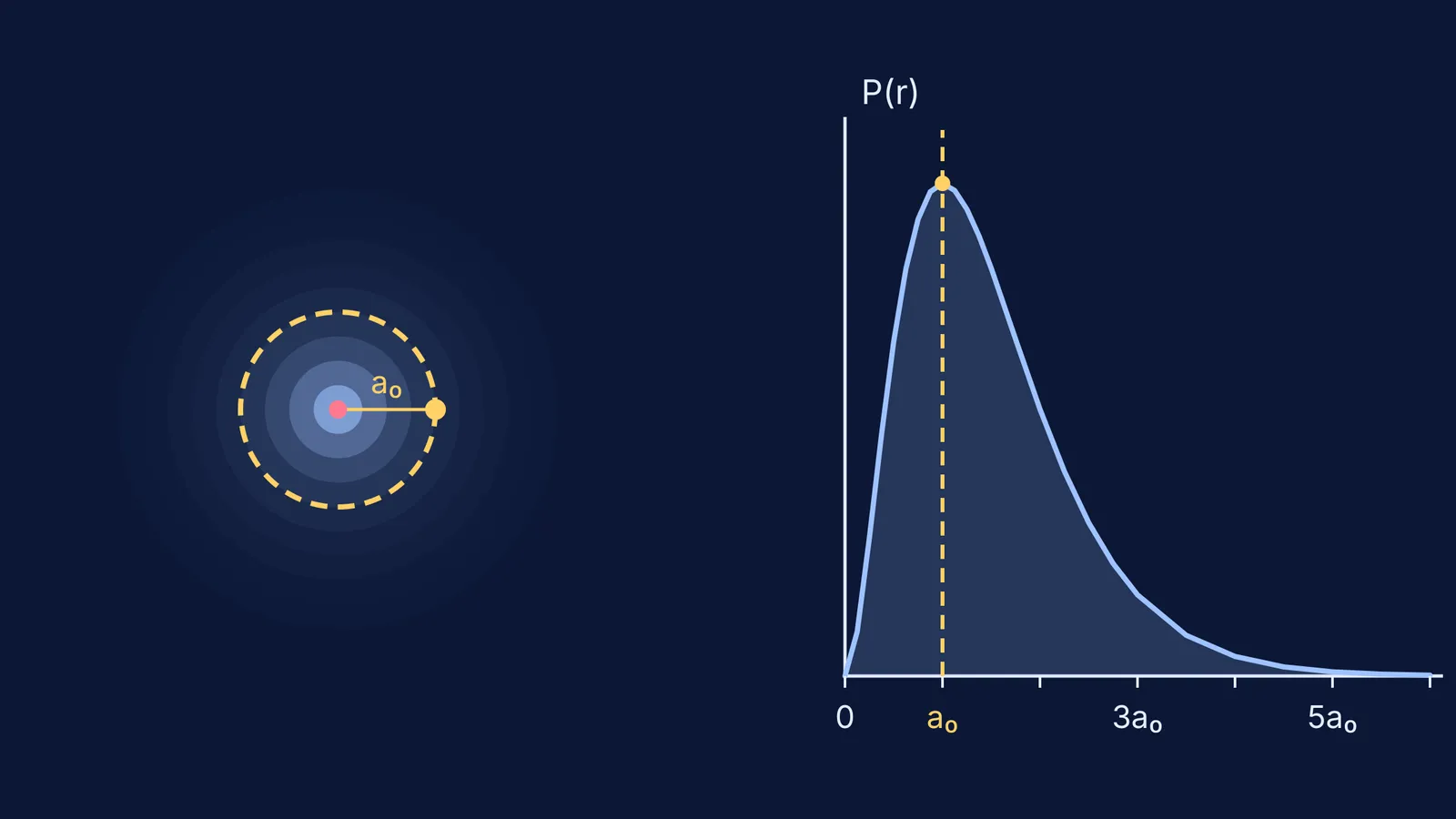
The flat orbit itself is also wrong. As a Physics Today feature by Svidzinsky, Scully and Herschbach puts it, quantum theory found that the ground state of hydrogen is spherically symmetric and has zero orbital angular momentum. Bohr had assumed a flat, circular orbit with angular momentum h/2π.
So "in Bohr's model, the electron moves in a fixed circular orbit" is a true statement about a model. "Electrons orbit the nucleus like planets" is a false statement about atoms. If the orbit-versus-cloud idea is still hazy, read our explainer on the difference between an orbit and an orbital.
What are the signs an AI explanation has gone too simple?
Absolute words with no conditions. "Always", "never", "simply", "just". Real rules usually come with "when", "if" or "for".
No model named. "Electrons orbit" instead of "in Bohr's model, electrons orbit".
The analogy is doing all the work. "Like planets", "like water in a pipe". An analogy is a starting point, not the explanation. Our guide to using analogies without picking up misconceptions shows how to test one.
It explains your example and nothing else. Try one step further: does it still work for helium, or in a magnetic field?
It clashes with a later chapter. If the next unit would contradict it, it was a stepping stone that never said so.
No equation or number where the topic has one.
How do you ask AI for the precise version?
Keep the simple answer and ask for its edges. Copy these follow-ups:
"Is that exact, or a simplified model? Name the model."
"Where does this stop being true? Give one experiment it cannot explain."
"What did you leave out to make it simple?"
"Now give me the version a Class 12 textbook would use, with the equation."
Here is how that goes for the atom. You ask, "Is the planet picture exact?" A good reply says no: it is Bohr's model, which works for hydrogen and hydrogen-like ions with one electron but fails for helium and for line splitting. The precise version swaps the path for a probability cloud, the s, p and d orbitals you meet later in the same NCERT chapter. Then check the reply against that chapter yourself.
The right depth depends on your exam, so say what you are preparing for. Our post on telling the AI tutor whether you are preparing for JEE or boards explains why that one line changes the answer.
When is the simple version good enough?
A simplification is fine when it comes with a label: "this is a model, it works for X, it breaks at Y". Bohr's model still gives you hydrogen's energy levels and spectral lines, and NCERT notes it can still be used to rationalise many points about atomic structure and spectra. The problem is only the unlabelled version.
Fermi's AI tutor works out what you already know, decides whether to explain, ask or show, and checks your understanding as it goes. Some ideas, like an electron cloud, are easier to see than to read. The Fermi Simulation Lab has interactive simulations for those.
Next time an answer sounds too neat, ask where it stops being true.


