

On this page
Before you can confidently figure out the electron configuration of ions like Fe³⁺ and Cu⁺, you need to know where those electrons actually reside. Ever since the days of George Johnstone Stoney, who named the electron, physicists have debated how these particles move. When you first study atomic structure, the shift from orbits to orbitals can feel jarring. You spend years picturing atoms as tiny solar systems, only to learn that electrons do not travel in neat circles.
Understanding the difference between an orbit and an orbital is not just about memorising definitions for your chemistry exam. It is the fundamental key to understanding why atoms bond the way they do, why the periodic table is shaped the way it is, and how molecules form complex structures in three dimensions.
What is an orbit?
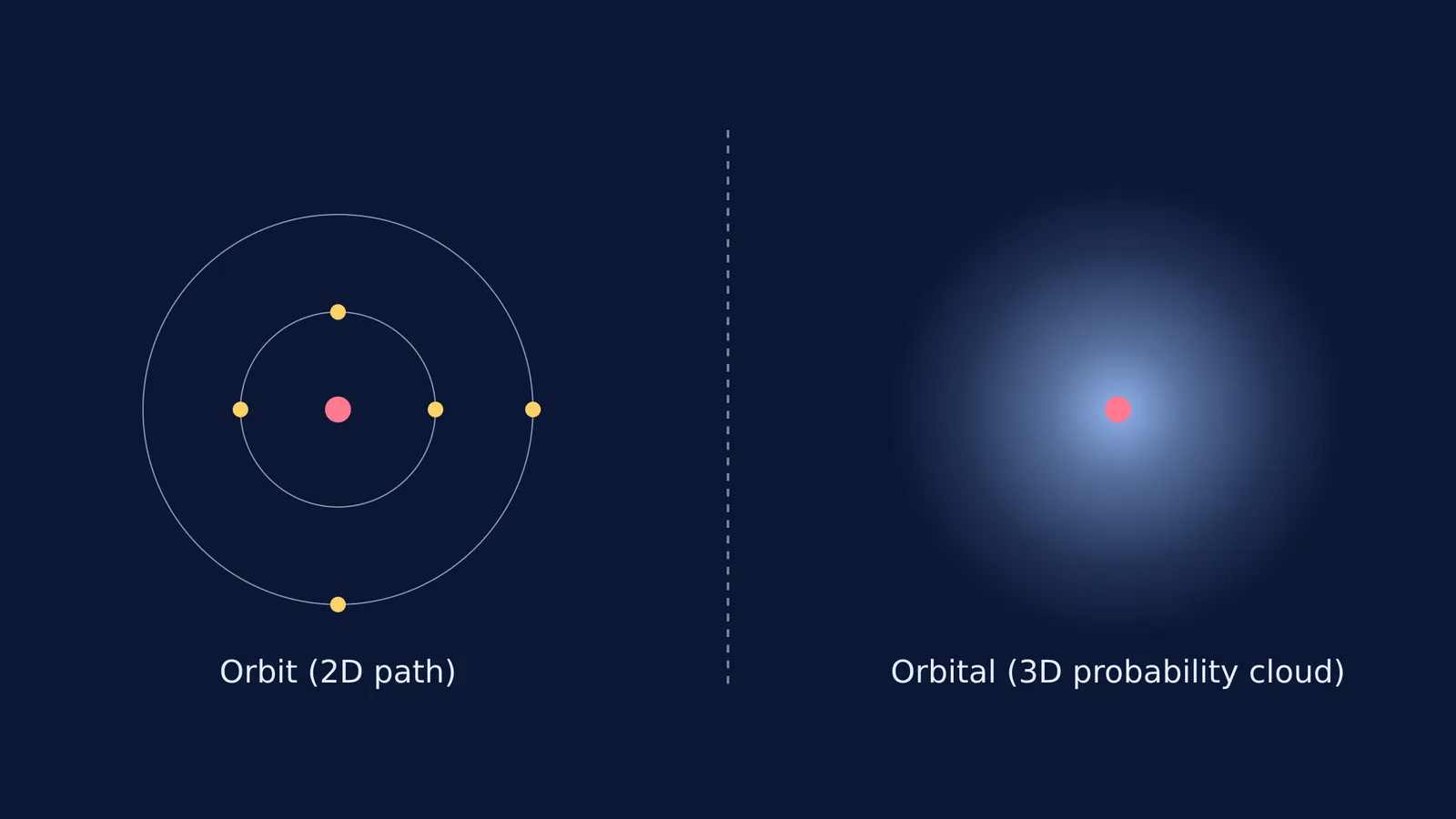
Niels Bohr proposed that electrons move around the nucleus in fixed, circular paths called orbits. This was a classical way of looking at motion, much like planets orbiting the Sun.
In Bohr's model, every orbit has a specific energy and radius. Because the path is clearly defined, you could theoretically calculate both the exact position and the exact velocity of the electron at any given moment. An orbit is a fixed, two-dimensional circular path around the nucleus, which according to OpenStax Chemistry holds a maximum of 2n² electrons.
The Bohr model works remarkably well for simple systems, such as calculating the recoil of a hydrogen atom when it emits a photon. However, treating an electron like a planet ignores its wave-like nature.
What is an orbital?
An orbital belongs to the quantum mechanical model of the atom. It is not a predefined path or a track.
An orbital is a three-dimensional region of space around the nucleus where the probability of finding an electron is very high, holding a maximum of 2 electrons as detailed in OpenStax Chemistry. Because of wave-particle duality, electrons behave like standing waves. The exact trajectory of an electron is undefined, so we only know where it is likely to be.
Shape: While orbits are always flat and circular, orbitals take on different 3D shapes. An *s* orbital is spherical, a *p* orbital is dumbbell-shaped, and *d* orbitals are even more complex.
Direction: Orbits are non-directional, but orbitals (except the *s* orbital) have specific directional properties that determine the shapes of molecules.
Why did we have to shift from orbits to orbitals?
The end of the orbit concept came from the Heisenberg uncertainty principle. Werner Heisenberg showed that it is fundamentally impossible to know both the exact position and the exact momentum of a microscopic particle like an electron at the same time.
Think about how you measure a planet's orbit. You can look at it through a telescope without disturbing its path. But an electron is so incredibly small that to "see" it, you have to bounce a photon of light off it. That very collision changes the electron's momentum. If you try to pin down exactly where the electron is, you lose all information about where it is going next.
If you cannot know an electron's exact position and momentum simultaneously, it cannot be travelling in a well-defined circular orbit. The classical Bohr model had to be replaced by Schrödinger's wave equation, which embraces this uncertainty. Instead of plotting a definite path, Schrödinger's mathematics calculate probability clouds, showing us where we are most likely to find the electron if we were to look.
How to identify which one a question is asking for?
Sometimes, exam questions try to trick you by mixing the terminology of orbits and orbitals. Here is a practical framework to decode what the examiner actually wants:
Look for the letter "n": If a question asks about the radius, velocity, or energy using only the principal quantum number (such as "the 3rd shell"), it is testing the classical Bohr orbit.
Look for letters like "s, p, d, f": If a question mentions azimuthal or magnetic quantum numbers, or specific shapes (like "the 2p subshell"), it is firmly in the realm of quantum orbitals.
Watch out for "maximum electrons": This is the most common trap. If you are asked for the maximum number of electrons in the "M shell" (which is an orbit), the answer is 2(3)² = 18. If you are asked for the maximum number of electrons in a "3d orbital", the answer is always 2, regardless of the principal shell.
Orbit vs orbital: what are the key differences?
When you need to compare them in an exam or a homework problem, keep this checklist in mind:
Meaning: An orbit is a fixed 2D path; an orbital is a 3D region of high probability.
Electron limit: An orbit holds up to 2n² electrons; an orbital holds a maximum of 2.
Shape: All orbits are circular; orbitals can be spherical, dumbbell-shaped or double-dumbbell-shaped.
Physical reality: The concept of an orbit violates the Heisenberg uncertainty principle, whereas the orbital is the foundation of modern quantum mechanics.
How to build your quantum intuition
If you are stuck trying to visualise how *s*, *p* and *d* orbitals overlap to form bonds, you are not alone. It is one of the hardest concepts in early chemistry because you cannot rely on everyday classical mechanics.
If you are working through atomic structure problems and keep confusing your azimuthal quantum number with the principal one, the Fermi Concept Library has a lesson for every concept and shows its place in the map. When you hit a roadblock on a specific numerical, such as calculating the number of nodes or finding quantum numbers, the Fermi Problem Library features a step-by-step solver that explains the reasoning rather than simply printing an answer.
Understanding orbitals means accepting that we live in a universe of probabilities. Once you let go of the fixed circular tracks, the rules of chemical bonding will start to make a lot more sense.


