

On this page
If you are studying for both school boards and competitive entrance exams, you already know the frustration of solving a physics problem only to realise you used the wrong method for the exam in front of you.
While the core concepts are the same, the two exams demand different ways of thinking and distinct approaches to problem-solving. When you sit down to use an AI tutor, it needs to know exactly which exam you are taking to give you the right kind of help. Without that context, you risk getting explanations that are either too superficial or unnecessarily complex.
Should I tell my AI tutor if I am preparing for JEE or boards?
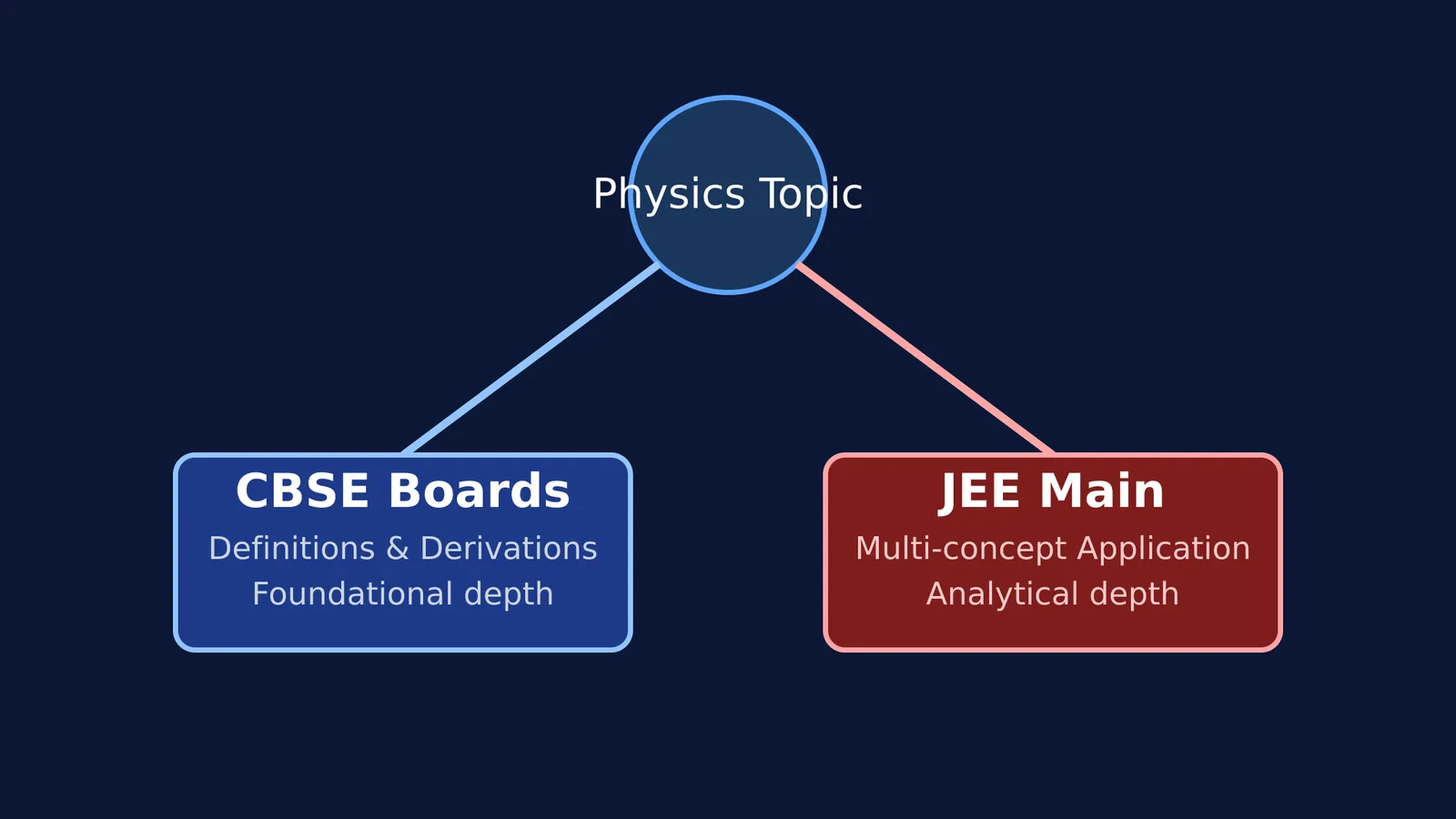
Yes, because although the CBSE and JEE Main syllabuses share a majority of their core topics, the way questions are asked is fundamentally different. CBSE board exams exist to test conceptual clarity and foundational understanding. They ask for definitions, step-by-step mathematical derivations and the direct application of standard formulas.
JEE Main, on the other hand, is heavily analytical. It tests your ability to apply multiple concepts simultaneously under intense time pressure, often with the added risk of negative marking for incorrect guesses.
A student might perfectly understand the underlying theory in a chapter on rotational motion, but they could still get stuck on a JEE question that combines rotation with work-energy principles and kinematics. If you ask an AI for help without stating your exam, it might give you a high-level theoretical summary—perfect for a board exam revision, but useless when you need a rigorous, multi-step mechanical breakdown for a competitive entrance test.
How does context change an AI tutor's explanation?
How does telling an AI your exam actually change its answer? It comes down to how large language models sort and filter their vast training data to produce a coherent response.
A 2023 study from Vanderbilt University found that assigning a persona to a large language model helps it filter its vast knowledge to match a specific context and tone (White et al., 2023). This technique, known in prompt engineering as the "Persona Pattern", relies on instructing the AI to adopt a specific role before asking your question. By starting your prompt with instructions such as "act as a strict JEE Advanced examiner" or "act as a Class 12 CBSE teacher", you effectively constrain its output.
The model immediately prioritises the knowledge, vocabulary, and explanation style associated with that specific role. When you clearly state your context, the AI stops giving generic, encyclopaedic answers. Instead, it starts mimicking the exact depth, difficulty, and marking style you need to succeed.
What should you tell your AI tutor?
To get the most out of a study session, you should not just paste a question into the chat. Give the AI a clear identity and state your current level. Include these three essential details in your first message:
Your current class: "I am in Class 12."
Your target exam: "I am preparing for JEE Main."
What you need to do: "I understand the theory of this chapter, but I need help solving numericals that combine it with kinematics."
By providing this framework, you ensure the AI does not waste time re-explaining basic definitions. Instead, it can dive straight into the analytical application you need.
If you are using the Fermi Problem Library, the AI tutor handles this context for you automatically. When a student brings a problem set, Fermi's AI tutor works out what they already know and builds a plan for the session. It holds a line of reasoning across the whole session, deciding whether to explain, ask or show, to match the right cognitive depth for the exam. Progress, notes and everything generated along the way stay in the student's library.
Getting the right help is not just about finding the correct final answer; it is about learning the right way to think for the test in front of you. To see how this compares to traditional learning methods, read about how an AI tutor vs private tutor balance each other out, or how to evaluate an AI tutor to make sure it is actually teaching rather than just giving answers.


