On this page
Beekeeping looks like a hobby until you read what a trained beekeeper is expected to know. In India it has a national training standard, a government mission and a direct link to crop yields. Here is what the work involves, which courses exist and how to test whether it suits you.
What does scientific beekeeping actually involve?
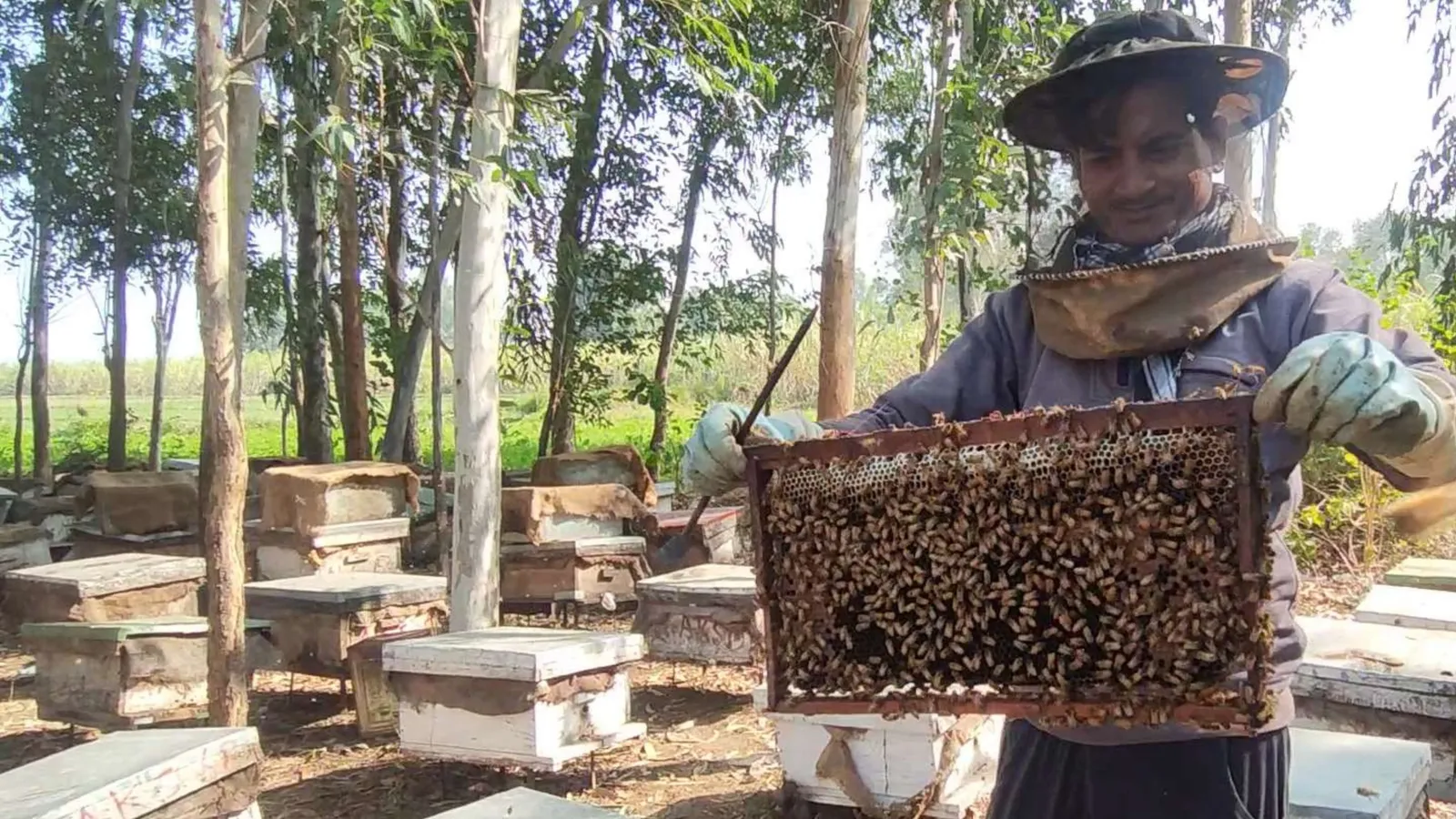
Scientific beekeeping (apiculture) means keeping bee colonies in managed boxes so you can inspect, feed, divide and harvest them, instead of collecting honey from wild combs. The Skill India Beekeeper qualification pack (AGR/Q5301) lists five compulsory units. Three cover the beekeeping itself: preparing and starting beekeeping operations, inspecting and maintaining the beehives, and harvesting, processing and marketing honey and related produce. The other two cover workplace health and safety and employability skills.
In practice that covers:
Siting hives: choosing a place with nectar and pollen flowers, shade and clean water, and no waterlogging.
Equipment: Langstroth or top-bar hives, smoker, honey extractor, comb foundation sheets, queen excluder and protective gear.
Colony care: spotting signs of swarming, feeding sugar syrup in the lean dearth season, and uniting weak colonies or dividing strong ones.
Health: recognising pests and diseases such as wax moth, varroa mite and foul brood, and keeping a record of every inspection and treatment.
Business: a cost-benefit analysis before choosing a system, then processing and marketing the honey.
Much of this is biology you already study: caste roles, life cycles, how bees find food and how they communicate. If those chapters feel shaky, the Fermi Concept Library has a lesson for every biology concept, with its place in the map. Our explainer on how haplodiploidy works in honey bees covers the genetics behind a colony.
Which beekeeping courses can a student take in India?
There are three main routes, from shortest to longest.
Short trainings (a few days). Krishi Vigyan Kendras (KVKs) run these, sometimes with the National Bee Board. For example, KVK Washim and the National Bee Board ran a three-day virtual training on scientific beekeeping in April 2021, attended by 58 trainees.
NIOS vocational certificate. The NIOS Bee Keeping course (650) lasts one year, with 240 hours of study: 80 of theory and 160 of practicals. It is taught in Hindi or English, the only entry requirement is being literate, and the listed fee is Rs 3,000.
Skill India Beekeeper (NSQF Level 3). The model curriculum sets the course at 270 hours, and the minimum job entry age is 16. One of the listed entry routes is passing Class 8 while continuing in regular school.
How does beekeeping link to agriculture?
Beekeeping matters to farming because of pollination. A review of crop data from 200 countries in Proceedings of the Royal Society B found that 87 of the leading global food crops depend on animal pollination, while 28 do not. The same review found that pollinator-dependent crops make up 35% of global crop production by volume.
India's policy is built on this link. According to the PIB backgrounder on the National Beekeeping and Honey Mission, the mission had a budget of Rs 500 crore for FY 2020-21 to FY 2025-26, and its first mini mission targets higher crop productivity through pollination with scientific beekeeping. The same document reports that India produced about 1.4 lakh metric tonnes of natural honey in 2024. It also says 14,859 beekeepers had registered on the Madhukranti portal by October 2025, and that a National Centre of Excellence in Beekeeping has been sanctioned at IIT Roorkee. The mission's stated period has now ended, so check with the National Bee Board or your state agriculture department for current schemes before you count on any subsidy.
Is apiculture a good career for students?
It can be a full career or a strong add-on. Beekeeping fits with horticulture, agribusiness and research. Read how agriculture science research careers work, or how agri-business management turns farm products into businesses.
Before you pay for a long course, try this four-week test:
Week 1: Call your district KVK or agriculture office and ask: "Is there a scientific beekeeping training coming up, and can a school student attend?"
Week 2: Visit a working apiary with an adult. Watch one full hive inspection in protective gear. Note whether you stay calm near open boxes.
Week 3: Map the flowering crops and trees within walking distance of your home, month by month. This is the forage calendar every beekeeper plans around.
Week 4: Decide. If you enjoyed it, compare the NIOS and Skill India courses on hours, cost and how much hive time each gives you.
A safety note: some people react badly to bee stings. If you have ever had a strong reaction, talk to a doctor before handling hives.
If the biology behind the forage calendar is new to you, Fermi's AI tutor can work out what you already know about pollination and build a plan for the session, so you go into your first apiary visit knowing what to watch for.