

On this page
India is moving from simply growing more food to growing it sustainably under climate stress. That shift requires dedicated researchers. If you have just completed or are nearing the end of your BSc Agriculture, a career in research is one of the most structured and well-funded paths available in the sciences.
What is the selection process for ICAR ARS?
The Agricultural Research Service (ARS) is the premier gateway to becoming a scientist in the government sector. The Agricultural Scientists Recruitment Board (ASRB) conducts the exam and evaluates candidates across three rigorous stages: a preliminary objective test of 150 marks, a descriptive main exam of 240 marks, and a viva-voce interview worth 60 marks.
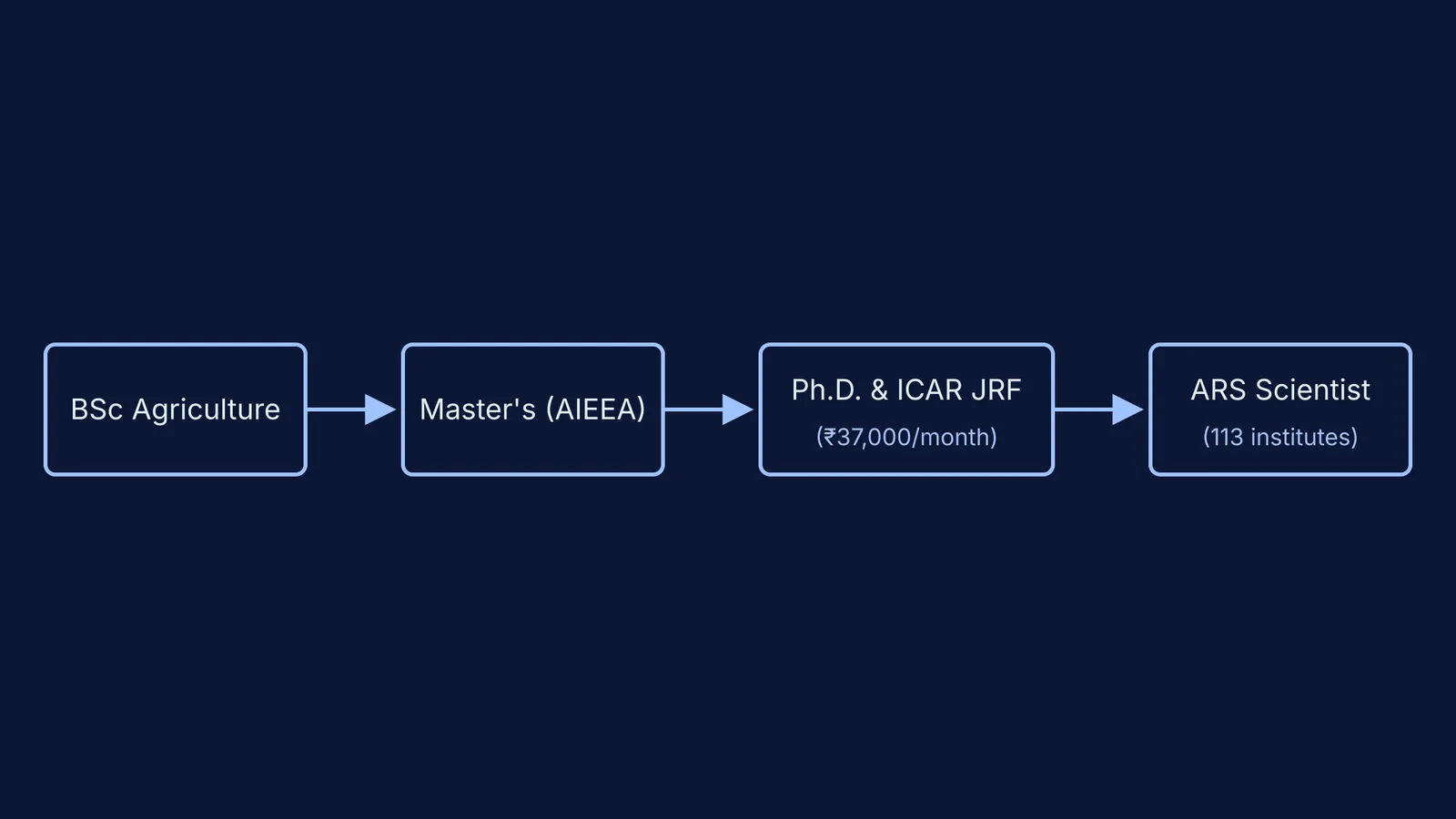
The preliminary round is purely qualifying, while your main exam and interview scores determine your final rank. Passing this secures you an entry-level scientist position, placing you in one of the 113 ICAR research institutes across India to work on national agricultural challenges.
How to get a research fellowship after BSc Agriculture?
You do not have to wait until you are a scientist to get funded. The ICAR supports postgraduate and doctoral scholars through structured fellowships.
To begin, you need to clear the ICAR AIEEA PG exam for a Master's degree. Once you complete your Master's, you take the AICE-JRF/SRF exam for doctoral research. The fellowship amounts were revised in late 2024: an ICAR Junior Research Fellow (JRF) currently receives ₹37,000 per month for the first two years of their Ph.D., while a Senior Research Fellow (SRF) in their third year receives ₹42,000 per month (National Scholarship Portal).
What is the scope in plant breeding and soil science?
Two disciplines are currently seeing significant research demand across public institutions and private agri-tech startups:
Plant Breeding and Genetics: The focus has shifted heavily toward climate resilience. Breeders are using molecular tools to develop crops that tolerate drought and extreme heat. They also employ biofortification to boost the nutritional value of staples. (You can read more about the history of artificial hybridisation: emasculation and bagging explained).
Soil Science: With the national push for regenerative agriculture, researchers are testing precision nutrient management and slow-release nano-fertilizers. Understanding fundamentals, such as Justus von Liebig and the law of the minimum for crops, remains critical, but modern soil scientists now map fields at the molecular level using sensors and AI.
How can you start planning your research journey?
If you are aiming for a fellowship or the ARS exam, the syllabus is vast. Here is a practical framework to prepare during your undergraduate years:
Map your syllabus to standard texts: Do not rely solely on lecture notes. Use standard textbooks for genetics and soil science so you learn the foundational theory that competitive exams test.
Find your concept gaps: When studying complex topics like molecular breeding or soil chemistry, it is easy to memorize without truly understanding the mechanism. Fermi's AI tutor can work out what you already know and build a plan for the session, so you sit down to a clear next step.
Practice descriptive writing: The ARS main exam requires you to write long-form answers. Practice summarizing complex agricultural cycles into clear, logical paragraphs. If you are struggling with a specific biological pathway, the Fermi Concept Library holds a lesson for every concept in biology and chemistry, each with its place in the map.
Time your practice: The ASRB preliminary exam demands speed, while the main exam demands depth. Set a timer when solving past papers to build endurance for both formats.
A career in agricultural research means solving problems that directly feed a billion people. With funded fellowships and a clear examination structure, the path is rigorous but open to anyone willing to master the science.


