

On this page
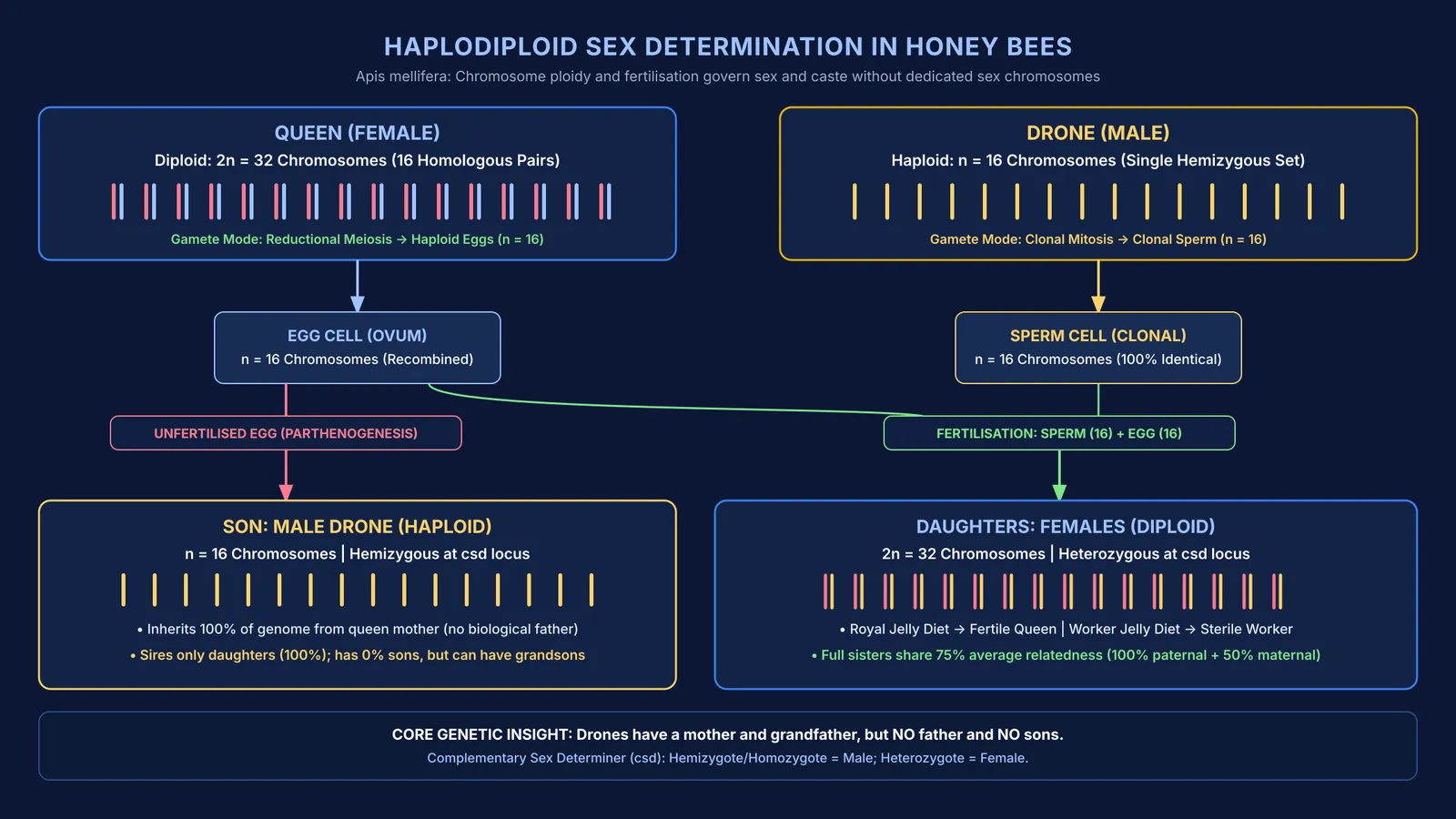
Most sexually reproducing animals establish sex with heteromorphic chromosomes—such as the XX/XY system discovered through Nettie Stevens' chromosome discoveries. Honey bees (*Apis mellifera*) rely on a fundamentally different mechanism: haplodiploidy. In this system, sex is determined not by specific sex chromosomes, but by whether an individual develops from a fertilised or unfertilised egg.
How does haplodiploidy determine sex in honey bees?
In a honey bee colony, caste and sex divide along chromosome ploidy lines, as characterized in developmental genetics by Beye et al. (2003)00606-8):
Females (queens and workers): Possess 32 chromosomes (2n = 32). They develop from fertilised eggs, receiving 16 maternal and 16 paternal chromosomes. Whether a female larva becomes a reproductive queen or a worker depends on nutrition: larvae fed royal jelly develop into fertile queens.
Males (drones): Possess 16 chromosomes (n = 16). They develop from unfertilised eggs through arrhenotokous parthenogenesis—virgin birth first identified systematically by Johann Dzierzon in 1845.
A mated queen stores sperm in her spermatheca and controls fertilisation. Releasing sperm produces a diploid female; withholding sperm produces a haploid male.
At the molecular level, sex is governed by the complementary sex determiner (*csd*) gene, isolated by Beye et al. (2003)00606-8) in *Cell*. Heterozygosity at *csd* directs female differentiation. Because haploid drones carry only one copy of the chromosome (hemizygous), this pathway remains inactive and defaults to male development.
Why does a drone have a grandfather but no father?
First analysed mathematically by Hamilton (1964)90038-4) in the *Journal of Theoretical Biology*, the reproductive geometry of haplodiploidy produces a classic pedigree puzzle: a drone has no biological father and cannot have sons, yet he has a grandfather and can have grandsons.
Tracking chromosomes across generations explains why:
No father: A drone hatches from an unfertilised egg. His entire nuclear genome comes from his mother.
No sons: When a drone mates, his sperm fertilises an egg, always creating a diploid female (2n = 32). Drones only sire daughters.
Has a grandfather: The drone's mother (the queen) developed from a fertilised egg. Her father is the drone's maternal grandfather.
Can have grandsons: When the drone's daughter lays unfertilised eggs, they hatch into drones: his genetic grandsons.
This system creates the evolutionary asymmetry described by Hamilton (1964)90038-4). Because a drone is haploid, all sperm he produces are identical clones. Full worker sisters share 100% of their father's genes and 50% of their mother's genes, giving an average sister-sister relatedness of 75%—higher than the 50% shared between mother and daughter.
How do haploid drones produce sperm without meiosis?
In standard sexual life cycles, gametes form through reductional meiosis, as described in guides to mitosis and meiosis chromosome stages. If a haploid drone with 16 chromosomes underwent reductional meiosis, his gametes would receive 8 chromosomes, halving the genome each generation. Cytological investigations published in *Nature* by Sanderson and Hall (1948) confirmed that drones circumvent this reduction by producing viable 16-chromosome sperm mitotically.
Instead of two reductional divisions, drones produce sperm by mitosis. Mitotic spermatogenesis preserves all 16 chromosomes in every sperm cell. The diploid queen undergoes normal meiosis, producing eggs with 16 chromosomes.
What happens if inbreeding causes a fertilised egg to inherit two identical *csd* alleles? In a landmark paper in the *Journal of Apicultural Research*, Woyke (1963) showed that homozygous diploid eggs develop into diploid drone larvae. However, worker bees detect their altered pheromones and eat them shortly after hatching, creating a patchy brood comb.
How do you solve haplodiploidy questions in genetics?
Genetics examinations regularly test this non-Mendelian pedigree, applying the single-locus complementary sex determination model proven by Beye et al. (2003)00606-8). To solve these problems quickly, use this 4-step framework:
Assign ploidy first: Females are diploid (32 chromosomes); drones are haploid (16 chromosomes).
Match the division mode: Eggs arise from meiosis; sperm arise from clonal mitosis.
Trace parentage backwards: Drones have only one parent (mother); females have two (mother and father).
Calculate transmission ratios: A drone transmits his single allele to 100% of daughters and 0% of sons. A heterozygous queen (W/w) transmits an allele to 50% of daughters and 50% of sons.
Worked example: Tracking a white-eye mutation
Suppose a white-eyed drone carrying a recessive mutant allele w mates with a homozygous wild-type queen (W/W).
Daughters: Every daughter receives W from the egg and w from the sperm (genotype W/w). All daughters have wild-type eyes, but 100% are carriers.
Sons: The queen produces sons from unfertilised eggs. Because her genotype is W/W, 100% of her drone sons receive W and have wild-type eyes.
Grandsons: When a carrier daughter (W/w) lays unfertilised eggs, meiosis segregates her alleles equally, as documented in Beye et al. (2003)00606-8). Exactly 50% of her drone offspring receive w (white eyes) and 50% receive W (wild-type eyes). The grandfather's trait skips his sons and reappears in his grandsons.
To master related pedigree traps, practice Punnett squares and Mendelian genetics problem-solving. When mapping complex pedigrees, the Fermi Concept Library maps every concept in biology, each with its own lesson and its place in the map. For practicing numericals, the Fermi Problem Library offers worked problems with a step-by-step solver that explains the reasoning rather than printing an answer. For persistent doubts, Fermi's AI tutor can work out what you already know and build a plan for the session, guiding you through each chromosome count.


