

On this page
If you are revising Chapter 7 of NCERT Class 12 Biology, Human Health and Disease, the cancer section fits three big ideas into one paragraph: contact inhibition, two kinds of tumour, and metastasis. Here is each one as cell biology, plus a revision list and a self-test.
What is the difference between a benign and a malignant tumour?
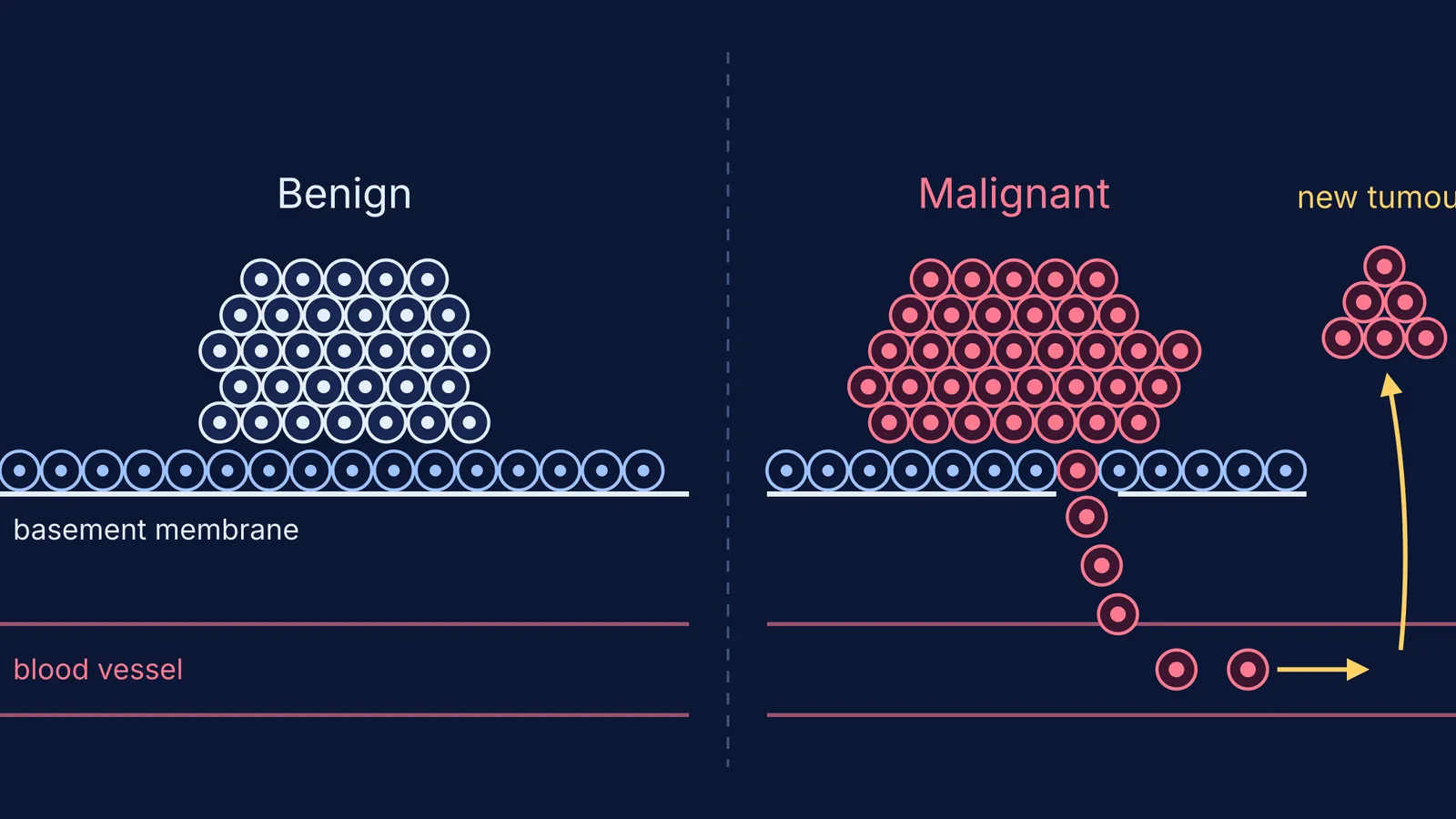
The one-word answer is invasion. Both kinds of tumour are masses of cells that keep dividing. Only a malignant tumour breaks out of its starting place.
According to the NCERT Class 12 Biology chapter on Human Health and Disease, benign tumours "normally remain confined to their original location and do not spread to other parts of the body and cause little damage". The same chapter describes malignant tumours as a mass of proliferating neoplastic cells that "grow very rapidly, invading and damaging the surrounding normal tissues."
The US National Cancer Institute agrees: "Benign tumors do not spread into, or invade, nearby tissues," and once removed they usually don't grow back, whereas cancerous (malignant) tumours sometimes do.
What is contact inhibition, and how do cancer cells lose it?
Contact inhibition is the property by which contact with other cells inhibits a normal cell's uncontrolled growth, as defined in the NCERT chapter. In short, neighbours act as a brake.
NCERT says cancer cells appear to have lost this property, so they keep dividing and give rise to masses of cells called tumours. The National Cancer Institute adds two related differences: "Normal cells stop growing when they encounter other cells, and most normal cells do not move around the body," while cancer cells also ignore signals that tell them to stop dividing or to die by apoptosis.
Shaky on cell division itself? Revise chromosome number and DNA content through the stages of mitosis first.
How does metastasis spread cancer through the body?
NCERT explains that cells sloughed from malignant tumours reach distant sites through the blood, and wherever they get lodged they start a new tumour. The chapter calls this property, metastasis, "the most feared property of malignant tumors."
In a 2011 review in Science, Christine Chaffer and Robert Weinberg described metastasis as two phases: a cancer cell physically moving to a distant organ, and then developing into a metastatic lesion there.
In another 2011 review, in Cell, Douglas Hanahan and Robert Weinberg summarised six hallmark capabilities of cancer: sustaining proliferative signalling, evading growth suppressors, resisting cell death, enabling replicative immortality, inducing angiogenesis, and activating invasion and metastasis. Notice that dividing without limits and spreading appear as separate items, which echoes the textbook's point that growth and spread are different properties.
This is why the difference matters so much. The WHO cancer fact sheet states that widespread metastases are the primary cause of death from cancer. It also reports that cancer caused nearly 10 million deaths in 2024, or nearly one in six deaths.
Benign vs malignant: a revision list you can memorise
Each line below comes from the NCERT chapter or the NCI explainer linked above.
Where it stays: benign remains confined to its original location; malignant invades and damages surrounding tissue.
Spread: benign does not spread; malignant sheds cells that travel through the blood and start new tumours.
Speed: NCERT describes malignant cells as growing very rapidly.
Damage: benign causes little damage; malignant cells also starve normal cells by competing for vital nutrients.
After removal: benign usually does not grow back; cancerous tumours sometimes do.
Contact inhibition: NCERT links its loss to tumour formation in general, which is why a mass forms at all.
Can you answer these in two minutes?
Assertion: Benign tumours do not undergo metastasis. Reason: Benign tumour cells remain confined to their original location. (Both true, and the reason explains the assertion.)
A classmate writes "cancer cells show contact inhibition". Correct the sentence. (Cancer cells have lost contact inhibition.)
Which property does NCERT call the most feared property of malignant tumours? (Metastasis.)
Name the two phases of metastasis described by Chaffer and Weinberg. (Moving to a distant organ, then growing into a lesion there.)
If the ideas blur together, the Fermi Concept Library gives every biology concept its own lesson and its place in the map, so you can see how one idea connects to the next. For more practice, the Fermi Problem Library has worked problems with a step-by-step solver that explains the reasoning rather than printing an answer.
NCERT notes that tumour cells avoid detection and destruction by the immune system, so read how humoral and cell-mediated immunity differ next, or how Peyton Rous found a cancer virus.
What if someone at home finds a lump?
This list is for exams, not diagnosis. NCERT notes that cancer detection relies on tests such as biopsy, where a pathologist examines thin, stained sections of tissue under a microscope. If you or a family member notices a lump, see a doctor rather than guessing. The WHO notes that many cancers can be cured if detected early and treated effectively.
For tonight, write out the revision list from memory, then check it against the chapter.


