

On this page
What was the 1911 chicken sarcoma virus experiment?
In 1910, a woman brought an American pathologist named Peyton Rous a Plymouth Rock hen with a large tumour on its breast. Rous, who was working at the Rockefeller Institute for Medical Research, identified the growth as a spindle-celled sarcoma, a type of cancer affecting connective tissue (Wikipedia).
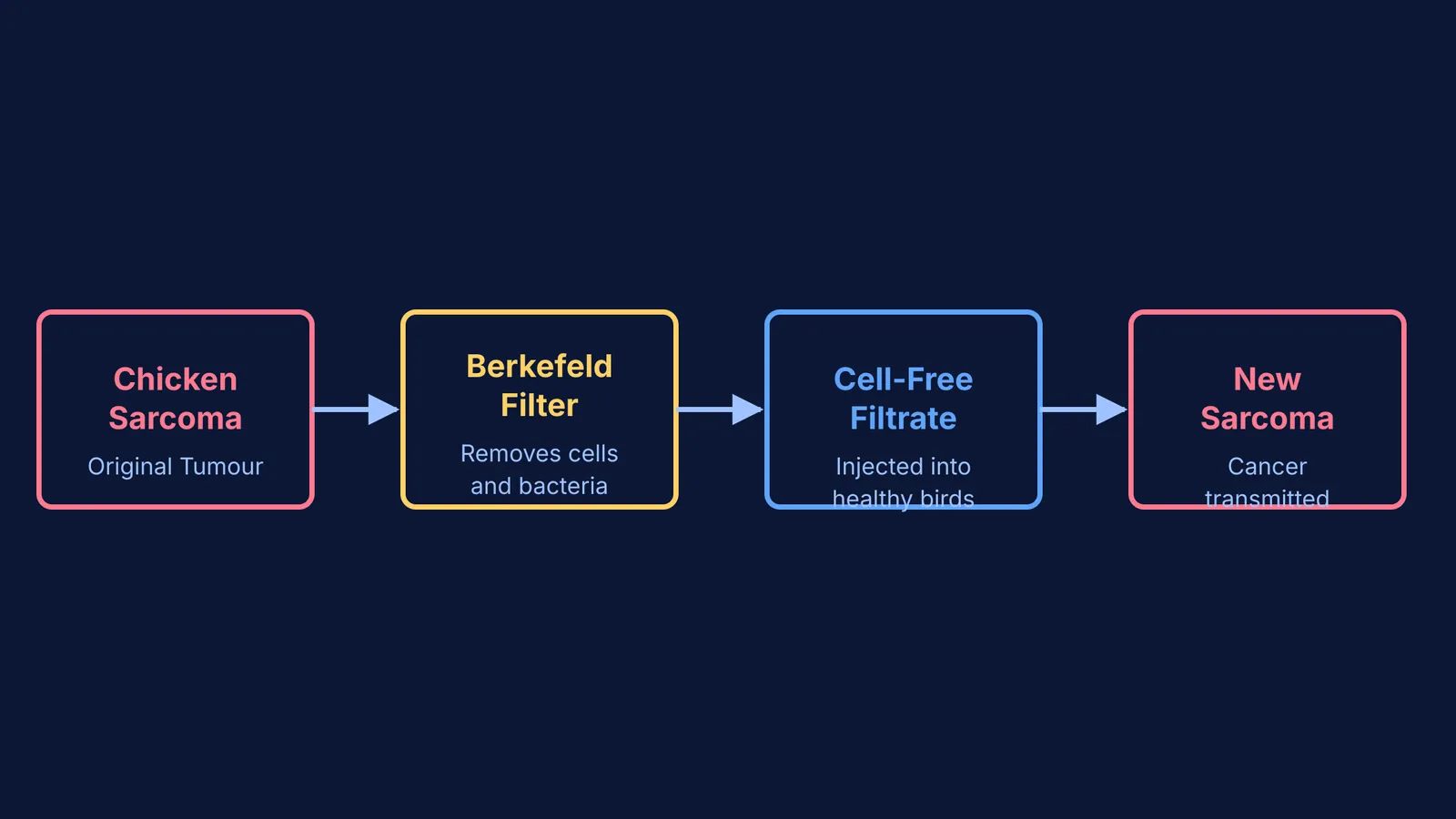
Curious if the cancer could be transmitted, Rous began a series of experiments in 1911. He removed the tumour, ground it up, and passed it through a Berkefeld filter. This filter was so fine that no bacterial cells or cancer cells could pass through it.
When Rous injected this cell-free filtrate into healthy chickens, the results were clear: the healthy birds developed the exact same malignant sarcoma. Rous had discovered a "filterable agent" capable of transmitting a tumour. Today, we know this agent as the Rous sarcoma virus (RSV), which holds the distinction of being the first oncogenic (cancer-causing) retrovirus ever identified.
Why did the scientific establishment reject his findings?
Despite his clear experimental evidence, the scientific community of the time rejected Rous's findings. The prevailing "German school" of pathology, heavily influenced by figures like Rudolf Virchow, insisted that cancer was strictly a cellular disease that arose from within the body, rather than an infectious one.
Experts dismissed Rous's work as "utter nonsense," maintaining that cancer simply could not be caused by a virus. Some critics even suggested that his technique was flawed and that his "cell-free" filtrate must have been accidentally contaminated with microscopic cancer cells.
Discouraged by the skepticism and his subsequent inability to find similar tumour-causing viruses in rodents, Rous eventually abandoned his cancer research in 1915. He did not force his theory on a skeptical world but instead allowed the evidence to accumulate over the following decades.
How did Peyton Rous pivot to other vital research?
Instead of quitting science, Rous shifted his focus to an urgent problem during World War I: blood preservation. In 1916, alongside Joseph R. Turner, Rous developed a citrate-glucose solution that allowed blood to be stored for up to two weeks (Wikipedia). This innovation moved transfusions away from direct person-to-person transfer and enabled the creation of the world’s first blood bank in Belgium in 1917.
Rous also made significant contributions to our understanding of the liver and gallbladder, demonstrating that the gallbladder concentrates bile by removing water. His ability to pivot and succeed in entirely different fields demonstrated his scientific resilience.
Why did Peyton Rous wait 55 years for the Nobel Prize?
Over the following decades, molecular biology advanced. Other researchers discovered viral papillomas in rabbits, and virology slowly began to explain how viruses interact with host cell DNA to trigger uncontrolled division. The scientific community gradually caught up to what Rous had shown back in 1911.
It was not until 1966 — exactly 55 years after his initial discovery — that Rous was finally awarded the Nobel Prize in Physiology or Medicine for his discovery of tumour-inducing viruses. At 87 years old, he became the oldest recipient in the Medicine category (Wikipedia).
How does scientific truth relate to deep learning?
When you study complex subjects, there is often a rush for immediate results and quick test scores. However, real understanding takes time. Just as the scientific community resisted radical ideas until they were undeniably proven, deep learning requires building a foundation layer by layer.
If you are struggling with a difficult biology topic, remember that rote memorization is like ignoring the cell-free filtrate; it looks for the obvious answer instead of understanding the true underlying mechanism. If you find a topic hard to grasp, Fermi's AI tutor teaches rather than answers. It holds a line of reasoning across a session, notices where you are stuck, and decides whether to explain, ask or show, ensuring you actually understand the science.
Whether you are waiting for an experiment to be proven or working towards mastering a new syllabus, use this approach when progress feels slow:
Build the evidence: Base your preparation on primary facts, not assumptions. Read your texts carefully and trust the fundamentals.
Accept skepticism: Your practice scores might dip before they rise. The new study methods you try will feel strange at first.
Keep going: Rous did not quit science; he pivoted to blood preservation. If one subject blocks you, review another while your brain processes the difficult one.
You can explore how other non-cellular entities behave in Viruses, viroids and lichens: the misfits of five-kingdom biology, or see modern virology in action with How HIV replicates: reverse transcription and helper T cell loss. When a concept refuses to click, the Fermi Concept Library holds a lesson for every concept in physics, chemistry, biology, mathematics and computing.
Like Rous's discovery, true understanding is undeniable once it is fully formed. You just have to do the work and wait for the results.


