

On this page
The five-kingdom table in NCERT sorts life by cell type, cell wall, nuclear membrane, body organisation and nutrition. Then the chapter ends with a section on things that do not fit. Students often memorise that section as a list of facts. It is easier, and more useful in NEET, to see exactly which column of the table each misfit breaks. This post does that, gives you a one-line test for each, and works through a sorting exercise.
What does the syllabus include?
The NEET (UG) 2026 syllabus lists "Five kingdom classification; salient features and classification of Monera; Protista and Fungi into major groups; Lichens; Viruses and Viroids." The CBSE Biology curriculum for 2026-27 has the same line for Class 11. The text is section 2.6 of the 2026-27 NCERT Class 11 chapter Biological Classification, titled "Viruses, Viroids, Prions and Lichens". Note the small difference: NCERT covers prions, but the NEET syllabus line does not name them. Read the prion paragraph anyway, since it is short and it sharpens the contrast with viroids. Check the syllabus for your exam year.
Why do they not fit the five kingdoms?
NCERT says that "in the five kingdom classification of Whittaker there is no mention of lichens and some acellular organisms like viruses, viroids and prions." Look at the table's first row, cell type: prokaryotic or eukaryotic. Both answers assume a cell.
Viruses, viroids and prions fail at the first row. They are not cells, so cell wall, nucleus and body organisation have no answer.
Lichens fail differently. Every row has two answers at once, because a lichen is two organisms. The alga is autotrophic and the fungus heterotrophic.
How do you tell them apart in one line each?
Use what each one is made of:
Virus: nucleic acid (DNA or RNA, never both) inside a protein coat, the capsid. NCERT calls a virus "a nucleoprotein" whose genetic material is infectious. Viruses are inert outside a host cell and are obligate parasites.
Viroid: free RNA with no protein coat. T. O. Diener found it in 1971 as the cause of potato spindle tuber disease, and its RNA is of low molecular weight.
Prion: abnormally folded protein with no nucleic acid. NCERT links prions to BSE (mad cow disease) in cattle and CJD in humans.
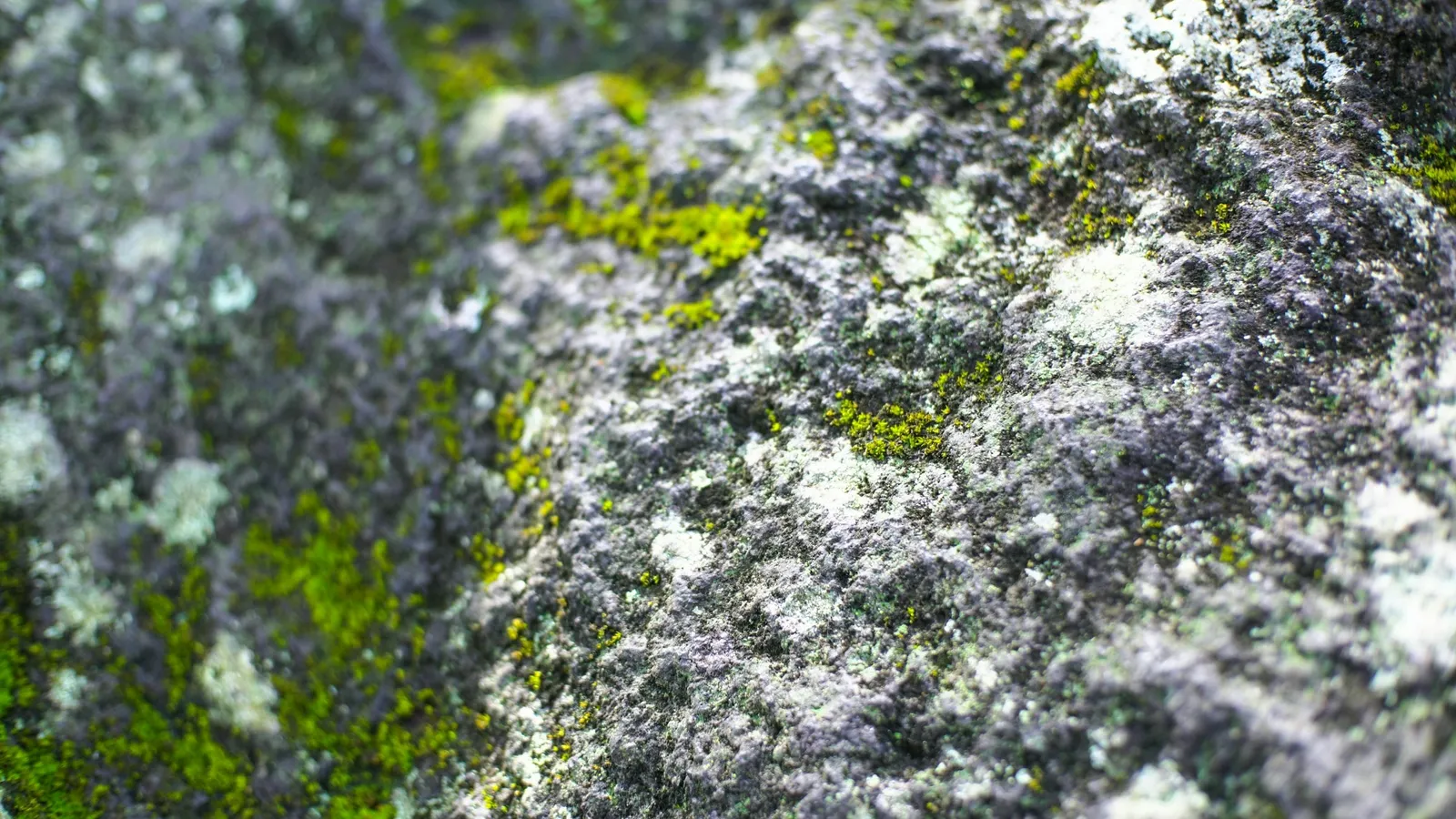
Lichen: a mutually useful association between an alga (the phycobiont) and a fungus (the mycobiont).
What facts about viruses does NCERT expect?
History: Ivanowsky (1892) found that the agent of tobacco mosaic disease passed through bacteria-proof filters. Beijerinck (1898) named it a virus and called the fluid contagium vivum fluidum. Stanley (1935) crystallised viruses and found the crystals were largely protein. The story is told in our post on Dmitri Ivanovsky and the discovery of viruses.
Genetic material by host: plant viruses generally have single-stranded RNA; animal viruses have single- or double-stranded RNA or double-stranded DNA; bacteriophages are usually double-stranded DNA.
Structure: the capsid is built from capsomeres arranged in helical or polyhedral forms.
Viruses did not stay unclassified. Virologists use their own system. A 2020 review by Koonin and colleagues describes the older grouping into seven "Baltimore classes" by genome type and replication route, and proposes a hierarchical taxonomy of viruses built on evolutionary relationships. That is beyond NEET, but it explains why viruses sit outside Whittaker's scheme instead of inside a sixth kingdom.
Is a lichen really just two partners?
NCERT describes two, and for NEET that is the answer. Research has complicated it. In 2016, Spribille and colleagues reported in Science that many common lichens contain, besides the known ascomycete fungus and the photosynthetic partner, specific basidiomycete yeasts embedded in the cortex, with lineages found on six continents. Their abstract notes that "the one lichen-one fungus paradigm" had seldom been questioned before. It is a good example of the point NCERT itself makes in this chapter: classification changes as our understanding improves.
NCERT also notes that lichens are "very good pollution indicators" because they do not grow in polluted areas.
Worked example: sort five descriptions
Identify each agent. (These descriptions are written for practice.)
Infectious; contains RNA and protein; crystallises outside the host. Virus: nucleic acid plus protein, inert crystals outside a cell (Stanley's finding).
Infectious; RNA only; low molecular weight; causes a disease of potato tubers. Viroid.
Infectious; contains no nucleic acid; linked to a brain disease in cattle. Prion.
Grows on bare rock; one partner photosynthesises, the other absorbs water and minerals. Lichen.
Contains double-stranded DNA; infects *E. coli*. Bacteriophage, a virus.
The trap is between 1 and 2. "Contains RNA" fits both; "and protein" is what makes it a virus.
Which mistakes cost the most marks?
Giving viruses a kingdom. They are outside Whittaker's five kingdoms.
Saying a virus has both DNA and RNA. NCERT: "No virus contains both RNA and DNA."
Calling viroids small viruses. They lack the protein coat that defines a virus particle.
Swapping phycobiont and mycobiont. Phyco- is the alga; myco- is the fungus.
Calling lichens parasites. NCERT calls them mutually useful associations.
For the rest of the chapter, see our guide to biological classification for NEET.
A practice routine
Day 1: Draw the five-kingdom table from memory, then add a sixth column for each misfit and write which row breaks first.
Day 2: Write ten one-line descriptions like the sorting example, swap with a friend and identify each other's.
Day 3: Answer NCERT's exercise "How are viroids different from viruses?" in two sentences, then do the phycobiont and mycobiont question.
If the five-kingdom criteria themselves are not clear yet, the Fermi Concept Library covers every concept in biology, each with its own lesson and its place in the map.
Next time you see a lichen on a wall or tree, name both partners and say which one makes the food.


