

On this page
It is one of the most common places to slip up in biology exams: keeping track of how much genetic material is inside a cell as it divides. A cell replicates its DNA long before it physically splits, creating a mismatch between the number of chromosomes and the sheer mass of DNA inside the nucleus.
If you understand the physical rule for what counts as a single chromosome, the numbers at each stage become entirely predictable.
What is the difference between chromosome number (n) and DNA content (C)?
The confusion usually begins because we use two different ways to count the genetic material.
The chromosome number (n) tells you how many individual chromosome structures are present. By convention, biologists count chromosomes by counting their centromeres—the pinched region that holds the structure together. In a normal human somatic cell, the diploid chromosome number is 46, often written as 2n (NCBI Bookshelf).
The DNA content (C) measures the physical amount of DNA. When a cell is resting in its normal diploid state, its DNA content is given the baseline value of 2C.
Crucially, a chromosome can consist of a single long DNA molecule (a chromatid), or two identical DNA molecules (sister chromatids) joined at one centromere. Because we count centromeres, a chromosome with two sister chromatids is still counted as exactly one chromosome, even though it holds twice the DNA.
How do the counts change during interphase (G₁, S, G₂)?
Most of a cell's life is spent in interphase, preparing for division. The Cell: A Molecular Approach (Cooper) outlines how the values shift before mitosis even begins:
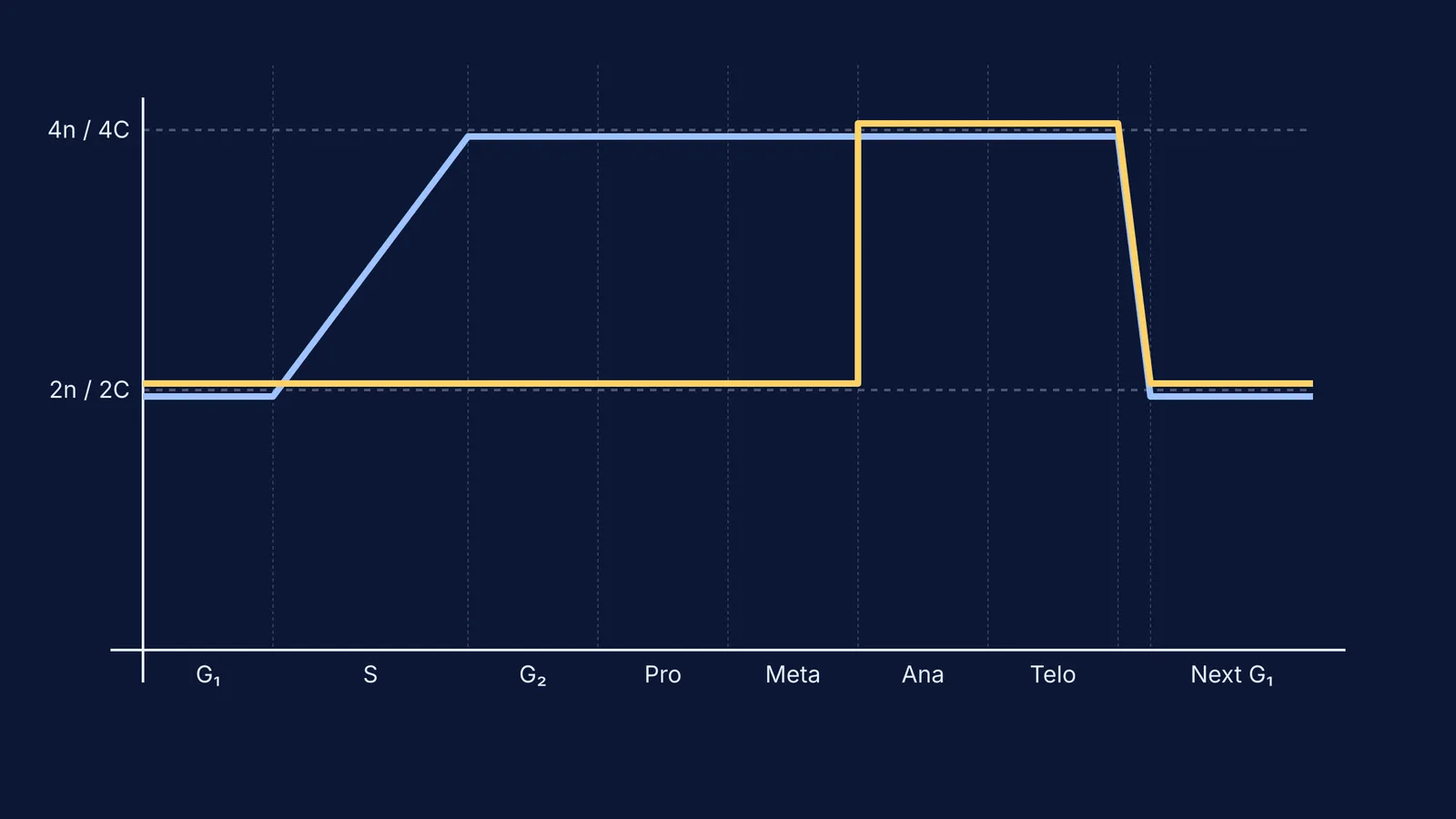
G₁ Phase: The cell goes about its normal functions. It is diploid (2n) with a baseline DNA content of 2C. In humans, this means 46 chromosomes and 46 chromatids.
S Phase (Synthesis): The cell replicates its DNA. The DNA content increases from 2C to 4C. However, because the newly formed sister chromatids remain attached at a shared centromere, the chromosome number remains 2n.
G₂ Phase: The cell prepares for mitosis. The DNA content remains at 4C, and the chromosome number remains at 2n.
By the time the cell enters prophase and metaphase of mitosis, the situation is unchanged. The chromosomes condense and align at the cell equator, still sitting at 2n and 4C.
The anaphase jump: why does the chromosome count double?
The defining moment of chromosome counting happens at anaphase. According to Molecular Biology of the Cell (Alberts et al.), anaphase is triggered by the sudden separation of sister chromatids.
The moment those chromatids pull apart, they no longer share a centromere. Each chromatid is now officially recognised as an independent, full-fledged chromosome.
Because all 46 duplicated chromosomes split simultaneously, the cell briefly contains 92 individual chromosomes. The chromosome number jumps from 2n to 4n. The DNA content, however, stays exactly the same (4C), because no new DNA has been manufactured; it has merely been separated.
This 4n and 4C state persists through telophase, as the new nuclei form at opposite ends of the cell. Finally, during cytokinesis, the cell physically divides down the middle. The 4n chromosomes and 4C DNA are shared equally between the two halves. Each new daughter cell starts life perfectly restored to the baseline G₁ state: 2n and 2C.
Step through a simulation to check your counts
Memorising the values is useful, but visualising the centromeres splitting makes the logic permanent. If you want to see exactly when the DNA doubles and when the chromosomes separate, try stepping through the process in the Fermi Simulation Lab.
You can pause the cell cycle at metaphase, predict the counts for the upcoming anaphase, and then run the simulation forward to verify that the chromosome number doubles just as the chromatids pull apart. Active prediction followed by immediate feedback is one of the most reliable ways to cement a counterintuitive rule.
For more on how these stages look under a microscope or how they compare to the reduction divisions that make gametes, explore these guides:


