

On this page
Benedict's test tells you a sugar is reducing. It does not tell you whether that sugar is one ring or two. Barfoed's test does, and it does it with a stopwatch rather than a new colour. If you are preparing for a biochemistry practical or viva, the whole test comes down to one idea: the same red precipitate means different things depending on when it appears.
What is Barfoed's test?
Barfoed's reagent is a solution of copper(II) acetate in about 1% acetic acid, and a reducing sugar turns its copper(II) into a brick-red precipitate of copper(I) oxide, Cu2O (Wikipedia: Barfoed's test). The reagent does not keep well, so it is best made up when you need it.
The test is named after the Danish chemist Christen Thomsen Barfoed, who published it in 1873 in the Zeitschrift für Analytische Chemie, in a paper on detecting grape sugar (glucose) alongside dextrin (Barfoed 1873, DOI record).
A King Saud University practical handout states the aim plainly: to detect reducing carbohydrates and to distinguish reducing monosaccharides from disaccharides (KSU CLS 281, Experiment 5).
Why do monosaccharides react faster than disaccharides?
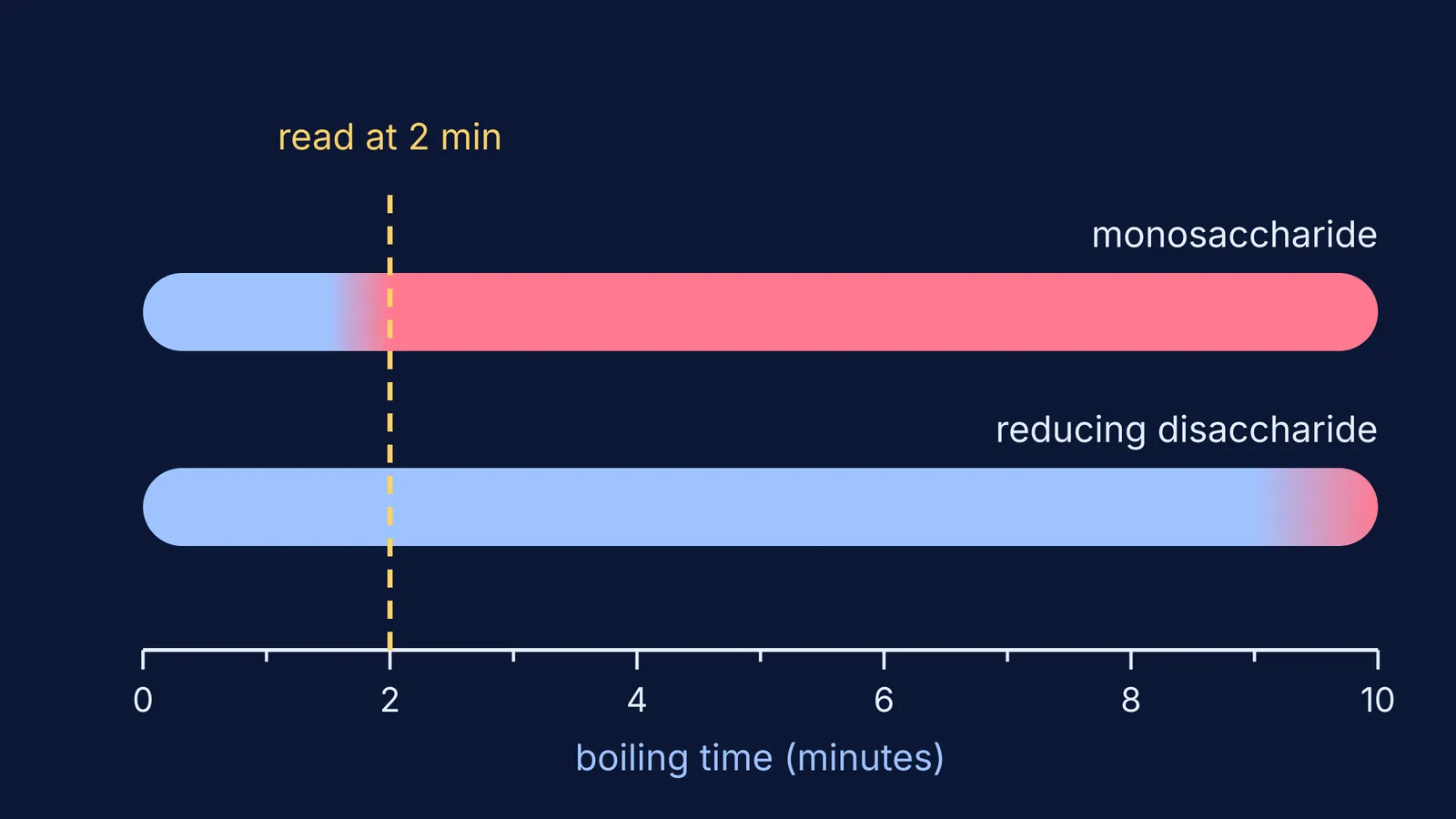
The difference is the medium. Benedict's reagent is alkaline; Barfoed's is weakly acidic (KSU CLS 281), and a LibreTexts lab manual calls it much milder than Fehling's reagent (LibreTexts lab manual). In that weak acid, monosaccharides such as glucose, fructose and xylose still act as reducing agents and pull copper(II) down to copper(I). The KSU handout notes the test is positive with all monosaccharides at 0.1% and above, and that hexoses act more rapidly and more vigorously than reducing disaccharides.
Reducing disaccharides such as maltose and lactose respond very slowly or not at all (LibreTexts). When they do react, it is because they have first been hydrolysed into monosaccharides, which then reduce the copper (Chemistry Learner).
So a disaccharide is not simply "negative" on Barfoed's test. It is late.
How do you run Barfoed's test and read the result?
One common procedure: add 2 mL of Barfoed's reagent to 10 drops of the sample, mix, boil in a water bath for 1 to 2 minutes, then let the tubes stand for a few minutes (LibreTexts).
A widely used reading rule: a red precipitate within two minutes means a monosaccharide; a red precipitate only after about ten minutes of heating means a disaccharide (Chemistry Learner).
Manuals differ on the exact clock. The KSU handout, for example, boils its tubes for 3.5 minutes or more (KSU CLS 281). Use the time your own lab manual gives, and write it in your record.
Where do students lose marks on Barfoed's test?
Boiling too long. Leave a maltose tube in the bath long enough and it can be hydrolysed, giving a red precipitate you might misread as a monosaccharide.
Forgetting sucrose. Sucrose is non-reducing and stays blue in Benedict's test, but it is very easily hydrolysed by Barfoed's dilute acid, and the fructose it releases is exceedingly reactive in this test (KSU CLS 281). Heat it long enough and sucrose can look like a monosaccharide.
Ignoring concentration. Disaccharides can give a reduction when present in very high concentration (same KSU source), so a very strong maltose solution may mislead you.
Salty samples. Other substances, including sodium chloride, may interfere with the result (Wikipedia).
Reading the colour of the liquid. The red cuprous oxide settles to the bottom while the solution can stay blue (KSU source). Look for the precipitate, not a colour change in the whole tube.
A worked example: four unknown sugars
Say you are handed four tubes: glucose, maltose, sucrose and starch, unlabelled. Run Benedict's first, then Barfoed's, and reason like this:
Benedict's, boiled about 5 minutes: two tubes give a coloured precipitate (glucose, maltose) and two stay blue (sucrose, starch). Benedict's detects reducing sugars, and sucrose and polysaccharides are not reducing (KSU CLS 281).
Barfoed's on the two Benedict's-positive tubes, read at your manual's short time: the tube with red precipitate is glucose; the tube with no precipitate is maltose.
Keep heating the maltose tube: a late red precipitate fits a reducing disaccharide.
Sucrose and starch need a different test from your manual (iodine, for example, picks out starch); Barfoed's is not the tool for that pair.
Write each observation with its time. "Red precipitate at 1 minute" tells whoever marks your record far more than "positive".
If the chemistry behind reducing sugars still feels shaky, the Fermi Concept Library covers every concept in physics, chemistry, biology, mathematics and computing, each with its own lesson and its place in the map. For more practice, the Fermi Problem Library has worked problems with a step-by-step solver that explains the reasoning rather than printing an answer.
Next time you stand at the water bath, keep a stopwatch next to the test tubes. In Barfoed's test, the timing is the result.


