

On this page
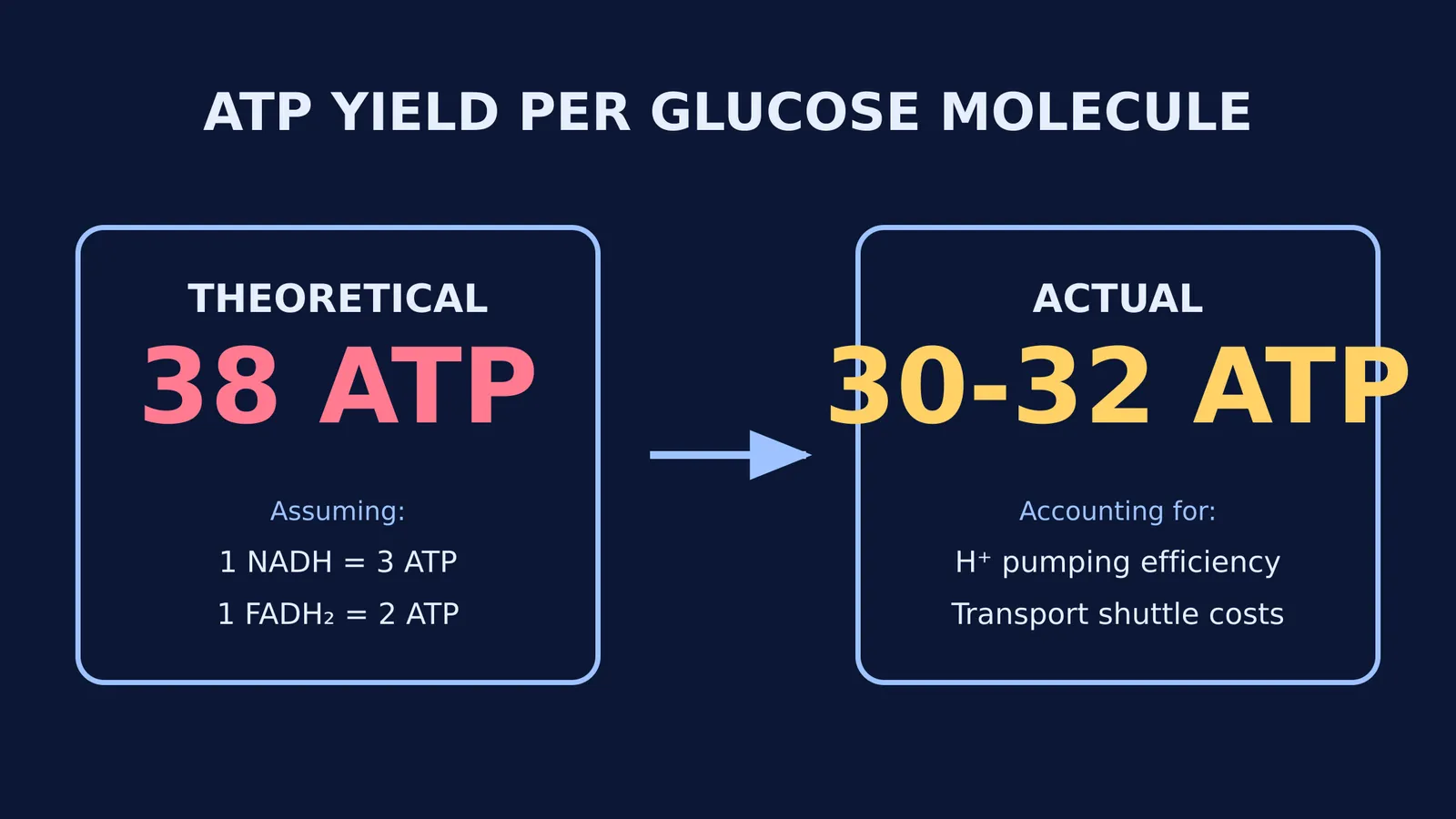
If you open the respiration chapter in different biology textbooks, you might spot a puzzling difference. The theoretical net gain from the complete aerobic oxidation of one molecule of glucose is 38 ATP, a figure detailed in NCERT Class 11 Biology. But if you look up the same topic in a modern biochemistry text or an international curriculum, it says 30 to 32 ATP.
Both numbers are "correct" for different reasons. Let's look at why they differ, and how you can use an AI tutor to map the pathway step by step instead of just memorising the final count.
Why does NCERT use 38 ATP?
The figure of 38 ATP is a strict, theoretical balance sheet. It assumes every single step of aerobic respiration runs perfectly and no intermediates are pulled away for other uses.
The calculation relies on the classic assumption that one NADH yields 3 ATP and one FADH₂ yields 2 ATP. Under this model, the breakdown looks like this:
Glycolysis: 2 ATP directly, plus 2 NADH (which will yield 6 ATP in the electron transport system), giving 8 ATP.
Link Reaction: 2 NADH, which yield 6 ATP.
Krebs Cycle: 2 ATP directly, 6 NADH (18 ATP), and 2 FADH₂ (4 ATP), giving 24 ATP.
Add those up, and the theoretical net gain is exactly 38 ATP per glucose molecule. For NEET-UG and CBSE exams, this is the accounting you must follow. (Keep in mind that these intermediates can be diverted to make other compounds; for more on this, see Respiration as an amphibolic pathway: where fats and proteins enter).
Where does 30 to 32 ATP come from?
In reality, cells are not perfectly sealed accounting books. Current measurements show that the total yield of ATP per glucose molecule typically varies between 30 and 32 ATP in a living eukaryotic cell, depending on the electron transport shuttle used [OpenStax Biology 2e]. This revised total accounts for the actual number of protons pumped across the inner mitochondrial membrane by the electron transport chain.
There is also a transport cost. The 2 NADH molecules made during glycolysis sit outside the mitochondria in the cytoplasm. To get their electrons inside, the cell has to use a shuttle system. In the liver, NAD+ is used as the electron transporter, resulting in a higher total yield of 32 ATP. In the brain, FAD+ acts as the transporter. Because FAD+ transports fewer ions, fewer ATP molecules are generated, dropping the yield to 30 ATP.
How can an AI tutor map the respiration pathway?
Because respiration is a chain of reactions—where the output of glycolysis feeds the Krebs cycle, which feeds the electron transport system (ETS)—it is easy to lose the big picture while trying to memorise the steps.
This is a good place to use Fermi's AI tutor. Most learning tools answer questions. Fermi teaches—it holds a line of reasoning across a whole session, notices where a student is stuck, and decides whether to explain, ask, or show.
Instead of reading the textbook linearly, you can ask the tutor to build a plan for the session and walk you through the carbon and energy accounting.
What is a good script to try?
Open the tutor and paste this prompt:
> "Walk me through the ATP balance sheet for aerobic respiration. Let's do it stage by stage, starting with glycolysis, and track where the 38 ATP come from. Ask me to fill in the blanks as we go."
The tutor will start with the first step, check your understanding of what goes in and what comes out, and help you keep a running tally. If you forget how many NADH molecules the Krebs cycle produces, the tutor can pull up the relevant map from the Fermi Concept Library to show you.
When you learn the pathway by building the balance sheet yourself, the difference between 38 ATP and 32 ATP stops being a confusing contradiction. You can see exactly which assumptions changed, and you will be ready whether the exam asks about the theoretical maximum or the real-world yield. To learn more about the history of how we measure respiration in humans, read about J. S. Haldane, carbon monoxide and the animals that warned miners.


