

On this page
When you study aerobic respiration, the final tally of ATP often feels like an accounting exercise. Textbooks have long taught that one molecule of glucose yields exactly 38 molecules of ATP Source: Biochimica et Biophysica Acta, PMID: 15620362.
This number is a theoretical maximum based on perfect efficiency. To get to 38, we add the ATP made directly in the cytoplasm and mitochondria to the ATP generated indirectly by electron carriers.
Here is how the 38 ATP are counted, and why modern biochemistry has revised the actual number downward.
How many ATP are produced from one glucose in aerobic respiration?
The 38 ATP calculation relies on two conversion rates for the electron transport chain: each NADH molecule yields 3 ATP, and each FADH₂ molecule yields 2 ATP Source: Biochimica et Biophysica Acta, PMID: 15620362.
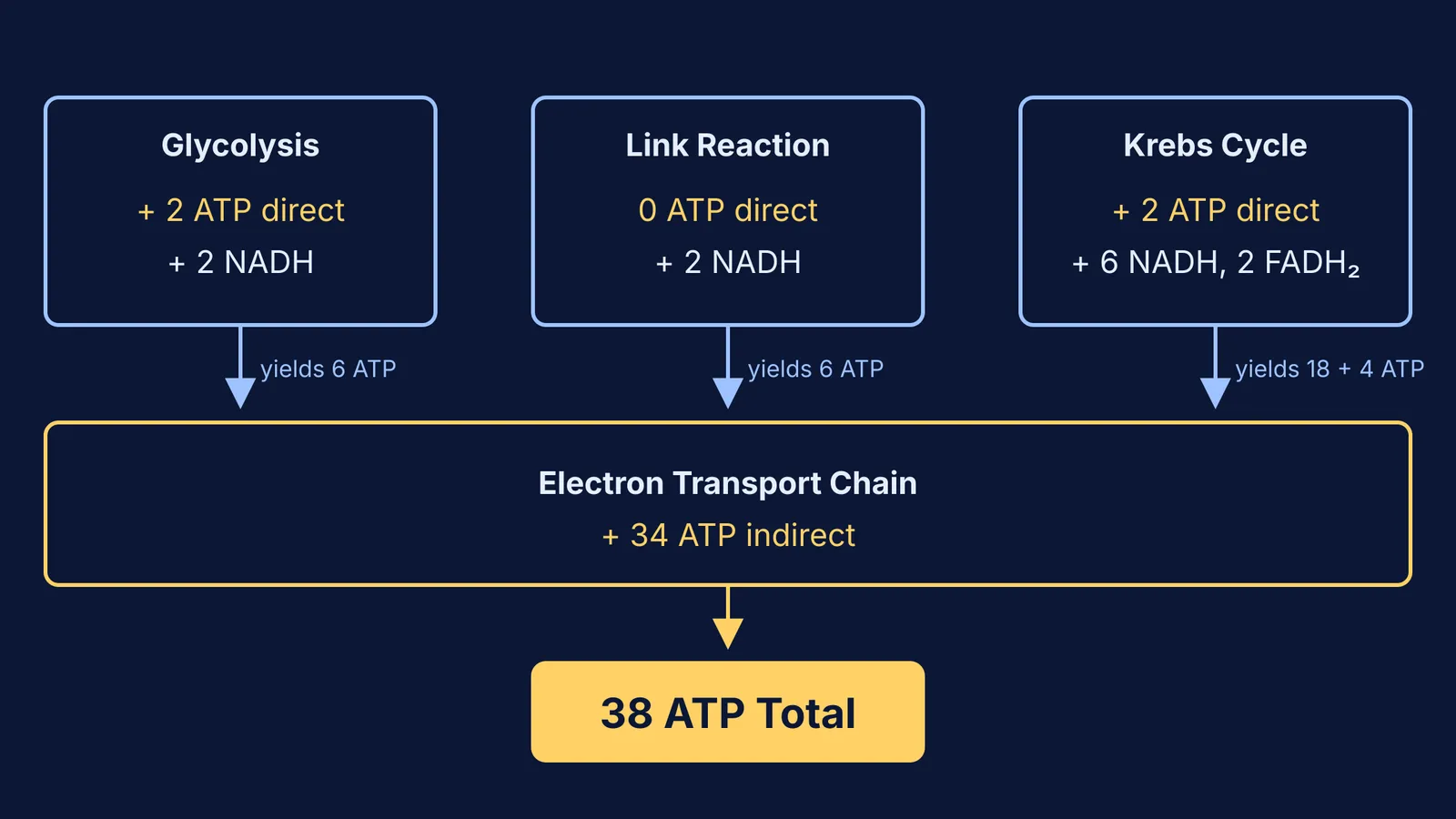
With these rates, you can add up the products of the three main stages of respiration:
Glycolysis (in the cytoplasm): Breaking glucose into two pyruvate molecules requires an investment of 2 ATP but produces 4 ATP, giving a net yield of 2 ATP. It also produces 2 NADH. In the theoretical model, these 2 NADH yield 6 ATP.
The link reaction (moving into the mitochondrion): Converting two pyruvates into acetyl-CoA produces 2 NADH, which yield another 6 ATP.
The Krebs cycle (in the mitochondrial matrix): Two turns of the cycle (one for each acetyl-CoA) produce 2 ATP directly. They also generate 6 NADH (yielding 18 ATP) and 2 FADH₂ (yielding 4 ATP).
Adding these together gives 4 ATP directly and 34 ATP indirectly from the electron transport chain, totalling 38 ATP. If you forget which stage produces which carrier, the Fermi Concept Library breaks down the inputs and outputs of each pathway step by step.
What is the difference between substrate-level and oxidative phosphorylation?
The 38 ATP come from two different methods of making ATP.
Substrate-level phosphorylation is direct. It happens when an enzyme takes a phosphate group from a molecule (like an intermediate in glycolysis) and attaches it directly to ADP to make ATP. This is how the 2 net ATP in glycolysis and the 2 ATP in the Krebs cycle are made Source: Biochimica et Biophysica Acta, PMID: 15620362.
Oxidative phosphorylation is indirect. Instead of making ATP immediately, the cell stores energy in the electron carriers NADH and FADH₂. These carriers travel to the inner mitochondrial membrane, where they drop off their electrons. The energy from these electrons is used to pump protons across the membrane, creating a gradient. Finally, ATP synthase uses this gradient to make ATP. This indirect method is responsible for the remaining 34 ATP in the theoretical model.
Why do textbooks sometimes say 36 ATP?
In eukaryotic cells, glycolysis happens in the cytoplasm, but the electron transport chain is inside the mitochondrion. The 2 NADH molecules produced during glycolysis cannot simply float across the inner mitochondrial membrane Source: Biochimica et Biophysica Acta, PMID: 15620362.
They must hand their electrons over to a shuttle system. In heart and liver cells, the malate-aspartate shuttle brings the electrons in as NADH, preserving the full 38 ATP yield. However, in muscle and brain cells, the glycerol-3-phosphate shuttle is used. This shuttle transfers the electrons to FADH₂ instead.
Because FADH₂ enters the electron transport chain later than NADH, it yields fewer ATP. The 2 NADH from glycolysis now only produce 4 ATP instead of 6, dropping the total yield to 36 ATP.
Why is the 38 ATP theoretical?
The 38 (or 36) ATP figure assumes that every proton pumped across the mitochondrial membrane is used perfectly by ATP synthase. In a real cell, the system is less efficient Source: Biochimica et Biophysica Acta, PMID: 15620362.
In 2005, a review by Peter Hinkle published in *Biochimica et Biophysica Acta* confirmed that the true "P/O ratios" (the amount of ATP made per oxygen atom reduced) are not whole numbers. Modern measurements show that one NADH yields about 2.5 ATP, and one FADH₂ yields about 1.5 ATP.
Why are the numbers lower?
Transport costs: The mitochondrion uses the proton gradient to do other work, such as pumping pyruvate, ADP and inorganic phosphate into the matrix.
Proton leakage: Some protons slip back across the inner membrane without passing through ATP synthase, meaning their energy is lost as heat rather than captured as ATP.
This stepwise energy release is still incredibly effective. If you find it hard to picture how the proton gradient drives this process, Fermi's AI tutor can draw the complexes on a board, run the simulation, and check your understanding as it goes.
How do you answer exam questions about ATP yield?
When you answer exam questions about Krebs cycle products and ATP yields, check what the question is asking Source: Biochimica et Biophysica Acta, PMID: 15620362:
"Theoretical maximum": Use 38 ATP (or 36 if the question specifies a muscle or brain cell).
"Net yield of glycolysis": Answer 2 ATP (do not include the NADH).
"Direct ATP from the Krebs cycle": Answer 2 ATP (or GTP) per glucose molecule.


