

On this page
When a match touches a spoonful of glucose, the sugar burns vigorously in air. This combustion consumes oxygen, yields carbon dioxide and water, and releases roughly 2,870 kilojoules of energy per mole in a single, uncontrolled flare. Yet living cells oxidise glucose continuously at 37 °C without scorching their membranes or wasting that energy. As outlined in NCERT Class 11 Biology, the secret lies in the architecture of cellular respiration: rather than detonating fuel in a single step, the cell dismantles glucose through a sequence of enzyme-catalysed reactions.
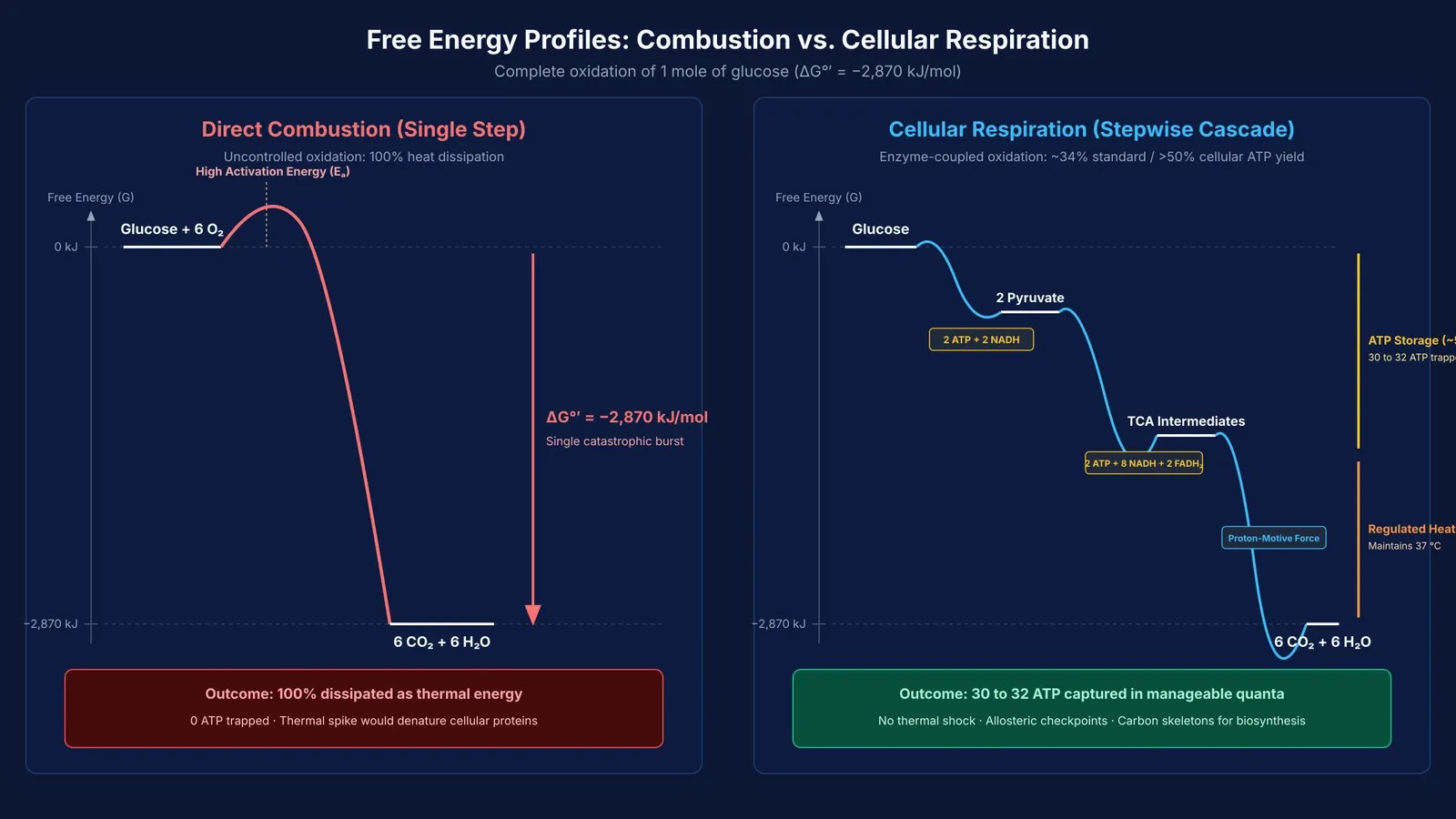
What happens if a cell burns glucose in a single step?
In open combustion, glucose oxidises rapidly through a free-radical chain reaction. Because all chemical bonds break in rapid succession, the standard Gibbs free energy change (ΔG°′ = −2,870 kJ/mol, catalogued in NCERT Class 11 Biology) discharges almost entirely as heat and light. In an open environment, rapid heat dispersal is harmless, but inside a microscopic cell, such a thermal burst would denature vital proteins and disintegrate lipid membranes.
More fundamentally, heat cannot drive cellular work. If all energy is released in one massive packet, no biochemical mechanism exists to capture it. By dividing oxidation into small increments, the cell ensures that the energy liberated in individual reactions matches the capacity of biological energy carriers.
How does stepwise oxidation trap energy as ATP?
To capture energy, cells couple exergonic breakdown steps to the synthesis of adenosine triphosphate (ATP). In 1941, biochemist Fritz Lipmann introduced the concept of high-energy phosphate bonds, identifying ATP as the cell's universal energy currency. Synthesising one mole of ATP from ADP and inorganic phosphate requires a standard Gibbs free energy input of +30.5 kJ/mol, or roughly +50 kJ/mol under physiological concentrations.
Instead of shedding free energy in a single drop, respiration lowers electrons down a thermodynamic staircase:
Glycolysis splits glucose into two pyruvates in the cytoplasm, yielding a net 2 ATP by substrate-level phosphorylation and reducing 2 NAD⁺ to NADH.
The citric acid cycle completely oxidises the carbon fragments inside the mitochondrial matrix, generating 2 ATP (or GTP), 8 NADH, and 2 FADH₂ while releasing 6 CO₂.
Oxidative phosphorylation collects those electron carriers at the inner mitochondrial membrane. As Peter Mitchell showed in his 1961 chemiosmotic hypothesis, electron transfer pumps protons across the membrane to drive ATP synthase.
Aerobic respiration yields roughly 30 to 32 ATP per glucose molecule, as explained in our guide to counting ATP in plant respiration. Under standard conditions, 32 ATP conserves about 976 kJ/mol (roughly 34% efficiency), which exceeds 50% under physiological conditions. A 2020 study by Wikström and Springett showed that the three protonmotive respiratory complexes (Complexes I, III, and IV) operate at 80% to 90% thermodynamic efficiency during active ATP synthesis. A thermodynamic analysis by Sunil Nath in 2016 similarly showed that the overall thermodynamic efficiency of ATP synthesis in oxidative phosphorylation is approximately 40% to 41%.
Why can living cells not use heat to do biological work?
Mechanical heat engines convert thermal energy into work by moving heat from a high-temperature zone to a low-temperature sink. According to the second law of thermodynamics, extracting work from heat requires a temperature gradient.
Cells cannot use this mechanism because they are isothermal systems. Temperatures inside organelles equilibrate with the surrounding cytosol almost instantaneously. If glucose discharged all its chemical potential energy as heat in one step, that heat would dissipate into the aqueous environment without driving active transport, protein synthesis, or motility. Stepwise oxidation avoids this dissipation by transferring bond energy directly into electrochemical and conformational states.
How do metabolic checkpoints control energy release?
Dividing respiration into discrete enzymatic steps also provides precise metabolic regulation:
Dynamic throttle points: The glycolytic enzyme phosphofructokinase-1 (PFK-1) acts as an allosteric sensor. When ATP levels are high, ATP binds an allosteric site on PFK-1 to slow glycolysis and conserve glucose. When ADP and AMP rise, inhibition lifts and fuel breakdown accelerates.
Biosynthetic branching: Stepwise oxidation yields intermediate carbon skeletons for biosynthesis. Acetyl-CoA feeds fatty acid production, while alpha-ketoglutarate and oxaloacetate yield amino acids. This makes respiration an amphibolic pathway, as explored in our guide to the amphibolic nature of respiration and the discovery of coenzyme A by Fritz Lipmann.
How much energy does respiration capture compared to combustion?
Using the bioenergetic parameters from NCERT Class 11 Biology, we can compare the energy fate of 1 gram of glucose (molar mass 180.16 g/mol):
Moles in 1 g glucose: 1 / 180.16 = 0.00555 mol.
Total free energy released (ΔG): 0.00555 mol × 2,870 kJ/mol = 15.93 kJ.
Single-step combustion: All 15.93 kJ is lost as heat within milliseconds, producing 0 ATP.
Stepwise respiration (32 ATP yield): Traps 0.00555 mol × 32 ATP/mol = 0.1776 mol ATP. At a physiological potential of 50 kJ/mol, this conserves roughly 8.88 kJ (55.7% efficiency) as cellular fuel, releasing 7.05 kJ as regulated warmth.
To trace how each step of glycolysis, the link reaction, and the citric acid cycle fits into broader metabolism, the Fermi Concept Library covers every concept in biology, each with its own lesson and its place in the map. For practicing bioenergetic calculations and ATP accounting, the Fermi Problem Library offers worked problems with a step-by-step solver that explains the reasoning rather than printing an answer.


