

On this page
What are the exact products of the Krebs cycle per turn?
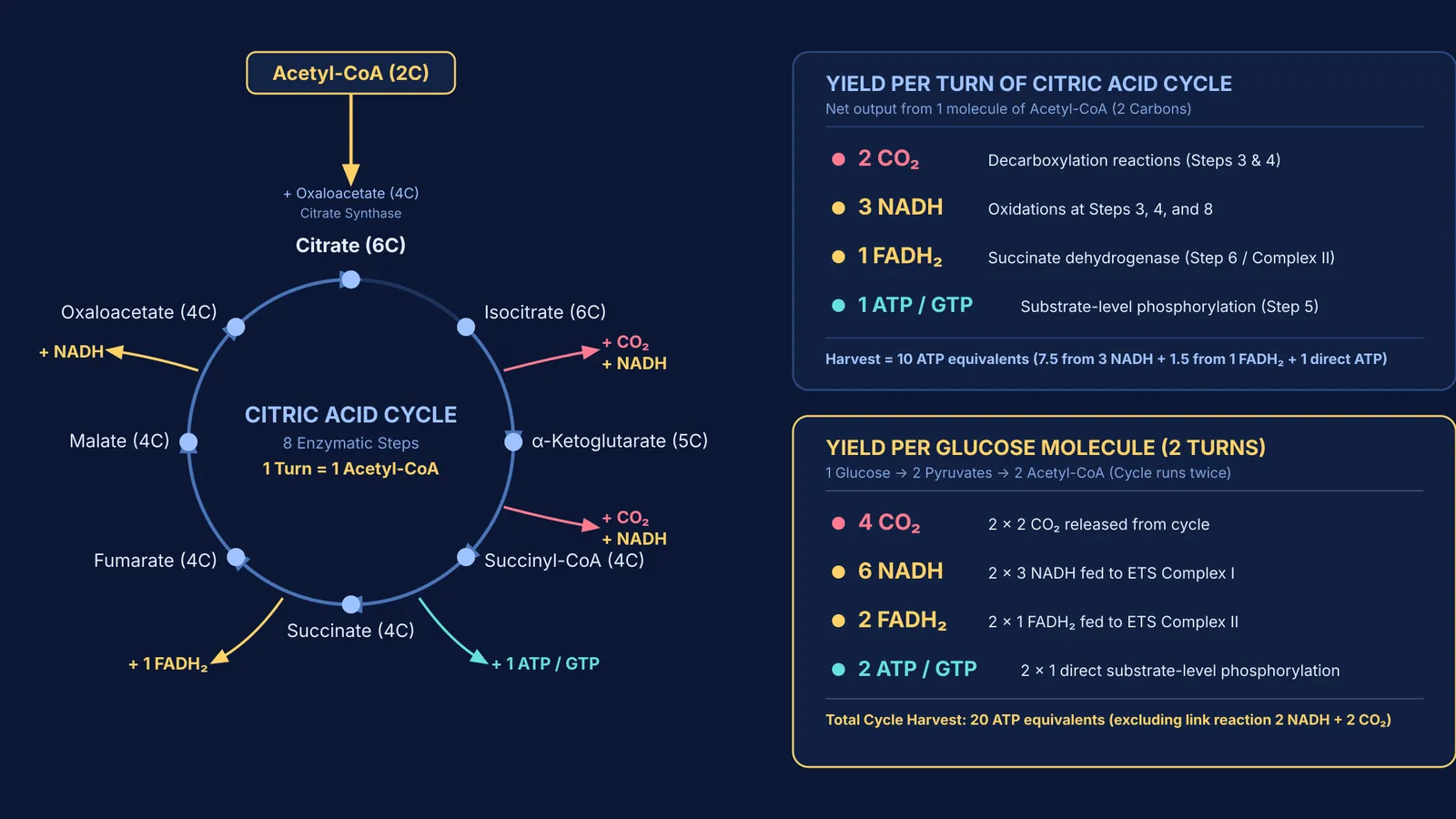
The citric acid cycle, commonly known as the Krebs cycle or tricarboxylic acid (TCA) cycle, occurs in the mitochondrial matrix of eukaryotic cells. It begins when a two-carbon acetyl group carried by acetyl coenzyme A (acetyl-CoA) condenses with a four-carbon oxaloacetate molecule to form six-carbon citrate. Over a closed loop of eight enzymatic reactions documented in Berg, Tymoczko, and Stryer's Biochemistry, that citrate is systematically oxidized, regenerating oxaloacetate to accept the next incoming acetyl group.
Each single turn of the cycle processing one molecule of acetyl-CoA produces:
Two molecules of CO₂
Three molecules of NADH
One molecule of FADH₂
One molecule of ATP or GTP
These products appear at specific enzymatic checkpoints. Carbon dioxide is released in two successive oxidative decarboxylation steps: first when isocitrate dehydrogenase oxidizes six-carbon isocitrate into five-carbon α-ketoglutarate, and second when the α-ketoglutarate dehydrogenase complex converts that intermediate into four-carbon succinyl-CoA. Both decarboxylations transfer high-energy electrons to NAD⁺, forming two NADH molecules.
Substrate-level phosphorylation occurs in the next step, where succinyl-CoA synthetase cleaves the high-energy thioester bond to yield succinate along with one GTP or ATP. Succinate dehydrogenase—an enzyme embedded in the inner mitochondrial membrane—then oxidizes succinate to fumarate, reducing FAD to FADH₂. Finally, after fumarase hydrates fumarate into malate, malate dehydrogenase oxidizes malate back to oxaloacetate, producing the third and final NADH.
In their landmark 1937 investigation into animal tissues (reprinted in FEBS Letters80564-3)), biochemists Hans Krebs and William Arthur Johnson demonstrated that this cyclic series of reactions acts catalytically, consuming intermediate acids to drive cellular oxidations. To explore how cellular fuels enter this central engine and understand respiration as an amphibolic pathway, students can trace every metabolic concept and its place in the map in the Fermi Concept Library.
Why does the Krebs cycle run two turns per glucose molecule?
A frequent point of confusion in cellular respiration is the relationship between one molecule of glucose and the turns of the Krebs cycle. As detailed in OpenStax Biology 2e, glycolysis takes place in the cytosol, where one six-carbon glucose molecule is cleaved into two three-carbon molecules of pyruvate.
Each pyruvate enters the mitochondrial matrix and undergoes the transition step known as the link reaction or pyruvate oxidation. The pyruvate dehydrogenase complex decarboxylates pyruvate, releasing one CO₂ and generating one NADH while joining the remaining two-carbon acetyl fragment to coenzyme A. Because one glucose produces two pyruvates, this preparatory reaction yields two molecules of acetyl-CoA, two molecules of CO₂, and two molecules of NADH.
Because each turn of the citric acid cycle accepts exactly one acetyl-CoA, the cycle must complete two full rotations to metabolize the carbon units originating from a single glucose molecule. Multiplying the per-turn stoichiometry by two gives the net output of the Krebs cycle per glucose:
Four molecules of CO₂
Six molecules of NADH
Two molecules of FADH₂
Two molecules of ATP or GTP
When combined with the link reaction, the mitochondrial matrix releases six CO₂ molecules in total, accounting for all six carbon atoms originally present in the glucose molecule.
How do electron carriers translate into ATP equivalents?
The direct energy yield of the cycle is modest: only one high-energy phosphate bond (ATP or GTP) forms per turn via substrate-level phosphorylation. However, as documented in Berg's Biochemistry, the primary energetic harvest of the cycle is stored in reduced electron carriers.
As established through Peter Mitchell's chemiosmotic hypothesis, NADH and FADH₂ deposit high-energy electrons into the respiratory chain, establishing a proton gradient across the inner mitochondrial membrane. In modern bioenergetic accounting, each mitochondrial NADH yields approximately 2.5 ATP, while each FADH₂ yields approximately 1.5 ATP when oxidized through the electron transport system.
Per turn of the cycle, the total ATP generation translates to:
Three NADH × 2.5 = 7.5 ATP
One FADH₂ × 1.5 = 1.5 ATP
One direct ATP or GTP = 1.0 ATP
This yields 10 ATP equivalents per turn, or 20 ATP equivalents per molecule of glucose from the citric acid cycle alone. In traditional curricula that apply older P/O ratios of 3 ATP per NADH and 2 ATP per FADH₂, the tally reaches 12 ATP per turn and 24 ATP per glucose, as detailed in our guide on counting ATP in plant respiration.
Where do students lose marks in exam stoichiometric questions?
In entrance examinations like NEET-UG administered by the National Testing Agency and senior secondary assessments aligned with the NCERT curriculum, stoichiometric questions often test boundary conditions rather than simple recall.
To prevent errors under timed conditions, apply this five-step verification framework:
Identify the reference molecule: Check whether the prompt asks for products per turn, per pyruvate, or per glucose molecule.
Separate the link reaction: Never include the CO₂ or NADH from pyruvate decarboxylation when asked specifically about the cycle.
Check phosphorylation type: Distinguish between direct substrate-level phosphorylation and total ATP from oxidative phosphorylation.
Verify carbon balance: Ensure that two turns account for 4 CO₂ from the cycle and 2 CO₂ from the link reaction, accounting for all 6 carbons.
Confirm coenzyme ratios: Remember that the cycle generates NADH and FADH₂ in a strict 3:1 ratio per turn.
Worked Example: An exam question asks how many CO₂ molecules and how many NADH molecules are generated exclusively within the citric acid cycle during the complete aerobic breakdown of one glucose molecule.
Step 1: One glucose yields two acetyl-CoA molecules, driving two turns of the cycle.
Step 2: In the cycle, each turn produces 2 CO₂ and 3 NADH.
Step 3: Multiply by two turns: 2 × 2 = 4 CO₂, and 3 × 2 = 6 NADH.
Conclusion: The answer is 4 CO₂ and 6 NADH. The 2 CO₂ and 2 NADH generated during pyruvate oxidation belong to the link reaction, not the cycle itself.
For students practicing multi-step numericals across metabolic pathways, the Fermi Problem Library offers worked problems with a step-by-step solver that explains the reasoning rather than printing an answer.


