

On this page
In 1941 a short paper in the Journal of the American Chemical Society settled a question that had divided leading chemists: when a plant gives off oxygen, which molecule did it come from? Samuel Ruben, Merle Randall, Martin Kamen and James Logan Hyde answered it by tagging oxygen atoms with a heavy isotope and following them (Ruben et al., 1941, JACS 63: 877–879). Their answer was water, and it is still the textbook answer today.
What did scientists think before Ruben and Kamen?
The overall reaction makes both answers look possible, because carbon dioxide and water both contain oxygen. Nobel laureates Richard Willstätter and Otto Warburg had said that the released O₂ came from CO₂, not H₂O (Govindjee and Blankenship, 2018).
Two clues pointed the other way. By analogy with photosynthetic bacteria, Cornelis van Niel suggested that the O₂ released by plants is derived from water rather than CO₂, and Robert Hill found in 1937 that the light phase of photosynthesis can run independently of the dark phase (Stirbet et al., 2020, Annals of Botany). It still needed a direct test. For the back-story, read how de Saussure showed plants are built from CO₂ and water and how Priestley's mint sprig and bell jar revealed photosynthesis.
How did Ruben and Kamen prove oxygen comes from water?
Ruben and Kamen worked at the Radiation Laboratory at UC Berkeley, where on 27 February 1940 they had identified carbon-14 (Sam Ruben, Wikipedia). For the oxygen question they used a different tag: oxygen-18, a heavier isotope of oxygen. It reacts like ordinary oxygen-16 but weighs more, so it can be traced.
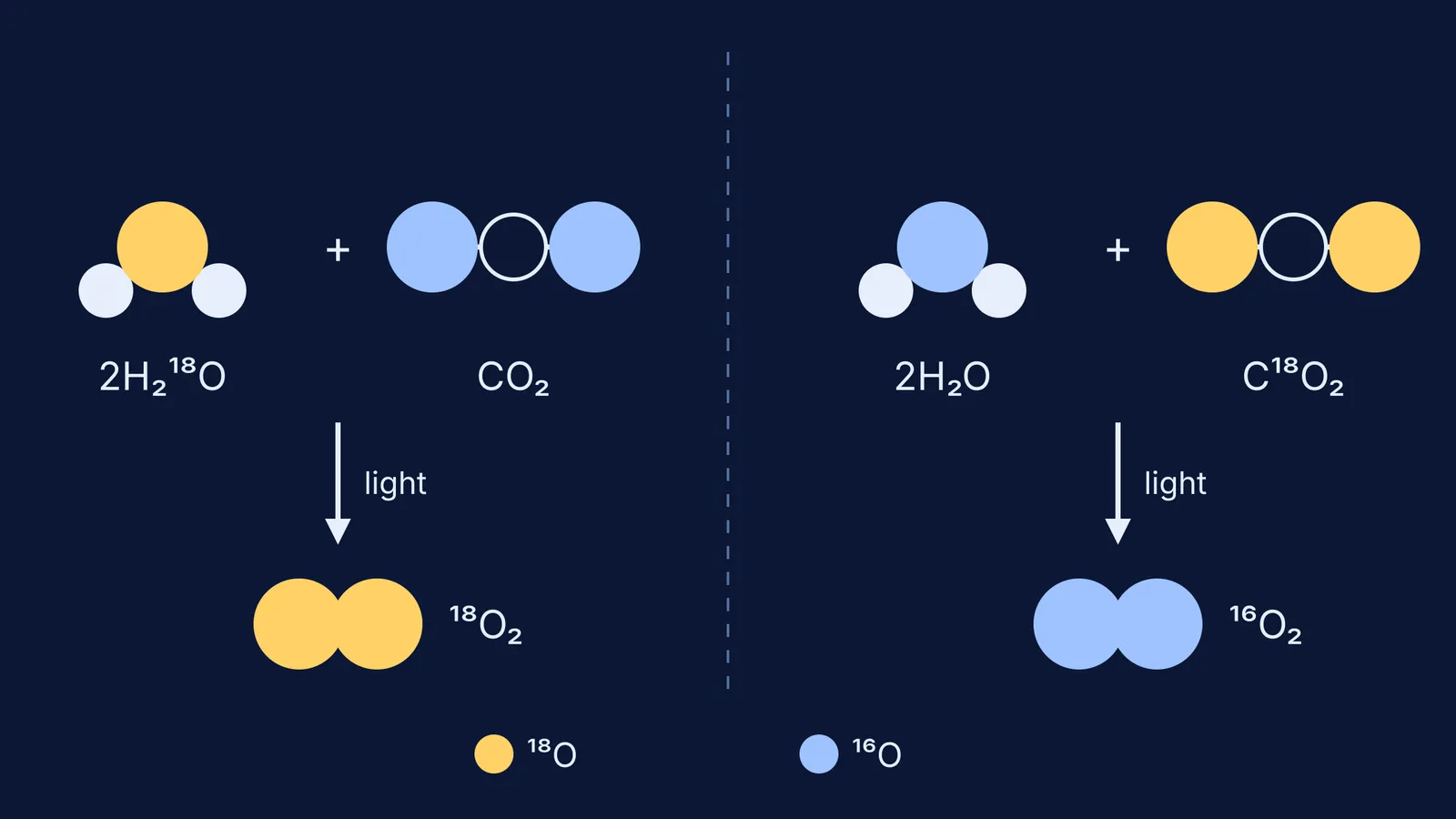
The team ran the experiment two ways, as summarised in a 1950 Berkeley report by G. D. Dorough and Melvin Calvin (Dorough and Calvin, 1950):
Label in the water: 2H₂¹⁸O + C¹⁶O₂ gave ¹⁸O₂. The heavy oxygen came out in the gas.
Label in the carbon dioxide: 2H₂¹⁶O + C¹⁸O₂ gave ordinary ¹⁶O₂. The heavy oxygen ended up in the carbohydrate and the water formed, not in the gas.
From these runs, Dorough and Calvin wrote, "It was thus established that the evolved oxygen is derived in its entirety by the oxidation of water." A 2024 perspective article describes the result the same way: the isotopic composition of the oxygen gas was nearly identical to that of the water (Vinyard and Govindjee, 2024, Photosynthesis Research).
Why does the equation have 12 water molecules?
Stirbet and colleagues give the balanced reaction as 6CO₂ + 12H₂O + light energy → C₆H₁₂O₆ + 6O₂ + 6H₂O (Stirbet et al., 2020). Do the oxygen bookkeeping yourself:
The 6 O₂ molecules on the right contain 12 oxygen atoms.
The 12 water molecules supply exactly 12 oxygen atoms, so all the released oxygen can come from water.
The 6 CO₂ molecules bring another 12 oxygen atoms: six go into glucose (C₆H₁₂O₆) and six into the 6 new water molecules.
The shorter form, 6CO₂ + 6H₂O → C₆H₁₂O₆ + 6O₂, balances but hides this: 6 waters hold too few oxygen atoms to make 6 O₂.
So the extra water is not padding. It is the 1941 result written into the equation. The water-splitting step itself happens in Photosystem II, which we explain in photolysis of water in Photosystem II.
Was the question settled for good?
Mostly, yes. Vinyard and Govindjee note that isotope experiments like these can be complicated by oxygen mixing between molecules, and that Otto Warburg and G. Krippahl later challenged the conclusion. They report that a consensus has now been reached among Photosystem II researchers that O₂ comes solely from water, while noting that alternative ideas involving bicarbonate still appear in the literature (Vinyard and Govindjee, 2024).
Both men's lives took hard turns. Ruben died on 28 September 1943 after exposure to phosgene in a laboratory accident (Sam Ruben, Wikipedia). Kamen was fired from the Berkeley laboratory with no hearing, worked for a time as an inspector in a San Francisco shipyard, and after the war was hired by Arthur Compton at Washington University in St. Louis (Govindjee and Blankenship, 2018).
How do you write this in a NEET-UG or board answer?
Use this four-part pattern:
Claim: the O₂ released in photosynthesis comes from water.
Evidence: Ruben, Kamen and co-workers (1941) labelled water with oxygen-18 and found the label in the released O₂; labelled CO₂ gave unlabelled O₂.
Equation: write 6CO₂ + 12H₂O → C₆H₁₂O₆ + 6O₂ + 6H₂O and point out why there are 12 waters.
Link: water is split in the light reaction, at Photosystem II.
If the light reactions still feel shaky, the Fermi Concept Library has a lesson for every concept in biology and chemistry. To talk a tracer question through, Fermi's AI tutor works out what you already know and builds a plan for the session.
Next time you write the photosynthesis equation, count the oxygen atoms on each side.


