

On this page
What happened in Priestley's 1771 mint and mouse experiment?
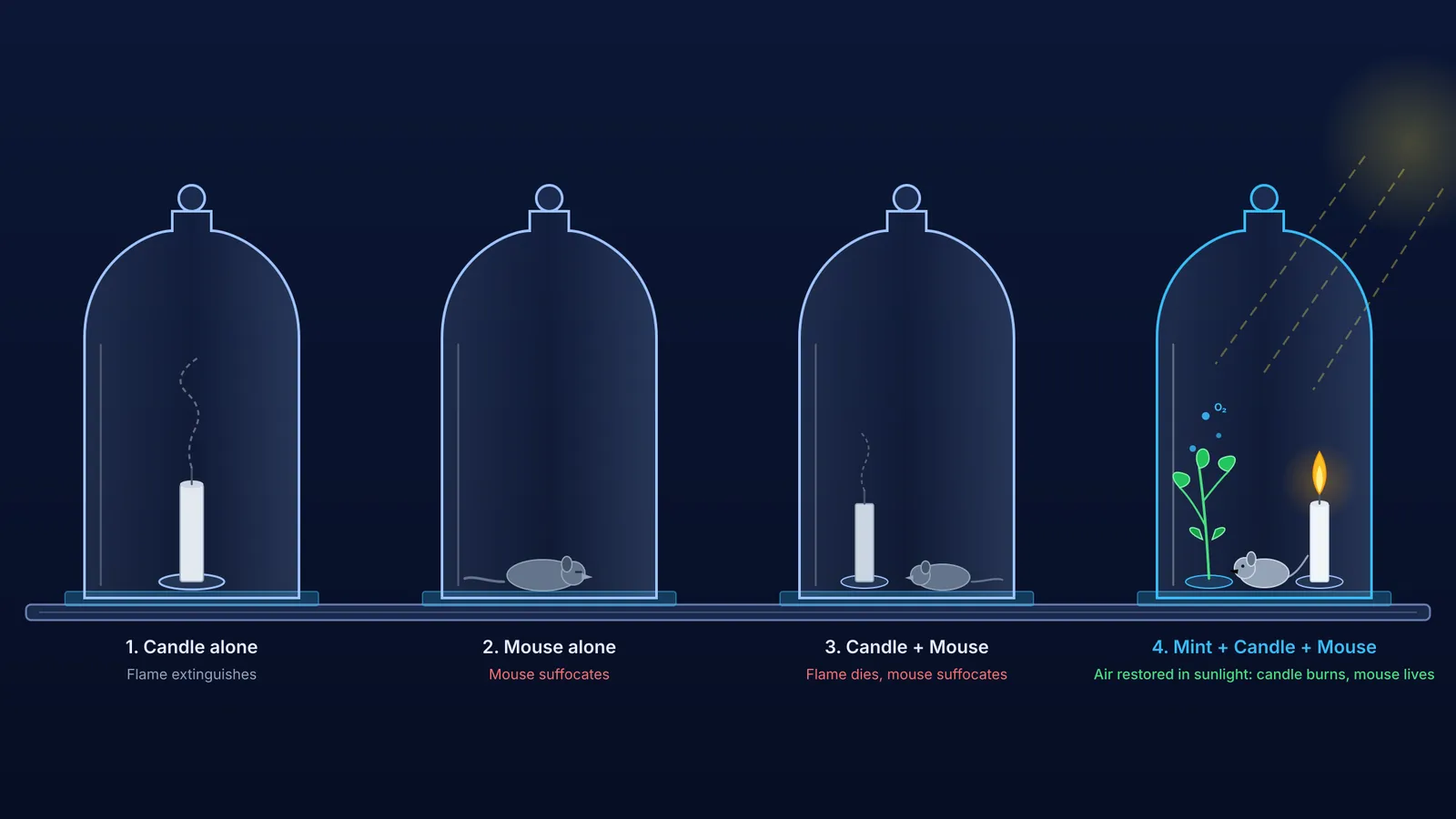
On 17 August 1771, British natural philosopher Joseph Priestley began an experiment that overturned prevailing assumptions about Earth's atmosphere. Working in Leeds, Priestley placed a burning wax candle inside an airtight glass bell jar inverted over water until the flame went out. At the time, air was viewed as a single, immutable elementary substance. A burning candle or breathing animal seemed to corrupt this air permanently, rendering it noxious and unbreathable.
Priestley investigated whether nature had a way to repair this fouled atmosphere. In his landmark paper Observations on Different Kinds of Air, published in the *Philosophical Transactions of the Royal Society* in 1772, he described placing a living sprig of mint (*Mentha spicata*) inside the spent jar. Ten days later, on 27 August 1771, he lowered another lighted candle inside. Rather than extinguishing immediately, the candle burned steadily. Priestley repeated the trial between 8 and 10 times that summer with identical results.
He then extended the trial to animal respiration. A mouse placed in an unrefreshed, candle-exhausted jar suffocated within minutes. Yet in a jar where a mint sprig had grown for several days, as recounted in his 1774 work Experiments and Observations on Different Kinds of Air, a mouse breathed comfortably and remained vigorous. On 30 November 1773, the Royal Society awarded Priestley the Copley Medal for his experimental discoveries on different kinds of air.
Why did the candle burn and the mouse survive?
Priestley interpreted his results through phlogiston theory, the dominant chemistry framework of his day. Natural philosophers believed that combustible materials contained an undetectable substance called phlogiston. Burning flames and breathing animals supposedly discharged phlogiston into the surrounding air until it became saturated with "phlogisticated air." Once saturated, the air could accept no more, choking flames and lungs alike. Priestley concluded that growing mint absorbed this phlogiston, dephlogisticating the air.
Modern chemistry explains this through reciprocal gas exchange between photosynthesis and cellular respiration. A burning candle consumes molecular oxygen (O₂) and releases carbon dioxide (CO₂) and water vapour. A mouse similarly consumes O₂ to sustain cellular metabolism:
C₆H₁₂O₆ + 6O₂ → 6CO₂ + 6H₂O + energy
In an enclosed bell jar filled with ambient air, combustion and respiration quickly drive oxygen levels below survival thresholds while carbon dioxide accumulates. A leafy mint sprig reverses this depletion. Using solar energy, its chloroplasts absorb carbon dioxide through stomata and split water molecules, producing carbohydrates and liberating molecular oxygen:
6CO₂ + 6H₂O + light energy → C₆H₁₂O₆ + 6O₂
By taking up carbon dioxide and generating oxygen, the mint restored the jar's atmospheric balance. For students connecting plant physiology with metabolic biochemistry, the Fermi Concept Library maps every concept across biology and chemistry into structured lessons showing how chloroplast reactions couple to mitochondrial pathways.
How did Ingenhousz and Lavoisier complete the puzzle?
Priestley's conclusion missed a crucial condition: plants do not purify air continuously. In 1779, Dutch physician Jan Ingenhousz published Experiments upon Vegetables, demonstrating that plants restore air only in the presence of sunlight and only through green foliage. In darkness or through non-green tissues, plants consume oxygen and emit carbon dioxide just like animals.
Between 1777 and 1779, French chemist Antoine Lavoisier dismantled phlogiston theory altogether, proving that combustion and respiration involve combination with a distinct element he named oxygen. Priestley had generated pure oxygen on 1 August 1774 by heating mercuric oxide with a focused burning lens, but his lifelong loyalty to phlogiston kept him from identifying it as a new chemical element.
Understanding gas exchange paved the way for modern photosynthesis research, including how light and carbon dioxide limit reaction rates under Blackman's law of limiting factors, how chloroplasts evolve oxygen in the Hill reaction, and why RuBisCO causes photorespiration in C3 plants. To test how light and gas concentrations alter photosynthetic rates, students can run interactive simulations in the Fermi Simulation Lab.
How do you solve NEET questions on Priestley's bell jar?
Questions on Priestley's experiment appear regularly in NEET-UG and CBSE Class 11 Biology under Chapter 11, *Photosynthesis in Higher Plants*, as outlined in the NCERT Biology textbook. Use this 4-step checklist when answering exam questions:
Identify gas sources and sinks: A candle or mouse acts only as an O₂ consumer and CO₂ producer. A green plant is an O₂ producer only in the light; in darkness, it becomes an O₂ consumer.
Check the lighting conditions: If the bell jar is kept in the dark, photosynthesis stops. Both the mouse and plant consume oxygen, causing the mouse to suffocate faster than it would alone.
Relighting the candle: Priestley relit the candle inside an undisturbed bell jar by focusing sunlight onto the wick with an external convex lens.
Attribution traps: Priestley showed that plants restore air and discovered oxygen in 1774. Ingenhousz proved that sunlight and green leaves are strictly required.


