On this page
In 1804 the Swiss chemist Nicolas-Théodore de Saussure (1767–1845) published *Recherches chimiques sur la végétation* (Chemical research on vegetation), a book that answered an old question with a balance: where does a plant's body come from? A history of photosynthesis research by Govindjee and David Krogmann places him after Jan Ingenhousz, who showed that plants need light, and Jean Senebier, who showed that they take in carbon dioxide. Saussure added the missing ingredient: some of the water a plant takes up becomes part of the plant.
What did de Saussure actually do in 1804?
He measured instead of guessing. A summary of his methods notes that he used replicates and control plants and repeated experiments with different species. You can read them in the 1804 book, scanned on the Internet Archive.
In one (pages 41–43), he sealed seven periwinkle plants (*Vinca minor*) under a glass jar holding about 5.7 litres of air with roughly 7.5% carbon dioxide, roots in a separate pot of water, and set it in morning sunlight for six days. Afterwards limewater found no carbon dioxide left, while a matching jar of ordinary air did not change. Charred in a closed vessel, the treated plants gave about 120 milligrams more charcoal than matching plants charred before the experiment. By his account, the extra carbon came from the gas.
How did de Saussure show plants use carbon dioxide and water?
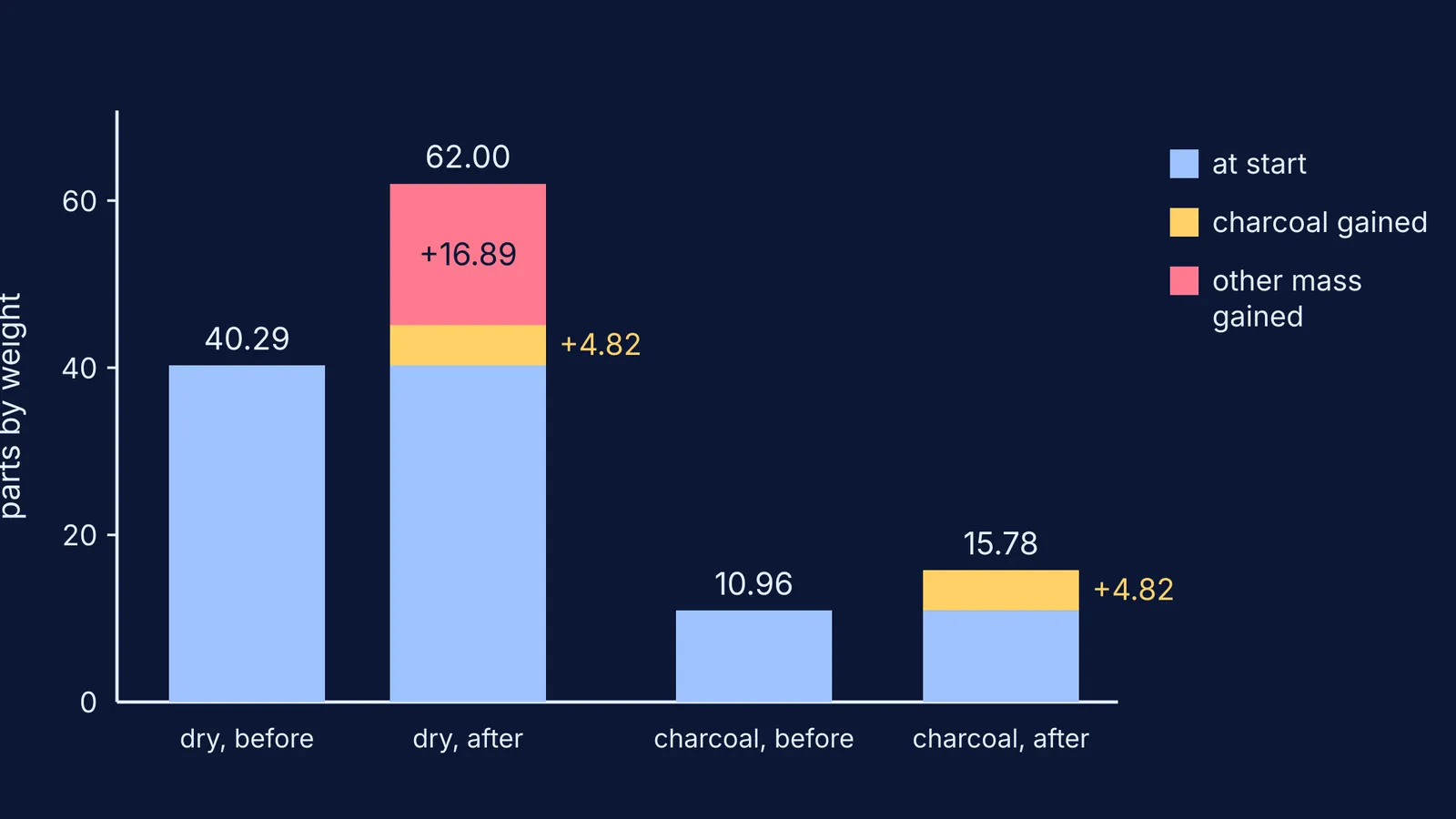
His peppermint experiment in the same book (pages 50–52) is the one to remember. He rooted peppermint (*Mentha piperita*) in bottles of distilled water on a sunny outside window ledge, sheltered from rain, for two and a half months. With no soil, whatever the plants gained came from air and water. His numbers, per 100 parts by weight of fresh mint:
At the start, 100 parts of fresh mint held 40.29 parts of dry matter, which gave 10.96 parts of charcoal.
After two and a half months, the dried plants weighed 62 parts. Gain in dry matter: 62 − 40.29 = 21.71 parts.
They now gave 15.78 parts of charcoal. Gain in charcoal: 15.78 − 10.96 = 4.82 parts.
Divide: 21.71 ÷ 4.82 ≈ 4.5. For every part of new charcoal, the plant added about 4.5 parts of new dry matter.
The other 16.89 parts were not charcoal. With no soil present, that extra mass had to come from the air and the water.
In his chapter on water (pages 225–228), Saussure stated the conclusion: plants grown in air with added carbon dioxide gained more dry matter than they took from the carbon dioxide, and plants take the oxygen and hydrogen of water into their own substance. Carbon dioxide and water go in, light drives the change, plant matter and oxygen come out. Today the overall equation is written, in simplified form, as CO₂ + H₂O + light → O₂ + {CH₂O}, as in the Govindjee and Krogmann review.
What did he get wrong, and who finished the story?
Saussure did not think plants split water and release its oxygen directly (page 228); he traced the oxygen given off to carbon dioxide. Later, Cornelis van Niel argued that the oxygen comes from water, a story told in Cornelis van Niel and where the oxygen in photosynthesis comes from. The other half, what the plant makes with the carbon, came from Julius Sachs, in the starch test that showed how leaves make food. For the step before Saussure, read Jan Ingenhousz and the light that lets plants purify air.
Saussure also showed that plants take nitrogen from the soil in dissolved, combined form and need minerals such as potassium and phosphorus, according to the same summary of his work.
How can you use this in a biology answer?
"Where does a tree's mass come from?" tests whether you can link the equation to evidence. A checklist:
Name the inputs: carbon dioxide from the air and water from the roots, with light as the energy source.
Name the evidence: Saussure, 1804, weighed plants and gases instead of only watching them.
Give one number: in Saussure's 1804 book, peppermint in distilled water gained 21.71 parts of dry matter but only 4.82 parts of charcoal.
Draw the conclusion: Saussure reasoned that plants build the hydrogen and oxygen of water into their own substance.
Add the limit: soil supplies nitrogen and minerals, not the bulk of the mass.
For a viva, say: "Saussure's mint gained about four and a half times as much dry mass as charcoal, so a plant is built mainly from carbon dioxide and water, not soil."
If photosynthesis still feels like a list of words, the Fermi Concept Library gives every biology concept its own lesson and shows its place in the map. To practise ratio problems like the mint calculation, the Fermi Problem Library has worked problems with a step-by-step solver that explains the reasoning rather than printing an answer.
Next time you water a plant, some of that water will become part of the plant.