

On this page
When a NEET question mentions the acid-insoluble fraction, it is pointing at one simple lab step: grind living tissue in acid, strain it and look at what passes through and what stays behind. Once you can picture that step, many questions on this topic come down to sorting molecules by size, plus one exception you need to remember.
What is the acid-soluble pool and the acid-insoluble fraction?
The Biomolecules chapter of NCERT Class 11 Biology describes the experiment. You take any living tissue, such as a vegetable or a piece of liver, and grind it in trichloroacetic acid (Cl3CCOOH) with a mortar and pestle until you get a thick slurry. Then you strain the slurry through cheesecloth or cotton.
Filtrate = acid-soluble pool. This is the liquid that passes through.
Retentate = acid-insoluble fraction. This is the material left on the cloth.
According to the same chapter, scientists have found thousands of organic compounds in the acid-soluble pool, which represents roughly the cytoplasmic composition. Macromolecules from the cytoplasm and organelles end up in the acid-insoluble fraction. Together, the two fractions represent the entire chemical composition of the tissue.
What does each fraction contain?
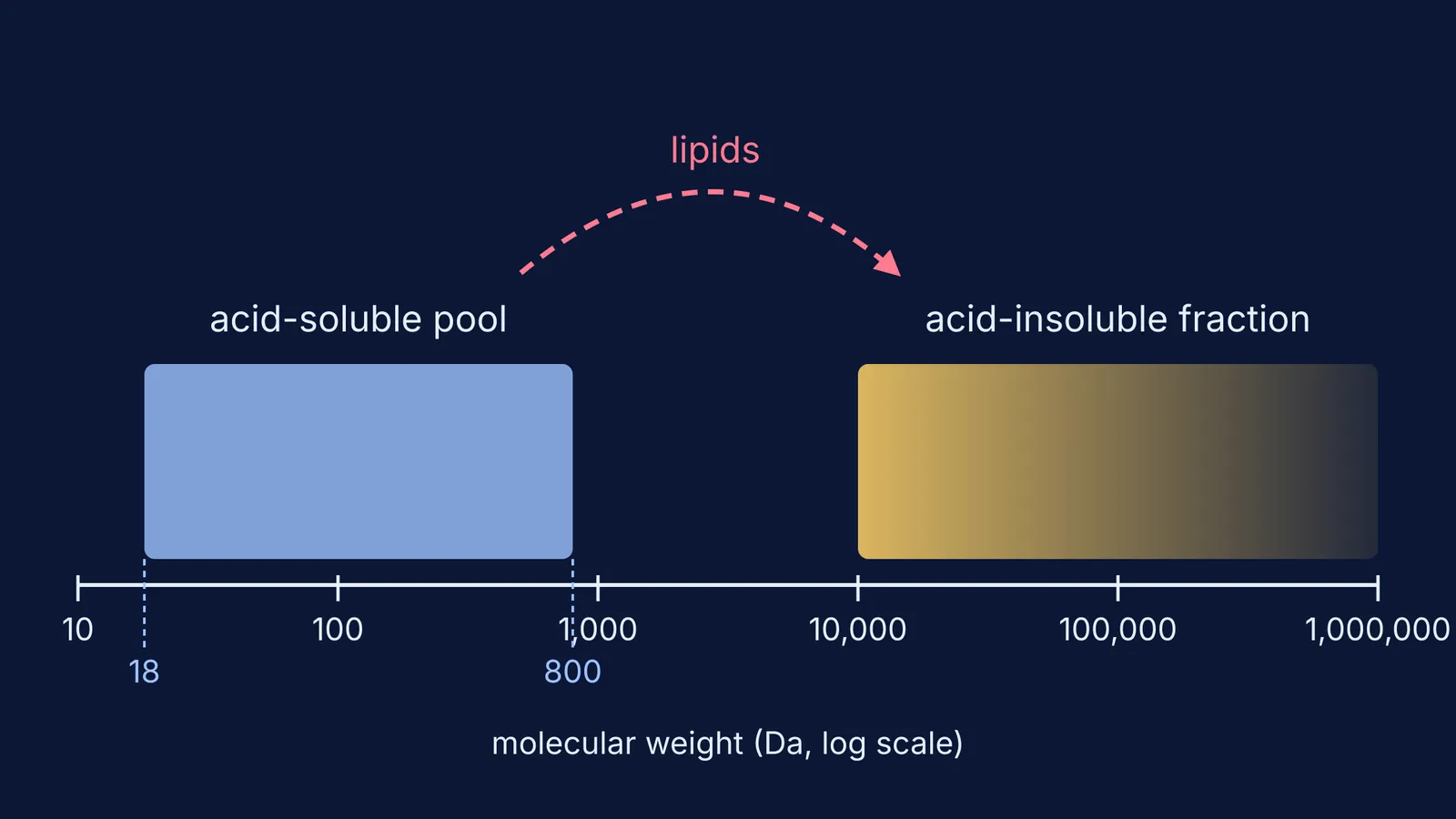
In NCERT's words, compounds in the acid-soluble pool have molecular weights from 18 to around 800 daltons (Da). The chapter's figure of small molecules in living tissue shows the kind of thing you find here: sugars such as glucose and ribose, amino acids, nitrogen bases, nucleosides and nucleotides. Inorganic compounds such as sulphate and phosphate are also seen in the acid-soluble fraction.
The acid-insoluble fraction holds only four types of organic compounds: proteins, nucleic acids, polysaccharides and lipids. Apart from lipids, these have molecular weights of 10,000 Da and above, so NCERT calls them biomacromolecules. Compounds below 1,000 Da are called micromolecules, or simply biomolecules.
The same chapter gives the average composition of cells as a percentage of total cellular mass:
Water: 70-90
Proteins: 10-15
Nucleic acids: 5-7
Carbohydrates: 3
Lipids: 2
Ions: 1
Why do lipids end up in the acid-insoluble fraction?
This is the exception to remember. NCERT states that lipids have molecular weights that do not exceed 800 Da, so by size they belong in the soluble pool. They don't end up there because lipids are also arranged into structures: the cell membrane and the other membranes inside the cell.
Grinding breaks these membranes into pieces. The pieces form vesicles that are not water soluble, so they get separated along with the acid-insoluble material (NCERT, Biomolecules). That is why the textbook says lipids are not strictly macromolecules.
How does trichloroacetic acid make proteins come out of solution?
NCERT doesn't explain the chemistry, but biochemists still use trichloroacetic acid (TCA) to precipitate proteins when preparing samples for analysis. A 2009 study in Protein Science looked at how this works. It found that TCA precipitation curves are U-shaped and that TCA is significantly less effective at precipitating unfolded proteins. Using a test protein called acidic fibroblast growth factor, the authors found that a partly folded, molten globule-like form builds up most at 5% (w/v) trichloroacetate. They concluded that precipitation happens through the reversible clumping of these partly folded forms.
That study looked at proteins only. For exams, you need the textbook outcome: the large molecules stay on the cloth, while small molecules stay dissolved and pass through.
How do you sort a molecule in an exam question?
Ask three questions in order:
Is it a lipid or part of a membrane, such as a phospholipid? Then it goes to the acid-insoluble fraction.
Is it a polymer: a protein, nucleic acid or polysaccharide? Then it goes to the acid-insoluble fraction.
Otherwise it is a small molecule or an ion, so it goes to the acid-soluble pool.
Worked example. Sort these: glucose, alanine, adenylic acid, phosphate, starch, DNA, trypsin, lecithin.
Glucose: sugar monomer, acid-soluble pool.
Alanine: amino acid, acid-soluble pool.
Adenylic acid: a nucleotide, acid-soluble pool. Watch this one: nucleotides are small, and only nucleic acids are macromolecules.
Phosphate: inorganic ion, acid-soluble pool.
Starch: polysaccharide, acid-insoluble fraction.
DNA: nucleic acid, acid-insoluble fraction.
Trypsin: an enzyme, so a protein, acid-insoluble fraction.
Lecithin: a membrane phospholipid, acid-insoluble fraction (the lipid exception).
Primary metabolites such as amino acids and sugars sit in the acid-soluble pool. Our post on primary and secondary metabolites picks up from there. For the big molecules, see how glycosidic links build starch and cellulose and how protein structure goes from primary to quaternary.
If the idea of a polymer still feels fuzzy, the Fermi Concept Library gives each biology and chemistry concept its own lesson and shows its place in the map. To practise sorting questions like these, the Fermi Problem Library has worked problems with a step-by-step solver that explains the reasoning rather than printing an answer.


