On this page
In January 1928 Frederick Griffith published a long paper in the Journal of Hygiene, The Significance of Pneumococcal Types, which opens with the types of pneumococci he found in sputum from pneumonia patients. Tucked inside it was an odd result: a harmless strain picked up a deadly trait from bacteria that had already been killed. That result opens the section on the search for genetic material in the NCERT Class 12 chapter on the molecular basis of inheritance.
What were the S and R strains in Griffith's experiment?
Griffith worked with *Streptococcus pneumoniae* (pneumococcus), the bacterium responsible for pneumonia, as the NCERT Class 12 Biology textbook describes it. On a culture plate, some cells grow into smooth, shiny colonies (S) and others into rough colonies (R).
The S strain has a mucous polysaccharide coat; the R strain does not (NCERT). If that coat is new to you, our explainer on the bacterial capsule and slime layer covers what it is. In mice, the S strain is virulent and the R strain is not.
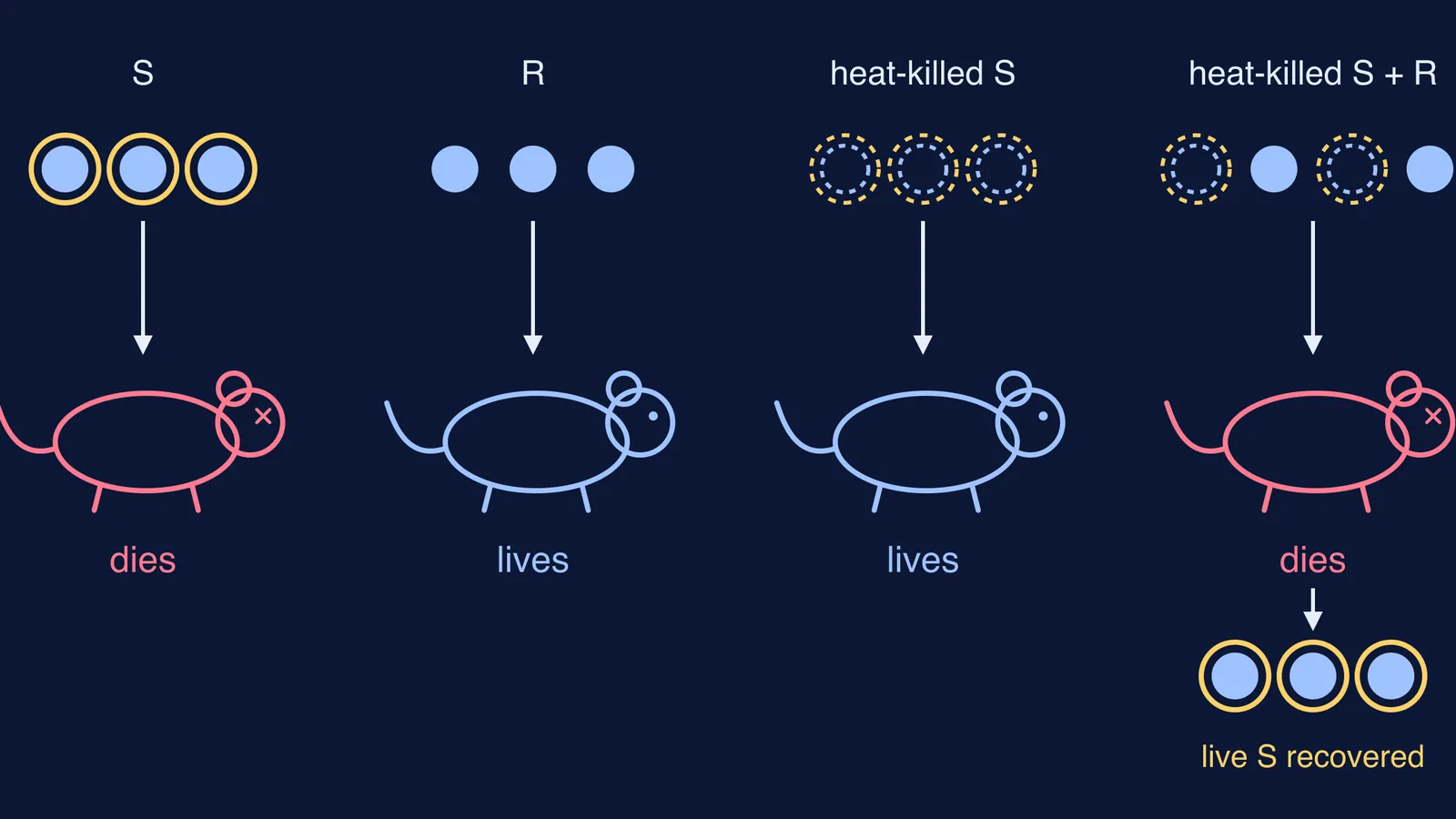
What were Griffith's four injections?
Read them as four questions, each a control for the next (see our post on control groups in biology experiments). Results as the NCERT textbook sets them out:
Live S strain into mice: the mice die. S is deadly.
Live R strain into mice: the mice live. R is harmless.
Heat-killed S strain into mice: the mice live. Dead S cells cannot cause disease.
Heat-killed S mixed with live R: the mice die, and living S bacteria are recovered from the dead mice.
Injection 4 is the surprise. Injections 2 and 3 had shown that neither ingredient could kill on its own. And the dead S cells had not come back to life: the living S cells in the mice had to come from the R cells, which now made a coat.
Griffith's paper adds a detail textbooks skip. He injected mice with an R strain derived from one type together with a large dose of another type killed by heating to 60 °C, and this "resulted in the formation of a virulent S pneumococcus of the same type as that of the heated culture."
What did 'transforming principle' mean?
Griffith concluded that the R bacteria had been transformed by the heat-killed S bacteria, and that some 'transforming principle' from the dead S strain enabled the R strain to make a smooth polysaccharide coat and become virulent, according to the NCERT textbook.
In 1928 the phrase was a name for an unknown. NCERT is direct about the limit: the biochemical nature of the genetic material was not defined from Griffith's experiments. What the result did show was that something survived the heat that killed the cells, which NCERT later points to as a sign that genetic material is stable.
Who proved the transforming principle was DNA?
Oswald Avery, Colin MacLeod and Maclyn McCarty took up the question. Their 1944 paper in the Journal of Experimental Medicine (abstract) reports that, within the limits of their methods, the active fraction purified from Type III pneumococci contained no demonstrable protein and consisted "principally, if not solely" of a highly polymerized, viscous form of desoxyribonucleic acid (DNA).
The NCERT textbook gives the enzyme logic: protein-digesting enzymes and RNA-digesting enzymes did not stop transformation, but DNase did. Not all biologists were convinced; NCERT credits the unequivocal proof to Alfred Hershey and Martha Chase (1952), working with bacteriophages. For why DNA rather than RNA is the usual genetic material, see our post on DNA vs RNA as genetic material.
How do you write Griffith's experiment in an exam answer?
A five-line frame that covers the steps of the experiment:
Organism and strains: *Streptococcus pneumoniae*; S has a polysaccharide coat and is virulent, R has none.
The four injections and results, drawn as a flow chart.
The key observation: living S bacteria recovered from mice given heat-killed S plus live R.
The conclusion: R was transformed by a 'transforming principle' from heat-killed S.
The limit: its chemical nature was not identified; Avery, MacLeod and McCarty showed it was DNA in 1944.
Mistakes that cost marks:
Writing that Griffith proved DNA is the genetic material. He did not.
Writing that the heat-killed S cells revived.
Leaving out the recovered living S bacteria, which is the evidence for transformation.
Mixing up Avery's enzyme experiments with Hershey and Chase's radioactive phages.
If transformation feels like a fact without a place, the Fermi Concept Library gives every concept in biology its own lesson and its place in the map. For practice, the Fermi Problem Library has worked problems with a step-by-step solver that explains the reasoning rather than printing an answer.
Next time you draw the four injections, add the recovered S cells to the last box. That one detail carries the whole argument.