

On this page
If you look at a bacterial cell from the outside in, the first structure you meet is often the glycocalyx. This external "sugar coat" is primarily made of polysaccharides or proteins, and it sits just outside the cell wall, as detailed in OpenStax Microbiology/03%3A_The_Cell/3.03%3A_Unique_Characteristics_of_Prokaryotic_Cells).
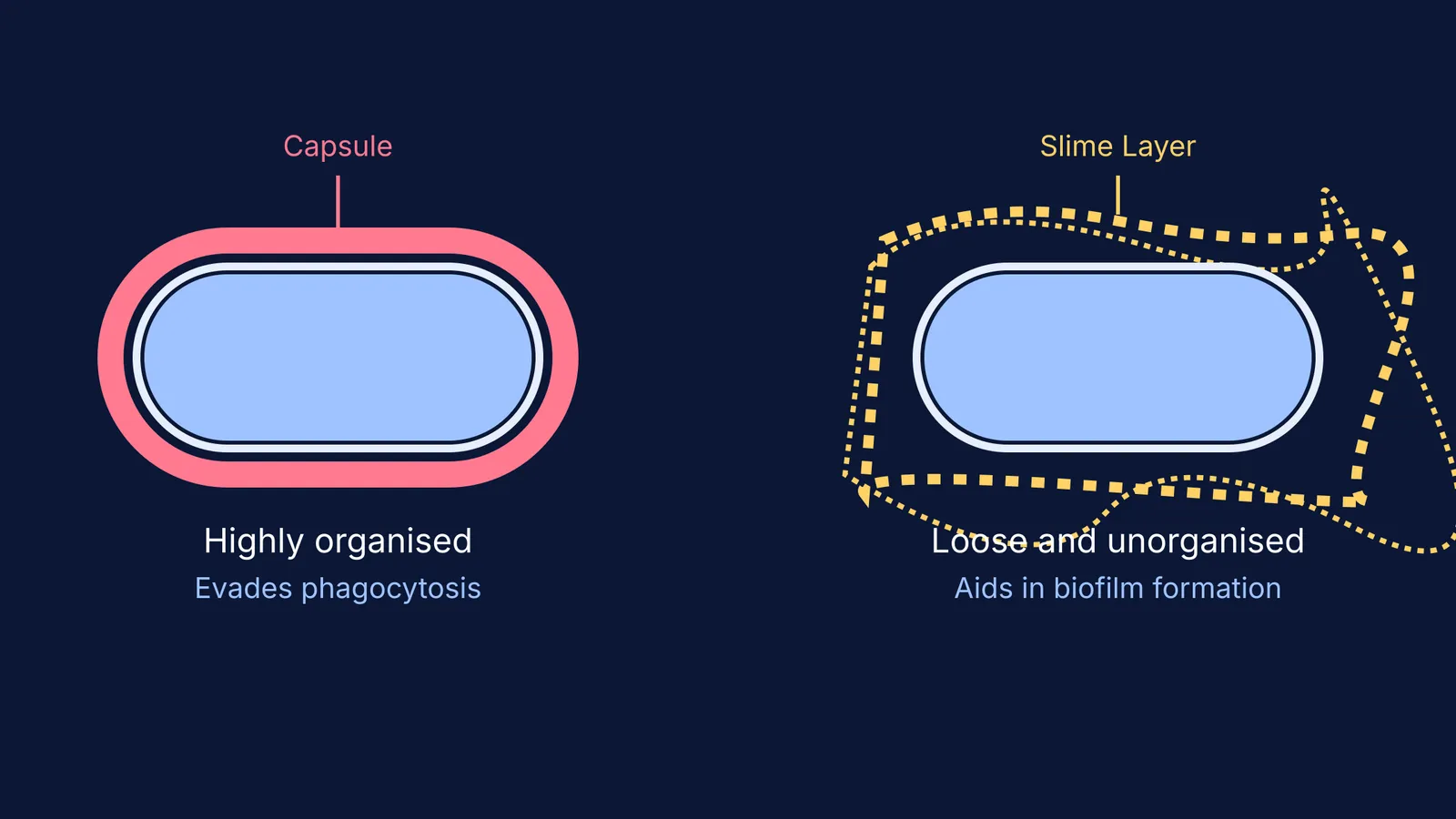
Its job is to interact with the environment, but it does not look the same on every microbe. Based on its thickness and organisation, the glycocalyx is classified as either a loose slime layer or a dense capsule.
What does the slime layer do?
A slime layer is unorganised, amorphous, and only loosely attached to the underlying cell wall OpenStax Microbiology/03%3A_The_Cell/3.03%3A_Unique_Characteristics_of_Prokaryotic_Cells). Because it is not tightly bound, it can be easily washed away.
Despite its loose structure, a slime layer is highly functional:
Biofilm formation: It allows bacteria to adhere to surfaces, aiding in the formation of biofilms.
Protection from desiccation: Biofilms hold water like a sponge, which prevents resident cells from drying out.
Chemical shielding: Biofilms hinder the action of antibiotics and disinfectants, protecting the cells from these threats.
When a bacterial colony establishes a biofilm, the shared environment protects the microbes. While bacteria build these defined cell envelopes, other biological entities challenge standard classifications entirely (see how viruses, viroids and lichens are grouped).
What makes a bacterial capsule different?
Unlike the less organised slime layer, a bacterial capsule is a highly organised layer that is located outside the cell wall OpenStax Microbiology/03%3A_The_Cell/3.03%3A_Unique_Characteristics_of_Prokaryotic_Cells).
Because it is an organised structure, the capsule is difficult to stain for microscopy. Instead, microbiologists typically use negative staining techniques. The dye stains the background but leaves the capsule as a visible, unstained region around the bacterial cell.
How does a capsule help the bacterium?
The most critical role of a capsule is in evading the host's immune system.
When a pathogen enters the human body, cells of the immune system try to detect and destroy it (a process known as phagocytosis). However, the structured capsule contributes to a microbe's pathogenicity by making the bacterium difficult for phagocytic cells to engulf and kill OpenStax Microbiology/03%3A_The_Cell/3.03%3A_Unique_Characteristics_of_Prokaryotic_Cells).
For example, *Streptococcus pneumoniae*, the bacterium that causes pneumonia, produces a capsule that is essential to its ability to cause disease.
If you are a student preparing for biology exams, tracing the exact mechanisms of host-pathogen interactions is crucial. In the Fermi Concept Library, you can find every concept in biology, each with its own lesson and its place in the map, so you can explore how cell envelopes dictate a microbe's survival.
Slime layer vs capsule: A summary for exam prep
Just as you must distinguish between the functions of the three RNA polymerases in eukaryotes, keeping the bacterial layers straight is essential. Focus on three key contrasts:
Organisation: The capsule is highly organised; the slime layer is less tightly organised.
Attachment: The capsule sits firmly as an organised layer; the slime layer is loosely attached and more easily washed off.
Primary role: The capsule acts as a virulence factor against phagocytic cells; the slime layer aids in adhesion and biofilm formation.
A practical checklist for studying bacterial structures
To ensure you have mastered this topic for your next test, run through this quick self-assessment checklist:
Can I define the term "glycocalyx" and identify its position relative to the cell wall?
Can I list the two main forms of the glycocalyx?
If asked about biofilms, do I immediately associate them with the slime layer and glycocalyx adherence?
If asked about pneumonia or evading immune cells, do I immediately associate it with the capsule?
Do I know which staining technique is used to visualise a capsule under a microscope?
If you ever find yourself struggling to check off these items, or if you get stuck on a microbiology question, try working it out with Fermi's AI tutor. The tutor teaches rather than answers: it works out what you already know and holds a line of reasoning across a session, checking your understanding as it goes.


