On this page
Many sperm swim towards the egg, yet a human egg must be fertilised by exactly one. The layer that makes this possible is the zona pellucida, the clear coat of glycoproteins around the egg. This post covers what happens when a sperm reaches it, how the egg shuts out the rest, and the lines you need for NEET.
What happens when the sperm contacts the zona pellucida?
The Class 12 NCERT chapter Human Reproduction (section 2.5, NCERT Biology, Chapter 2) gives the sequence you are examined on:
Sperm swim through the cervix and uterus to the ampullary region of the fallopian tube, where fertilisation takes place.
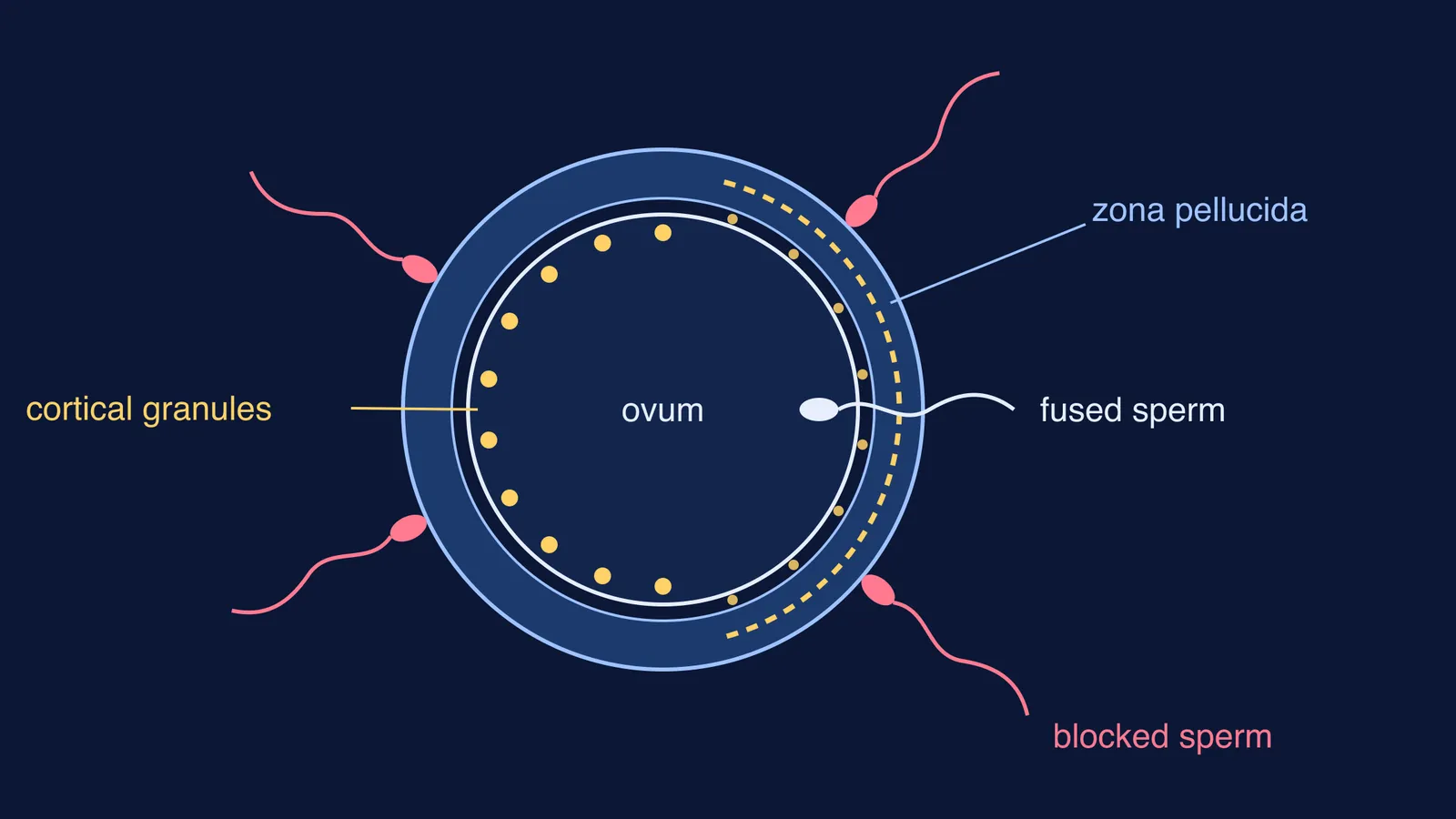
A sperm comes in contact with the zona pellucida layer of the ovum.
This contact induces changes in the membrane that block the entry of additional sperms, so only one sperm can fertilise the ovum.
Secretions of the acrosome help the sperm enter the cytoplasm of the ovum through the zona pellucida and the plasma membrane.
Sperm entry induces the secondary oocyte to complete its second meiotic division, which is unequal and forms a second polar body and a haploid ovum (ootid).
The haploid nuclei of sperm and ovum fuse to form a diploid zygote.
The sperm only reaches step 2 in a fit state because of changes it went through on the way. Our explainer on sperm capacitation and its timing covers that part.
How does the zona pellucida prevent polyspermy?
Polyspermy means more than one sperm fertilising the same egg. NCERT gives you one sentence on it. Research on mouse eggs points to two separate barriers behind that sentence.
The zona block. Just under the egg's surface sit cortical granules, small packets of enzymes and other proteins. After the first sperm fuses, they empty into the perivitelline space, the gap between the egg membrane and the zona. A 2012 study in the Journal of Cell Biology by Burkart and colleagues found that one granule enzyme, ovastacin, cuts the zona protein ZP2 (Burkart et al., 2012). Female mice lacking ovastacin did not cut ZP2 after fertilisation, and sperm bound to their two-cell embryos as well as they did to normal eggs. So cutting ZP2 is a key step in stopping later sperm from binding to the zona.
The membrane block. The egg membrane has a receptor, Juno, that pairs with the sperm protein Izumo1 so the two cells can fuse. In a 2014 Nature paper, Bianchi and colleagues reported that Juno is rapidly shed from the egg membrane after fertilisation, which suggests a mechanism for the membrane block to polyspermy (Bianchi et al., 2014).
Do humans have a fast block to polyspermy?
Accounts built on sea urchin and frog eggs describe two blocks: a fast electrical block, where the egg's membrane voltage changes, and a slower block from cortical granules. Do not carry the fast block over to mammals. A 2025 review in Frontiers in Cell and Developmental Biology says an electrical block has not been demonstrated in mammals, and that in mouse eggs the membrane potential remains constant for 60 minutes after insemination, suggesting there is no electrical block (Frontiers review, 2025). The same review describes the mammalian route: cortical granules release their contents and cause a zona reaction that reorganises the zona.
If a question says mammals rely on a rapid change in membrane voltage to stop polyspermy, treat it with suspicion.
What does NEET ask about the block to polyspermy?
Before a test, check that each line comes back to you without looking:
Site of fertilisation: the ampullary region of the fallopian tube.
Contact that sets off the block: the sperm meets the zona pellucida layer of the ovum.
Result of contact: membrane changes that block additional sperms, so only one sperm fertilises the ovum.
How the sperm gets through: acrosome secretions.
What sperm entry triggers: completion of meiosis II in the secondary oocyte and formation of the second polar body.
A worked assertion-reason example
Assertion: Only one sperm can fertilise a human ovum. Reason: Contact of a sperm with the zona pellucida induces changes that block the entry of additional sperms.
Ask three questions. Is the assertion true? Yes, NCERT says so. Is the reason true? Yes, it is NCERT's own sentence. Does it explain the assertion? Yes. Answer: both true, and the reason is the correct explanation.
Now change the reason to "Acrosome secretions help the sperm enter the ovum." That is true, but it explains how one sperm gets in, not why the others stay out. Both statements are true, and the reason is not the correct explanation. Our guide to assertion-reason traps in human reproduction has more pairs built like this.
If you mix up the corona radiata, the zona and the perivitelline space, look up each layer in the Fermi Concept Library, which covers concepts in biology, physics, chemistry and mathematics. If you do not know where to begin with this chapter, Fermi's AI tutor can work out what you already know and build a plan for the session.
To see how other animals handle fertilisation, read our post on internal vs external fertilisation.