

On this page
Every animal that reproduces sexually has to get one sperm to one egg. The only question is where that meeting happens: inside the mother's body, or outside it, usually in water. That single difference explains why a frog leaves a pond full of jelly while a hen lays one egg at a time, and it is a distinction that school and NEET-UG biology both test.
What is the difference between internal and external fertilisation?
The NCERT Class 8 chapter Reproduction in Animals gives the definitions you are expected to know.
Fertilisation is the fusion of a sperm and an ovum; their nuclei fuse to form a single nucleus, giving a fertilised egg called the zygote.
Internal fertilisation is fertilisation that takes place inside the female body. NCERT's examples are humans, cows, dogs and hens.
External fertilisation is the fusion of a male and a female gamete outside the body of the female. NCERT calls it very common in aquatic animals such as fish and starfish.
For what comes next, see our explainer on zygote, embryo and foetus.
Which animals use external fertilisation?
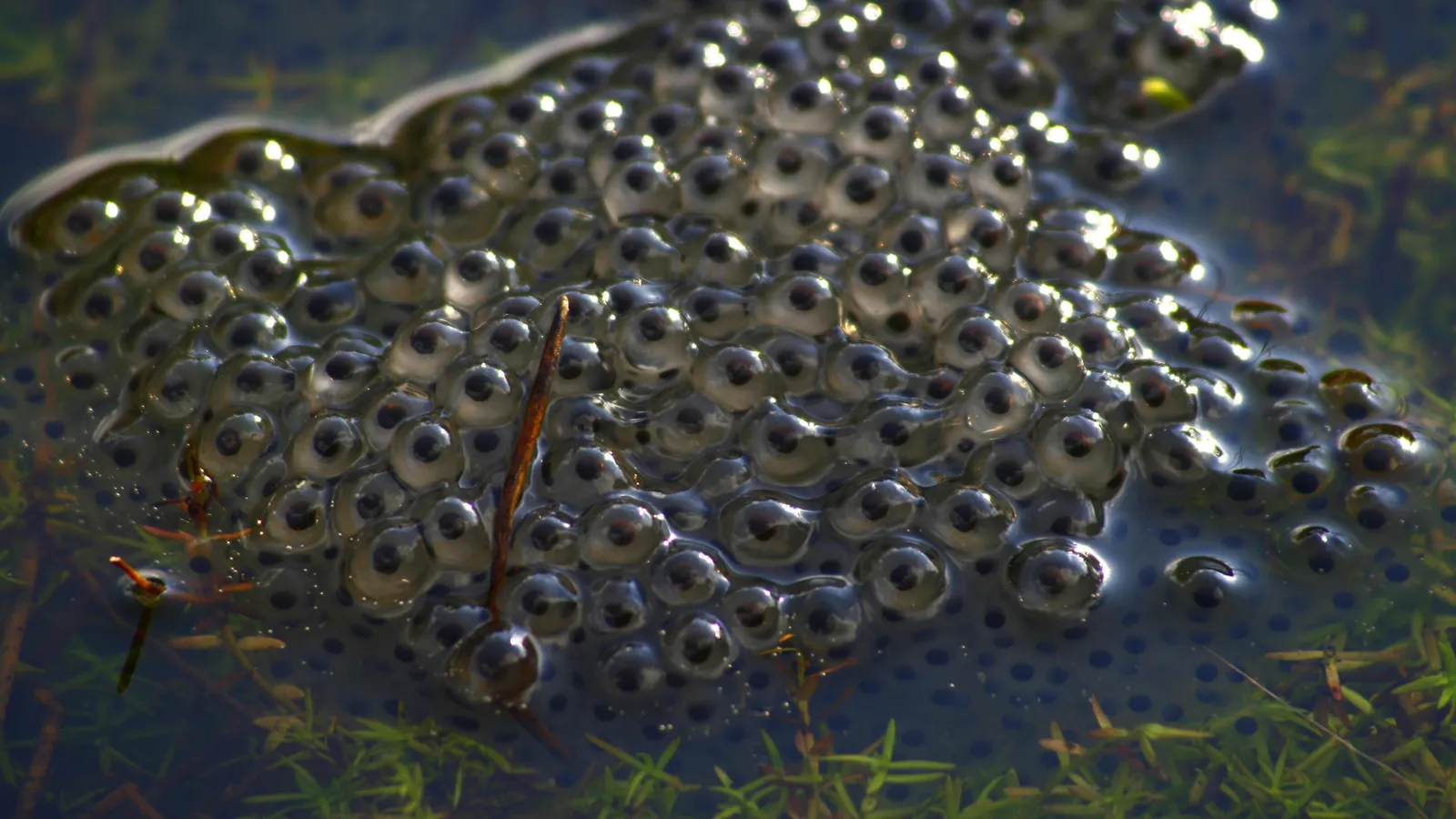
The frog is the textbook case. In the rainy season or spring, frogs and toads move to ponds and slow-flowing streams; the female lays hundreds of eggs and the male deposits sperm over them, according to the same NCERT Class 8 chapter. The eggs have no shell, only a layer of jelly that holds them together.
The Class 11 chapter Animal Kingdom extends this to whole groups. In Amphibia, "Fertilisation is external." In bony fish (Osteichthyes), such as rohu and katla, fertilisation is usually external. For why frogs stay tied to water in other ways too, see our post on how amphibians live a dual life.
Why do external fertilisers lay so many eggs?
NCERT's Class 8 chapter gives the reason in plain terms: eggs and sperm left in a pond are exposed to water movement, wind and rainfall, and other animals in the pond may feed on the eggs. Producing a large number of eggs and sperm is what makes sure at least a few are fertilised.
NOAA Fisheries states that larger female Atlantic cod can produce 3 to 9 million eggs when they spawn (NOAA species page).
Internal fertilisation avoids much of that loss. Sperm meet the egg inside the female, and the developing young are usually better protected, so far fewer eggs are needed. In humans, a single mature egg is released into the oviduct by one of the ovaries every month (NCERT Class 8).
Do birds and humans both use internal fertilisation?
Yes. A hen lays eggs, but fertilisation happens inside her body first. NCERT's Class 8 chapter explains that the zygote divides as it travels down the oviduct, protective layers form around it, and the hard shell is one of them; the embryo then takes about 3 weeks to become a chick.
The Class 11 Animal Kingdom chapter states that fertilisation is internal in reptiles, birds and mammals. Reptiles and birds are oviparous (egg-laying); mammals are viviparous with a few exceptions, such as the egg-laying platypus. Cartilaginous fish such as sharks and dogfish are the classic surprise: they are fish, yet they have internal fertilisation, and many of them are viviparous.
Our post on oviparous vs viviparous animals covers the second pair of terms in detail.
How do you sort any example in 30 seconds?
Ask three questions, in order.
Where do sperm and egg meet? Inside the female's body means internal; in water or outside the body means external.
Is there a hard shell? In a hen the shell forms in the oviduct after fertilisation, so a hard-shelled egg like a bird's points to internal fertilisation.
Is it one of NCERT's named exceptions? Sharks and dogfish (fish, but internal) and the platypus (mammal, but lays eggs) are the ones NCERT singles out.
Five NCERT examples, sorted:
Frog: eggs laid in water, sperm deposited over them, no shell. External.
Rohu: a bony fish; fertilisation is usually external.
Shark: a cartilaginous fish; males have claspers and fertilisation is internal.
Hen: shell formed in the oviduct after fertilisation. Internal, and oviparous.
Human: one egg released each month, fertilised in the female body. Internal, and viviparous.
One trap to watch: IVF, or in vitro fertilisation, joins a human egg and sperm outside the body, and the zygote is allowed to develop for about a week before it is placed in the mother's uterus (NCERT Class 8). It is a medical technique; humans remain internal fertilisers.
If these terms keep blurring together, the Fermi Concept Library gives each concept in biology its own lesson and its place in the map. When you want practice, the Fermi Problem Library has worked problems with a step-by-step solver that explains the reasoning rather than printing an answer.
Next time you see frog spawn in a monsoon puddle, count the eggs you can see. Then ask how many will become frogs.


