

On this page
Understanding how different species reproduce is a foundational topic in biology. When preparing for exams, classifying animals by their reproductive strategies requires knowing not just the primary categories, but also the notable exceptions. The animal kingdom primarily splits reproduction into two main strategies: egg-laying and live-bearing.
What are oviparous animals?
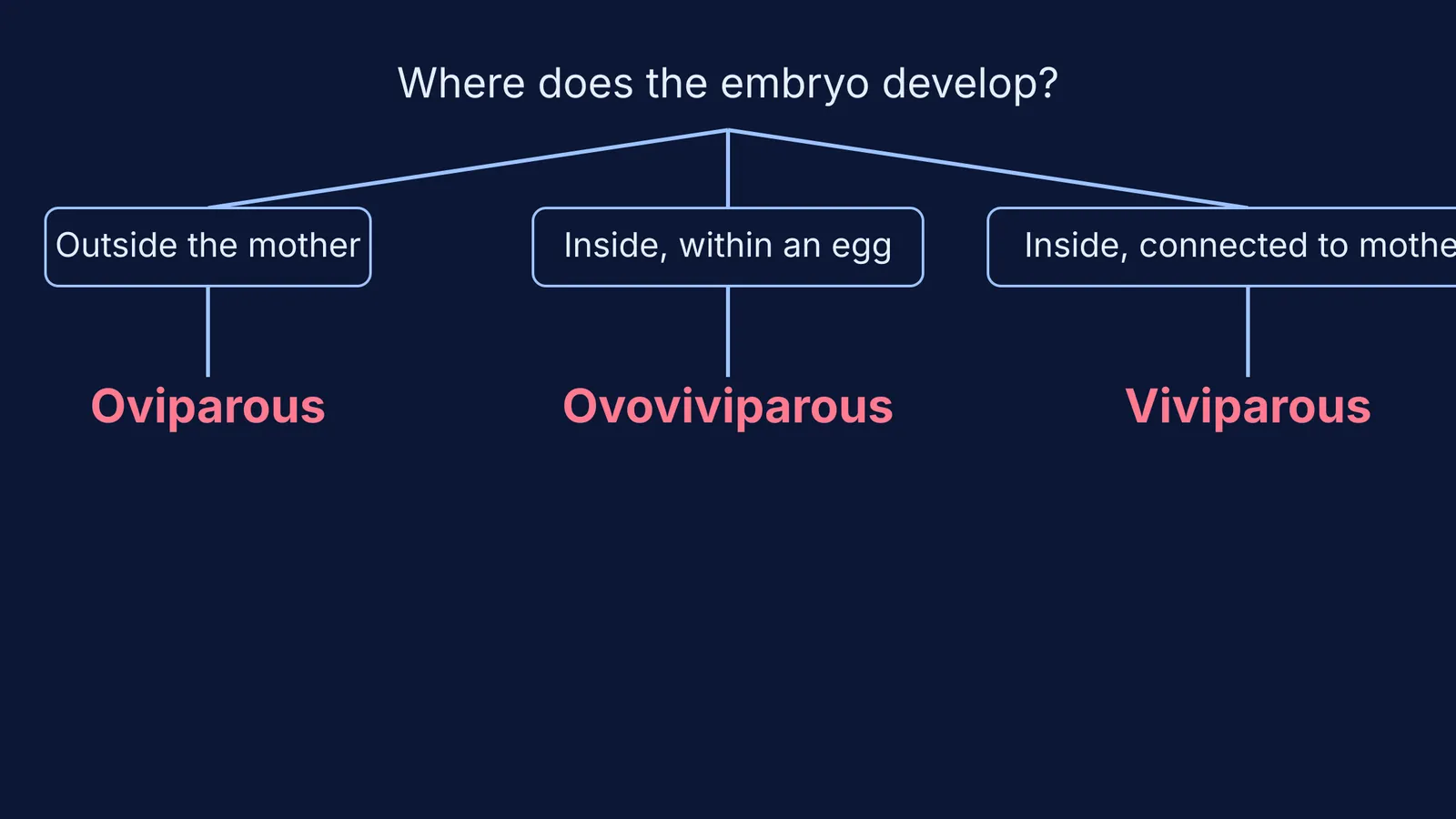
Oviparous animals are those that reproduce by depositing either unfertilised or fertilised eggs outside the body (Wikipedia). Once laid, these eggs are metabolically independent incubation organs. The embryo develops entirely outside the mother's body, relying exclusively on the egg's yolk for the nutrients it needs to grow.
Because the eggs are exposed to the external environment, oviparous species often lay a large number of eggs at once to ensure that at least a few survive predators and weather conditions. This reproductive strategy is the most common across the animal kingdom. All birds, most reptiles, amphibians, and most arthropods are oviparous. For example, frogs spawn many soft eggs in water, while birds lay hard-shelled eggs in nests.
When you are mapping out animal taxonomy, grouping these species by shared traits is a common exam pattern. You can explore these phylogenetic relationships interactively in the Fermi Concept Library, which maps out the evolutionary branches of biology.
What are viviparous animals?
In contrast, viviparity is the development of the embryo inside the body of the mother. In this mode of reproduction, the maternal circulation provides for the metabolic needs of the developing embryo until the mother gives birth to a juvenile (Wikipedia).
Viviparous animals do not rely on a standalone yolk sac. Instead, nutrients and oxygen are typically transferred from the mother to the embryo through a specialized organ called a placenta. This method provides the embryo with a highly protected and stable environment, shielding it from external predators and temperature fluctuations during its most vulnerable stage of life.
This strategy is a defining characteristic of most mammals, including humans, dogs, and whales. It also appears in scattered branches of other animal groups, such as the skink *Pseudemoia entrecasteauxii* and a few specialised amphibians.
What is the difference between oviparous and viviparous animals?
The fundamental difference lies in where the embryo develops and how it gets its food.
Location of development: Oviparous embryos develop outside the mother in a sheltered egg, whereas viviparous embryos develop internally within the mother's reproductive tract.
Source of nutrition: An oviparous embryo eats the yolk packaged inside its shell. A viviparous embryo receives continuous nourishment directly from the mother's bloodstream.
Offspring survival: Oviparous species tend to invest less energy in individual offspring but produce many of them. Viviparous species produce fewer offspring but invest significant metabolic energy into protecting each one until birth.
If you struggle to recall these biological distinctions during tests, Fermi's AI tutor can work out what you already know and build a plan for the session, teaching you the underlying evolutionary reasons rather than just drilling vocabulary.
Are there mammals that lay eggs?
A common trick question in biology exams asks whether all mammals give live birth. The answer is no. While viviparity is the standard for mammals, there is a fascinating exception found in Australia and New Guinea.
There are exactly five extant species of monotremes, comprising the platypus and four species of echidnas, which are the only living mammals that lay eggs (Wikipedia). The platypus (*Ornithorhynchus anatinus*) is a semiaquatic mammal that deposits leathery eggs similar to those of reptiles. However, like all mammals, a female platypus still nurses her hatched young with milk produced by her body.
This exception often trips students up. Recognizing evolutionary misfits is a recurring theme in biology, much like understanding the classification of viruses, viroids and lichens.
What are ovoviviparous animals?
There is a third, intermediate reproductive strategy known as ovoviviparity. This is a bridging form of reproduction between egg-laying oviparous and live-bearing viviparous methods.
In ovoviviparous species, the embryos develop inside eggs that are retained within the mother's body until they are ready to hatch. The key distinction from true viviparity is that these embryos are still metabolically independent; they feed entirely on their egg's yolk rather than taking nutrients from the mother's bloodstream. Once the yolk is depleted and development is complete, the eggs hatch internally, and the mother gives birth to live young.
This strategy offers the physical protection of the mother's body without the metabolic cost of a placenta. You will find ovoviviparity in certain sharks (such as the great white shark), various rays, and some snakes like the common garter snake.
Classifying animals by reproduction often overlaps with how they manage internal chemistry, such as why waste products differ between ammonotelic, ureotelic and uricotelic animals. By connecting these traits, you build a much stronger, interconnected understanding of the animal kingdom.


