

On this page
Every feature of amphibians in your textbook ties back to one idea: these animals spend part of their life in water and part on land. Here is each feature, why it fits that dual life, and a plan for writing the answer.
What are the main features of amphibians?
The NCERT Class 11 chapter Animal Kingdom (section 4.2.11.4) lists these features for Class Amphibia:
Can live in water and on land (Greek amphi, dual, and bios, life).
Most have two pairs of limbs; the body is divided into head and trunk, and some have a tail.
Moist skin without scales.
Eyes with eyelids, and a tympanum that works as the ear.
A cloaca: one chamber into which the gut, urinary and reproductive tracts open.
Breathing through gills, lungs and skin.
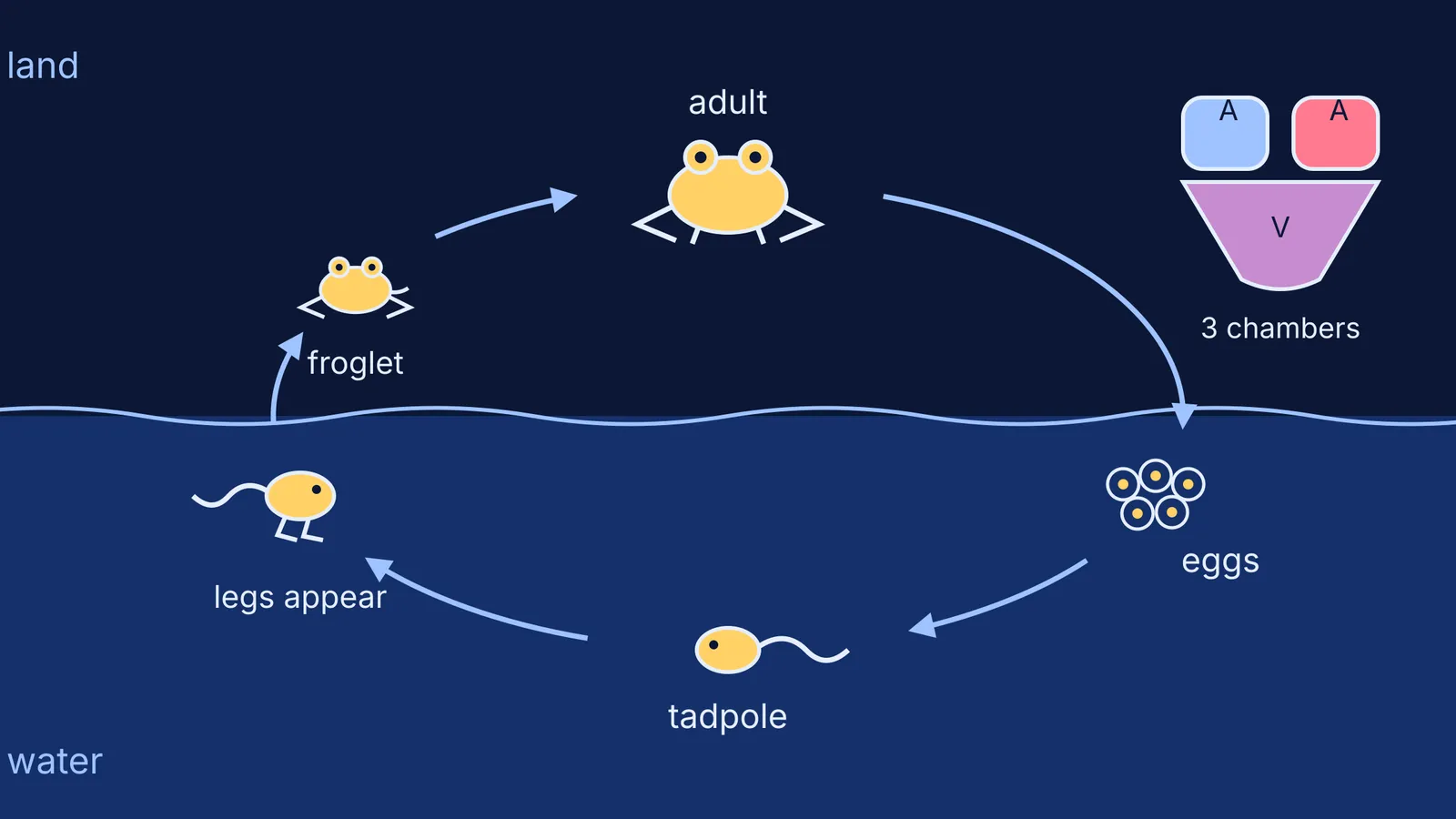
A three-chambered heart: two auricles and one ventricle.
Cold-blooded, with separate sexes.
External fertilisation; they lay eggs (oviparous) and development is indirect.
The same page gives the examples you should learn: Bufo (toad), Rana (frog), Hyla (tree frog), Salamandra (salamander) and Ichthyophis (a limbless amphibian).
Why is amphibian skin always moist?
Moist skin is a breathing surface. A review of cutaneous gas exchange by Martin Feder and Warren Burggren in Biological Reviews (1985) states that in many lower vertebrates the skin is the major or even the only route for respiration. They also noted that skin breathing is often most important in small animals, at cool temperatures and at low activity, and that the skin often handles carbon dioxide release more than oxygen uptake.
So when you write "moist skin" in an answer, add its purpose: it is a breathing surface. Compare reptiles, whose skin NCERT describes as dry and cornified, covered with scales.
Salamanders show how far this can go. AmphibiaWeb lists 523 species of lungless salamanders (family Plethodontidae), and it says every member of this family lacks lungs and relies on breathing through the skin.
How does a three-chambered heart work?
The NCERT chapter Body Fluids and Circulation explains it. The left atrium receives oxygenated blood from the gills, lungs or skin. The right atrium receives deoxygenated blood from the rest of the body. Both empty into a single ventricle, where the two streams mix, so the heart pumps out mixed blood. NCERT calls this incomplete double circulation.
For comparison, the same chapter says fishes have a two-chambered heart, while crocodiles, birds and mammals have four chambers. In birds and mammals, the two streams do not mix.
Why do frogs need water to lay eggs?
Amphibian fertilisation is external, so the eggs and sperm meet outside the body, usually in water, and what hatches is a tadpole that lives in water. The change from tadpole to frog is called metamorphosis. To see how the hormone thyroxine controls it, read our post on frog metamorphosis and thyroxine.
There are exceptions worth knowing. In the Western Ghats, researchers K. S. Seshadri, K. V. Gururaja and David Bickford described the frog Raorchestes chalazodes laying eggs inside hollow, living bamboo shoots. The eggs hatch straight into froglets, with no tadpole stage. The study appeared in the Biological Journal of the Linnean Society, and Mongabay reported on it. In exams, write the NCERT rule unless a question asks for an exception.
How do frogs, toads and salamanders differ?
AmphibiaWeb's species count shows how unequal the three amphibian groups are: on 27 October 2026 it listed 9,149 amphibian species. Of these, 8,068 were frogs and toads (Anura), 846 were salamanders and newts (Caudata), and 235 were caecilians (Gymnophiona), the limbless group that includes Ichthyophis.
Frog (Rana), tree frog (Hyla) and toad (Bufo): these belong to Anura, the largest group. For external features, see our frog morphology key points.
Salamander (Salamandra): belongs to Caudata; use it for NCERT's line that a tail may be present in some.
Ichthyophis: use it when a question asks for a limbless amphibian.
All three also share the three features every chordate has.
How should you write a 5-mark answer?
Use this plan for a question like "Give the characteristic features of Class Amphibia with two examples":
One opening line: amphi = dual, bios = life, so they live in water and on land.
Four or five features, each with the reason that links it to a dual life: moist skin for breathing, three ways to breathe, a three-chambered heart with mixed blood.
Reproduction: external fertilisation, eggs, indirect development through a tadpole.
Two examples with both names, such as Rana (frog) and Salamandra (salamander).
One labelled sketch if time allows: a frog, or a heart with two auricles and one ventricle.
If a term like cloaca or incomplete double circulation still feels fuzzy, the Fermi Concept Library has a lesson for each biology concept and shows where it sits on the map of related ideas. When you move on to past-paper questions, the Fermi Problem Library has worked problems with a step-by-step solver that explains the reasoning rather than printing an answer.


