

On this page
When you look at a sea squirt, a lancelet, and a human, they do not appear to have much in common. Yet, all three belong to the phylum Chordata.
While adult chordates are incredibly diverse, they are united by a specific body plan during their embryonic development. Recognizing this anatomical plan is a core part of the biology syllabus for board exams and NEET.
What are the fundamental features of chordates?
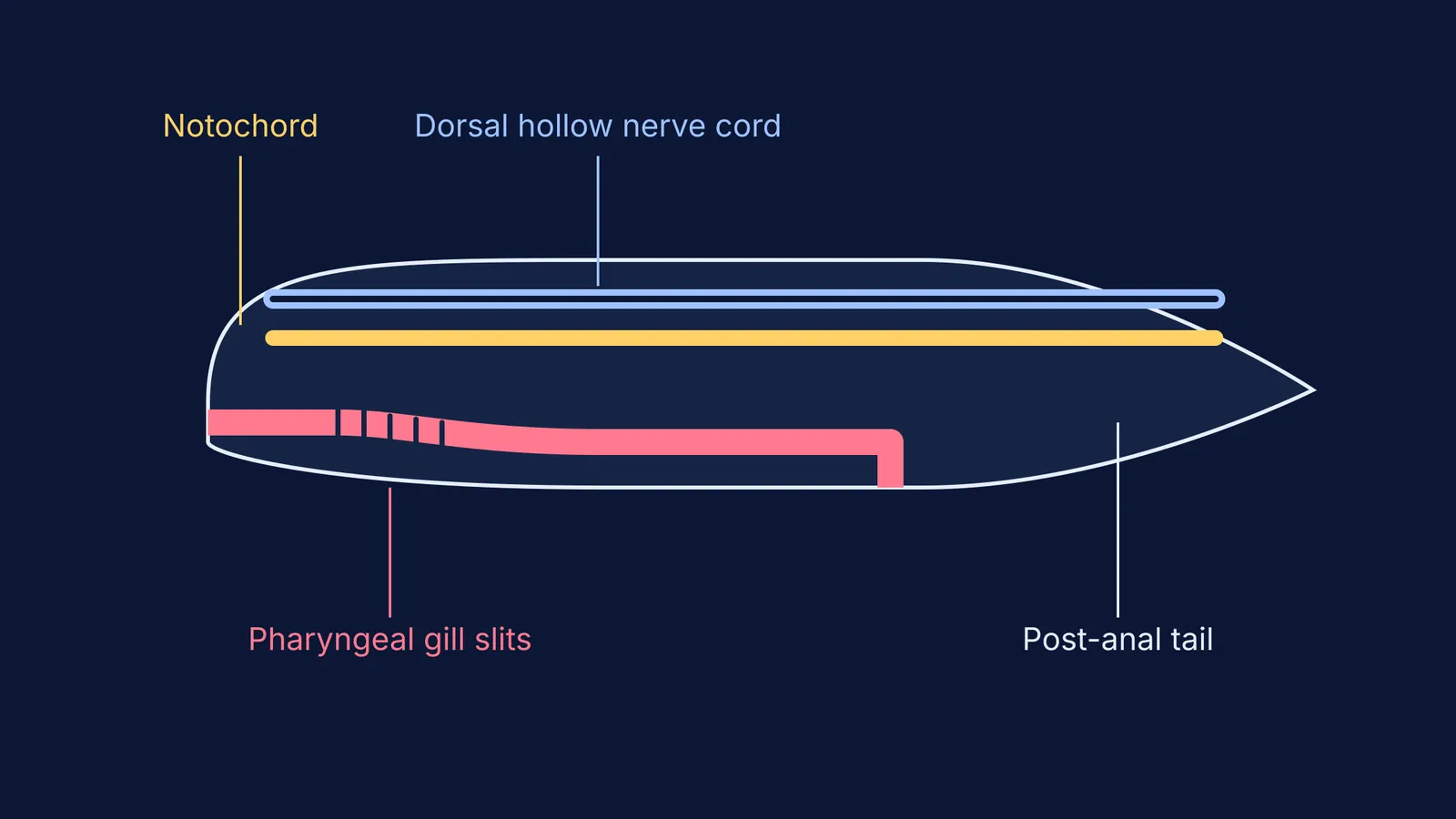
Biologists define the phylum Chordata by a set of primary anatomical structures that appear at some stage of the animal's life cycle. According to OpenStax Biology 2e, there are four defining features:
Notochord: This is a flexible, rod-shaped structure that provides primary skeletal support. It runs along the dorsal axis of the animal, just below the nerve cord. In vertebrates, it is present during embryonic development but is later replaced by the bony or cartilaginous vertebral column (spine) in adults. In most derived vertebrates, the embryonic notochord actually becomes the nucleus pulposus of the intervertebral discs that cushion your vertebrae.
Dorsal hollow nerve cord: Derived from the ectoderm during embryonic folding, this hollow tube sits above the notochord. In vertebrates, the front end of this cord enlarges and differentiates to develop into the brain, while the remainder becomes the spinal cord, together forming the central nervous system.
Pharyngeal gill slits: These are paired openings located in the pharynx, which is the region of the throat just behind the mouth. In aquatic chordates, these slits allow water that enters the mouth during feeding to exit the body without passing through the entire digestive tract. In land-dwelling tetrapods like mammals and birds, the slits are heavily modified during embryonic development into components of the inner ear, tonsils, and thymus gland.
Post-anal tail: This is a posterior elongation of the body that extends past the anus. It contains skeletal elements and blocks of muscle. In many aquatic species, the post-anal tail provides the powerful sweeping locomotion needed to swim, but in humans, it is reduced to a small vestigial tailbone (the coccyx) that helps anchor pelvic muscles.
*Over 62,000 living species of vertebrates exist today.* Source
If you find yourself stuck while reviewing these anatomical plans, the Fermi Concept Library provides a unified index of definitions, formulas and solved examples, letting you quickly verify concepts.
How do chordates differ from non-chordates?
Exam questions frequently ask you to contrast chordates with non-chordates (invertebrates). The differences go beyond just having a backbone. According to OpenStax Biology 2e, the major distinctions are:
Nerve cord structure: Non-chordate phyla typically possess solid nerve cords that are located either ventrally or laterally. This contrasts with the dorsal hollow nerve cord of chordates.
Gill slits and tail: Non-chordates lack both pharyngeal gill slits and a post-anal tail. In most invertebrates, the digestive tract usually ends right at the terminal tip of the body, meaning there is no tail extending beyond the anus.
Why do we not see these features in humans?
It is easy to learn these features and then wonder where they are in your own body. The key is that these are embryonic features.
As a human fetus develops, the notochord is replaced by the bones of the spine. If you are curious about how these bones are classified, you can read our guide to the human skeleton: counting axial and appendicular bones. The dorsal hollow nerve cord thickens and differentiates into your brain and spinal cord. The pharyngeal slits become parts of your inner ear and neck tissues, and the post-anal tail shrinks into the coccyx.
Chordates also have specific ways of managing metabolic waste, which you can explore further in our breakdown of ammonotelic, ureotelic and uricotelic animals.
If you are preparing for a major exam and cannot figure out why you keep getting taxonomy questions wrong, Fermi's AI tutor can work out what you already know and build a plan for the session, keeping you focused on what matters.


