

On this page
Why is iodine necessary for tadpole metamorphosis?
Metamorphosis transforms an aquatic, gill-breathing tadpole into a four-legged, lung-breathing adult frog. This transformation is governed by the thyroid gland, which produces thyroxine (T4) and triiodothyronine (T3). Because vertebrates cannot make elemental iodine, developing larvae must absorb inorganic iodide ions directly from pond water across their gills and skin. Inside thyroid follicles, iodide binds tyrosine residues on thyroglobulin to assemble thyroid hormones.
The experimental proof of iodine's specific chemical role was established over a century ago. In 1919, W. W. Swingle published findings in the Journal of General Physiology demonstrating that iodine is the active developmental trigger of the thyroid gland, showing that related halogens like bromine produce no metamorphic change in tadpoles. Without dissolved environmental iodine, the thyroid gland cannot manufacture functional thyroxine, bringing metamorphosis to a complete standstill.
How does thyroxine transform the tadpole body?
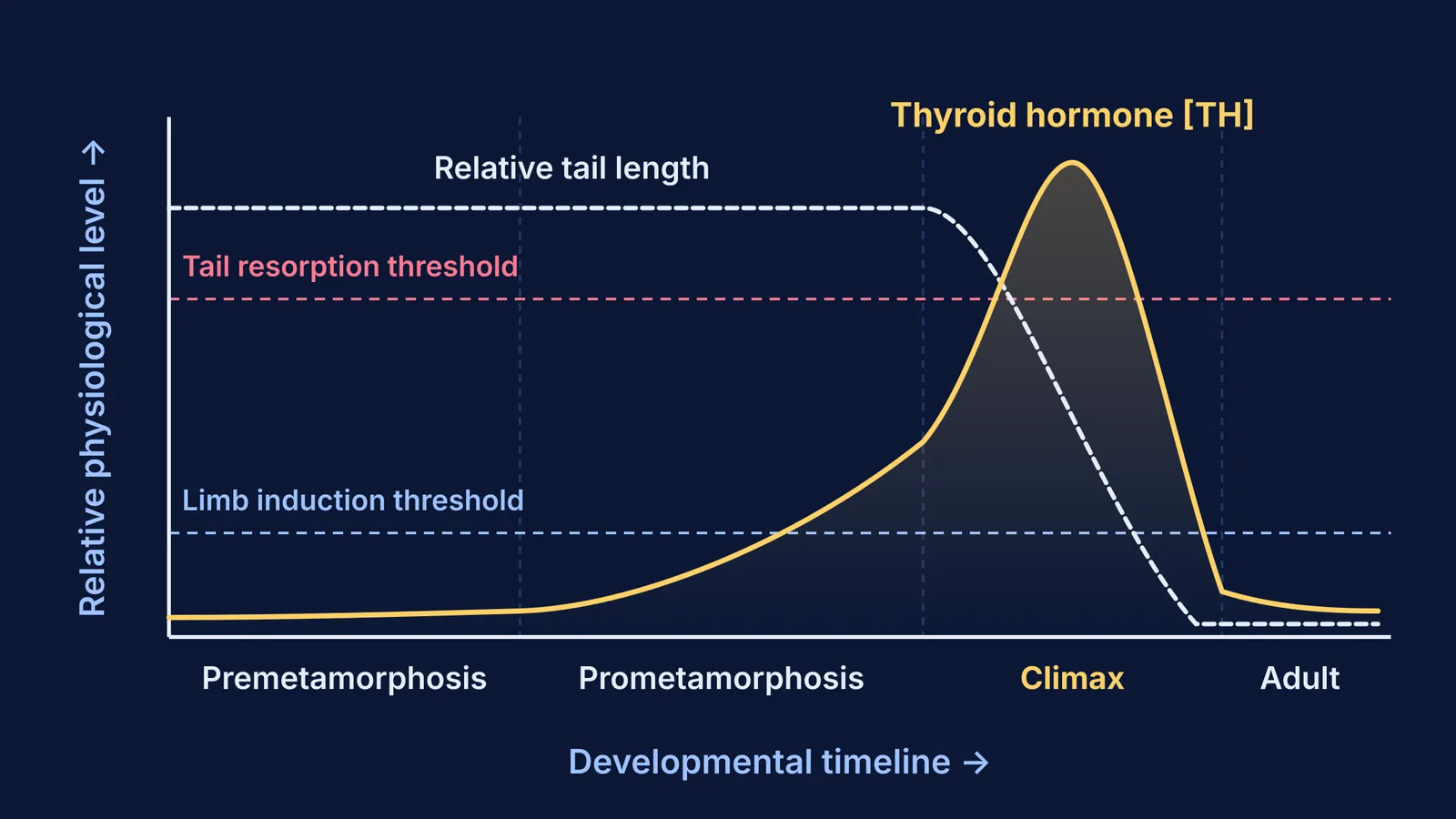
Thyroxine acts as an endocrine morphogen whose concentration dictates which developmental programs turn on. As the hypothalamus-pituitary-thyroid axis matures, circulating hormone levels rise from low baseline levels in premetamorphosis to a sharp peak at metamorphic climax. In a 2006 review in Molecular and Cellular Endocrinology, developmental biologist Jamshed R. Tata explained that thyroid hormone receptors (TRα and TRβ) bind triiodothyronine to turn on tissue-specific gene networks, with receptor autoinduction driving the speed of transformation during climax.
Different larval organs possess distinct sensitivity thresholds to circulating hormone levels:
Limb morphogenesis: Low hormone levels during early prometamorphosis stimulate cell division in dormant limb buds, causing hindlimbs to emerge first.
Respiratory remodeling: Rising hormone levels prompt the degeneration of branchial gills while driving lung maturation and skin vascularisation.
Tail resorption: High hormone levels at climax trigger apoptosis in the swimming tail, where matrix metalloproteinases break down collagen and macrophages clear cellular debris.
Digestive restructuring: Because tadpoles eat algae while frogs hunt insects, the herbivorous gut shortens dramatically. A study in the Proceedings of the National Academy of Sciences showed that over 8 days during metamorphic climax, the tadpole intestine shortens in length by 75%, driven by muscle contraction and epithelial apoptosis.
Excretory switch: Liver enzymes switch the animal from ammonotelism (excreting ammonia into water) to ureotelism (producing urea via the ornithine-urea cycle to conserve water on land).
Understanding these structural transitions is essential for competitive exams. For frog anatomy and histology for NEET, explore our guide to structural organisation in animals. When exploring how lipophilic hormones bind intracellular receptors to regulate gene expression, the Fermi Concept Library covers every concept in biology, each with its own lesson and its place in the map.
What happens if tadpoles grow without iodine?
When tadpoles hatch in water deficient in iodine, or when their thyroid glands are removed, normal metamorphosis stops. In 1912, J. F. Gudernatsch reported in Archiv für Entwicklungsmechanik der Organismen that feeding thyroid tissue to tadpoles triggered premature metamorphosis into miniature adult frogs. Four years later, Bennet M. Allen demonstrated in Science that surgically removing the thyroid gland or the anterior pituitary from *Rana pipiens* larvae permanently prevented metamorphosis.
Tadpoles denied iodine suffer an arrest in differentiation while continuing ordinary body growth. They fail to grow limbs, retain their gills and tails, and continue swimming as sterile "giant tadpoles." If iodine or synthetic thyroxine is restored to the water, the arrested larvae resume metamorphosis once thyroid hormone becomes available.
This dual requirement of an endocrine gland and an essential dietary mineral illustrates core principles of vertebrate physiology. You can review endocrine feedback loops in our guides to chemical coordination and hormones and hormone action receptors. If you are tackling multi-step questions on hormonal regulation, the Fermi Problem Library provides worked problems with a step-by-step solver that explains the reasoning rather than printing an answer.
How do you solve exam questions on frog metamorphosis?
Endocrine control of metamorphosis appears regularly in NCERT Class 8 Science, Class 11 Biology, and NEET-UG papers. Follow these four steps to analyse exam questions:
Identify the precursor and gland: Recognise that iodine is an inorganic trace element absorbed from water, serving as the required substrate for the thyroid gland to synthesise thyroxine (T4) and triiodothyronine (T3).
Apply the concentration threshold rule: Differentiate between low-threshold changes (early hindlimb emergence during prometamorphosis) and high-threshold changes (rapid tail resorption and gill loss at climax).
Classify tissue fates by mechanism: Separate constructive morphogenesis (limbs, lungs) from destructive apoptosis (tail shrinkage, gill regression).
Predict experimental outcomes: If water lacks iodine or the thyroid is removed, deduce metamorphic arrest leading to a giant tadpole; if thyroxine is added early, deduce precocious miniature frogs.
Practising these distinctions builds confidence across developmental anatomy. When you sit down to test your knowledge, Fermi's AI tutor notices where a student is stuck and decides whether to explain, ask, or show.


