

On this page
Assertion-reason questions look like one-mark gifts, but in human reproduction they test whether you know exactly when something happens and which hormone causes it. In CBSE's Class XII Biology sample question paper for 2026-27, questions 13 to 16 are assertion-reason items. The first of them compares spermatogenesis with oogenesis. Its reason says oogenesis begins in the embryonic stage, is arrested at prophase I, resumes after puberty and is arrested again at metaphase II. The official marking scheme gives option A: both statements are true and R explains A.
How do assertion-reason questions on human reproduction trick you?
The CBSE paper uses four fixed options: (A) both true and R explains A; (B) both true but R does not explain A; (C) A true, R false; (D) A false, R true. Run three checks, in this order:
Is A true? Read it word by word. Check every "always", "only", "before" and "after".
Is R true on its own, without looking at A?
If both are true, join them with "because": "A, because R". If the sentence describes a cause, the answer is A. If it just puts two facts side by side, the answer is B.
Option B is easy to miss. Two true facts from the same chapter can feel connected just because they sit on the same page.
Which gametogenesis timing traps should you watch for?
The trap here is mixing up the male and female timelines. According to OpenStax Anatomy and Physiology, spermatogenesis begins at puberty and continues throughout a male's life. The same source puts one production cycle, from spermatogonia to formed sperm, at about 64 days.
Oogenesis starts much earlier and stops twice. OpenStax describes oogonia forming and dividing during fetal development, with primary oocytes arrested in meiosis I until puberty. The number of primary oocytes falls from one to two million in an infant to about 400,000 at puberty (OpenStax). The cell released at ovulation is a secondary oocyte, and its meiosis finishes only if a sperm gets through its barriers.
If you want the two arrest points drawn out step by step, our guide to why oogenesis pauses at meiosis covers them. Arrest points also show up in assertion-reason questions on cell division.
Which hormone traps catch students?
One classic hormone trap swaps the target cells. In the testis, FSH acts mainly on Sertoli cells to promote spermatogenesis, and LH acts on Leydig cells to raise testosterone production (OpenStax). FSH also stimulates Sertoli cells to make inhibins, which reduce FSH release.
In the ovary, the LH surge triggers ovulation, and the corpus luteum then makes large amounts of progesterone. Without pregnancy, the corpus luteum stops secreting progesterone and breaks down into the corpus albicans (OpenStax). In pregnancy, the trophoblast secretes hCG, which directs the corpus luteum to survive and keep making progesterone and estrogen (OpenStax). For what the placenta adds later, see our explainer on placenta hormones hCG and hPL.
What timing traps hide in the menstrual cycle and implantation?
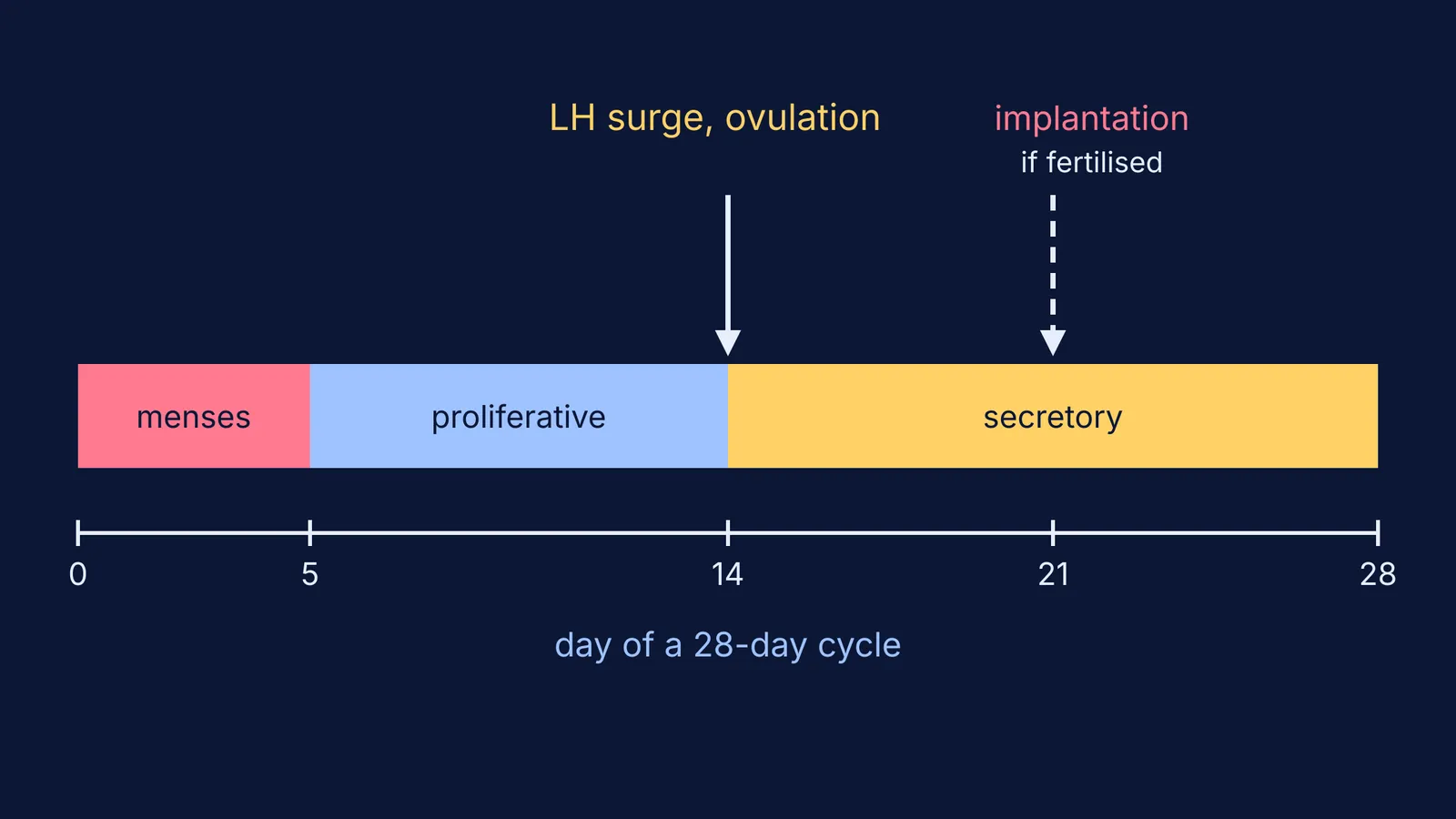
OpenStax describes a typical 28-day cycle, with menses averaging about five days, then the proliferative and secretory phases. Ovulation comes around day 14. Fertilisation typically takes place in the ampulla of the uterine tube, not the uterus. The blastocyst reaches the uterine wall and sticks to it at the end of the first week (OpenStax). Its inner cell mass becomes the embryo, and its outer trophoblast cells help with implantation.
Watch for statements that move an event to the wrong place or the wrong day, such as fertilisation in the uterus or implantation on the day of ovulation.
Can you spot the trap? Four practice items
Use the three checks on each item before you read the answer.
A: The cell released at ovulation has completed meiosis. R: Meiosis of a secondary oocyte finishes only if a sperm penetrates it. Answer: D. A is false and R is true.
A: Spermatogenesis begins at puberty. R: FSH acts on Leydig cells to produce testosterone. Answer: C. R swaps the target cells: it is LH that acts on Leydig cells.
A: The corpus luteum keeps secreting progesterone in early pregnancy. R: The trophoblast secretes hCG, which directs the corpus luteum to survive. Answer: A. Joined by "because", R describes the cause.
A: Ovulation occurs around day 14 of a 28-day cycle. R: Menses lasts about five days. Answer: B. Both are true, but the length of menses does not cause the timing of ovulation.
If you get one wrong because a basic idea is shaky, such as what the corpus luteum is, look it up in the Fermi Concept Library, which gives every concept in biology its own lesson. If you understand the idea but keep choosing the wrong option, work through similar questions in the Fermi Problem Library, where a step-by-step solver explains the reasoning rather than printing an answer.


