

On this page
Assertion-reason questions in NEET-UG, conducted by the National Testing Agency, and board exams from the Central Board of Secondary Education, punish superficial memorisation. In cell division, questions test exact mechanical boundaries: whether a replicated chromosome counts as one unit or two, when genetic exchange begins, and why plant cytokinesis differs from animal cleavage.
To master the general two-statement logic, review our guide on assertion-reason questions in CBSE papers. For cell division, staying out of trouble requires mastering three specific turning points.
Why does DNA content double while chromosome number stays 2n?
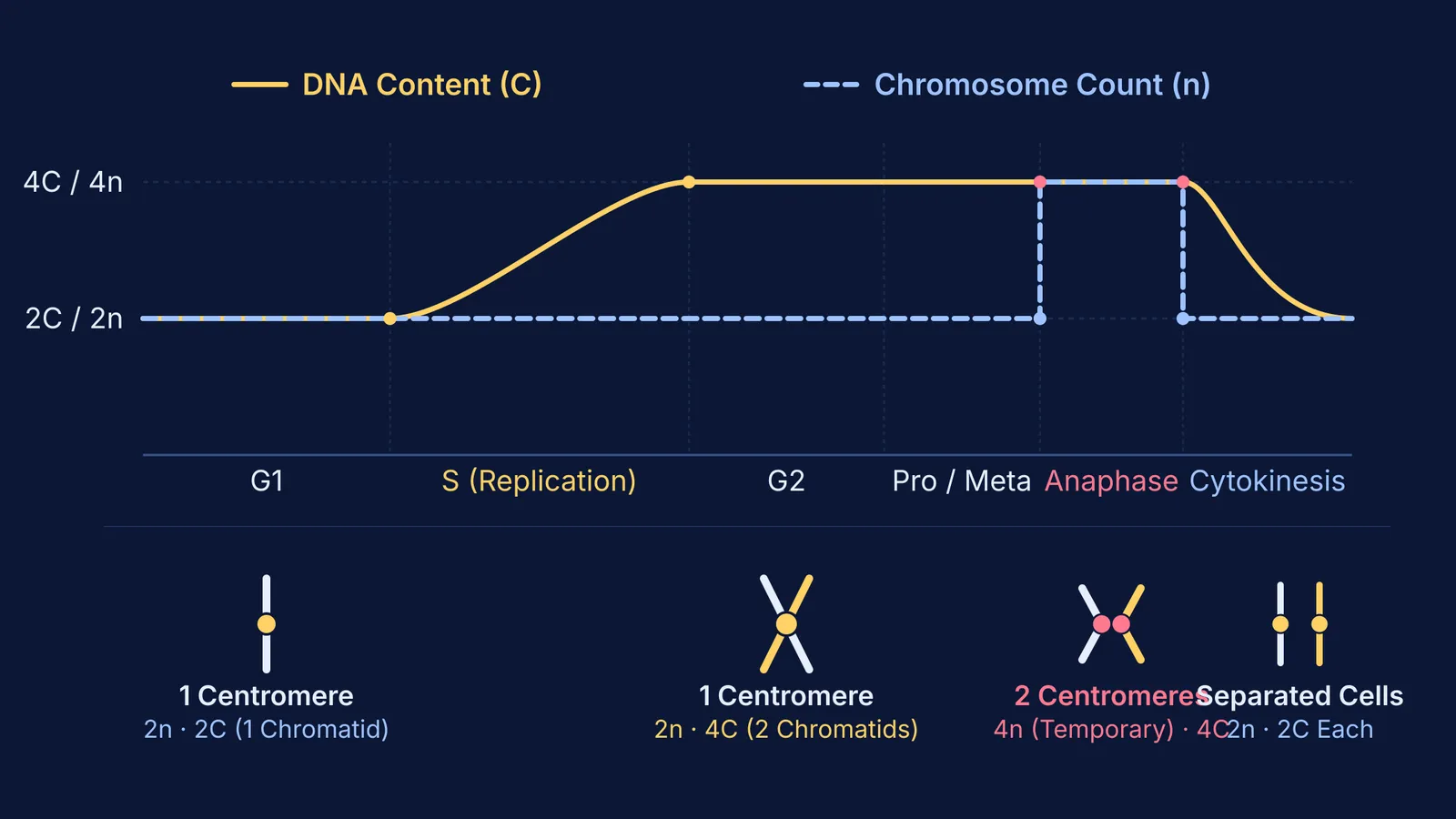
The most common numerical trap targets the synthesis (S) phase. According to Cooper's analysis of the eukaryotic cell cycle, interphase occupies approximately 95% of the cell cycle—roughly 23 hours in a typical 24-hour human cell cycle. During S phase, DNA replication doubles the genetic content. Yet the chromosome count remains 2n.
Chromosomes are counted by functional centromeres, not by DNA strands. When a chromosome replicates, the two identical DNA molecules remain cemented at a single centromere as sister chromatids. Because there is still one centromere, there is still one chromosome. In a study in *Science Education*, Kindfield (1994) identified a variety of misunderstandings individuals have when reasoning about meiosis, highlighting why counting chromosomes can be counterintuitive.
Chromosome count doubles only in anaphase, when centromeres split. Each chromatid becomes an independent daughter chromosome, temporarily giving 4n chromosomes until cytokinesis. You can trace these counts in our guide to cell cycle stages and chromosome counts.
When does crossing over actually happen in prophase I?
Meiotic prophase I has five sub-phases, and examiners routinely scramble their sequence:
Zygotene: Synapsis pairs homologous chromosomes into bivalents via the synaptonemal complex.
Pachytene: Crossing over occurs between non-sister chromatids of homologous chromosomes, catalysed by recombinase at recombination nodules.
Diplotene: The synaptonemal complex dissolves, leaving chromosomes held at X-shaped chiasmata.
Diakinesis: Chiasmata terminalise as chromosomes prepare for metaphase.
The trap asserts that crossing over occurs in diplotene or zygotene. Genetic exchange happens strictly during pachytene; diplotene merely reveals the chiasmata.
In a study evaluating >600 students with the Genetics Concept Assessment, Smith et al. (2008) demonstrated how to identify which genetic concepts are poorly learned during a course. For instance, students must remember that crossing over requires non-sister chromatids. To review these stage-specific transitions, the Fermi Concept Library covers every concept in physics, chemistry, biology, mathematics and computing, each with its own lesson and its place in the map.
How does plant cytokinesis differ from animal cell cleavage?
Cytokinesis uses opposite physical mechanisms in plants and animals, detailed by Alberts et al. in *Molecular Biology of the Cell*:
Animal cells: An actomyosin contractile ring assembles and contracts to form a cleavage furrow that divides the cell.
Plant cells: Most higher-plant cells are enclosed by a semirigid cell wall, preventing furrowing. Instead, vesicles derived from the Golgi apparatus coalesce to form an early cell plate. This process is guided by the phragmoplast, partitioning the cell from the inside out.
Examiners often reverse the mechanism. Another trap asks about syncytia: karyokinesis without cytokinesis produces multinucleate cells, such as coconut liquid endosperm. You can examine these stages in our guide to the onion root tip mitosis practical.
How do you verify an assertion-reason question step by step?
Use this three-step verification sequence:
Check Assertion alone: Is it biologically true? If false, choose (d) immediately.
Check Reason alone: Is it factually true? If false, choose (c) immediately.
The "Because" test: If both are true, read: *"[Assertion] BECAUSE [Reason]"*. Does Reason provide the genuine physiological cause?
Consider this problem:
Assertion (A): In plant cells, cytokinesis begins at the centre and moves outward to partition the cell.
Reason (R): Plant cells possess semirigid cell walls that prevent membrane furrowing.
Both statements are true. Reading them with "because" confirms the causal link: the cell plate must grow outward *because* the semirigid wall precludes furrowing. Reason correctly explains Assertion.
When diagnosing multi-statement problems and checking whether explanations hold up, the Fermi Problem Library offers worked problems with a step-by-step solver that explains the reasoning rather than printing an answer. For visualising spindle mechanics and chromosome alignment, the Fermi Simulation Lab provides interactive simulations for the ideas that are easier to see than to read.


