

On this page
The placenta is not just a physical barrier separating mother and fetus; it is a powerful, temporary endocrine gland. The endocrinology of pregnancy involves complex metabolic changes, and much of the heavy lifting happens during a period known as the luteal-placental shift. This is when the placenta takes over the bulk of hormone production from the ovarian corpus luteum.
What does hCG do in early pregnancy?
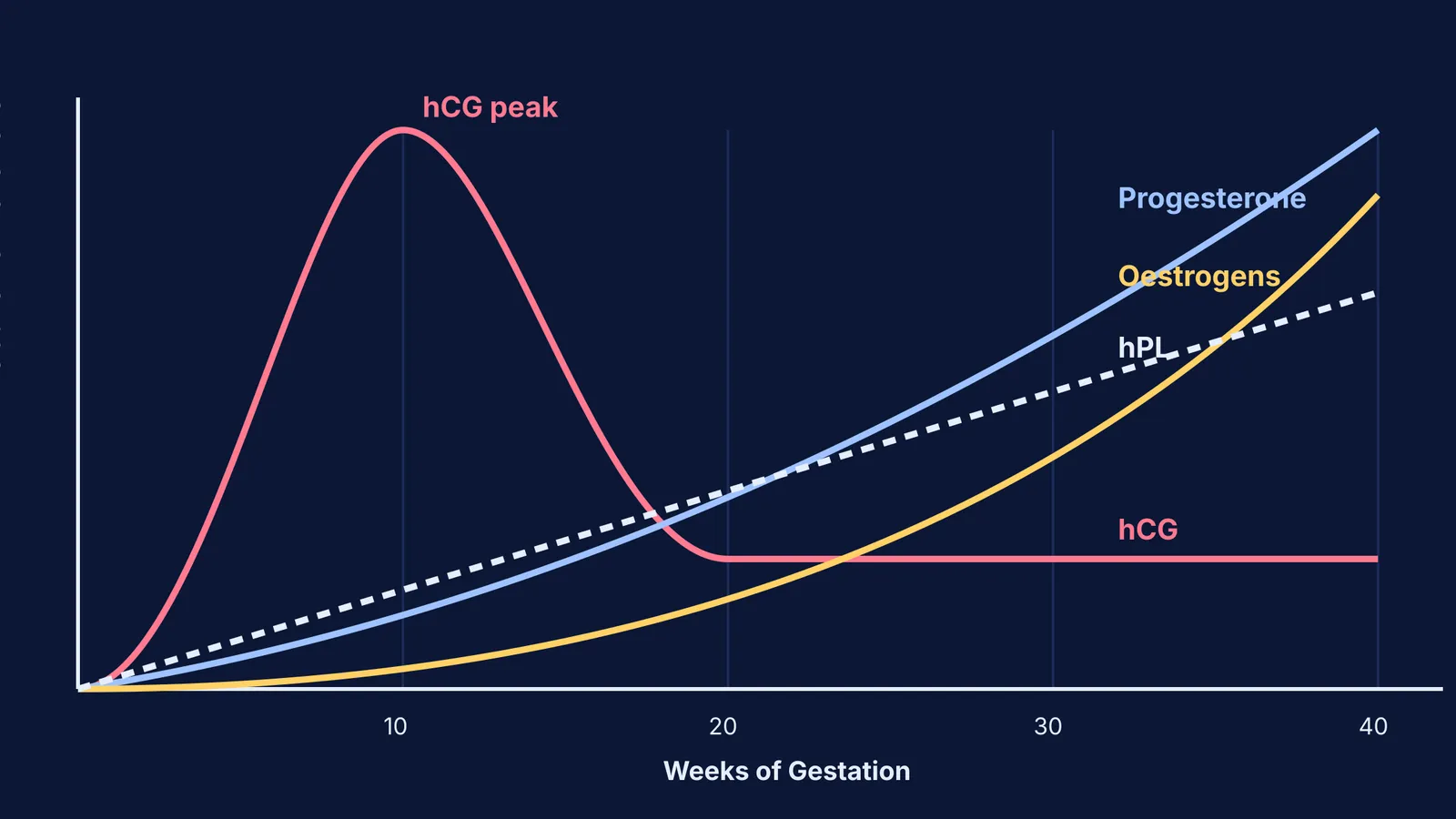
Human chorionic gonadotropin (hCG) is often the first hormone detected by a pregnancy test. In the early weeks, before the placenta is fully developed, hCG rescues the corpus luteum from involution, maintaining progesterone secretion until the placenta can take over (PMC3640235).
Produced primarily in the syncytiotrophoblast, hCG is detectable just days after implantation. Levels rise rapidly in early pregnancy, peaking between the 8th and 10th week of gestation at around 100,000 IU/L (PMC3640235). After this peak, the placenta is capable of producing sufficient steroid hormones on its own, and hCG concentrations drop to a lower plateau for the remainder of the pregnancy.
How does human placental lactogen (hPL) affect metabolism?
Also known as human chorionic somatomammotropin (hCS), hPL alters maternal metabolism to ensure the fetus has a steady supply of energy. It acts as an insulin antagonist, which means it induces mild maternal glucose intolerance, limits gluconeogenesis, and stimulates lipolysis (PMC3640235). This ensures that more glucose is left in the maternal blood to feed the developing baby.
Secreted primarily into the maternal circulation, hPL is responsible for the marked rise in maternal plasma IGF-1 concentrations as the pregnancy approaches term (PMC3640235). Along with other signals, it also prepares the mammary glands for the hormones behind birth and milk that drive lactation.
How do progesterone and oestrogen levels change?
Progesterone is the great stabiliser of pregnancy. It maintains the thickened uterine lining established in the first week of pregnancy, shifts maternal cytokines to suppress the immune response to fetal antigens, and keeps the uterus quiet by reducing contractility to prevent premature labour. At term, the placenta produces about 250 mg of progesterone daily (PMC3640235).
Oestrogens, particularly estriol (E3), act as catalysts for the chemical changes necessary for fetal growth. However, the placenta lacks the 17-hydroxylase enzyme needed to convert progesterone directly into oestrogens. Instead, it relies on precursors like DHA-S sent from the fetal adrenal glands (PMC3640235). Because this pathway requires a collaborative effort between the fetus and the placenta, maternal estriol levels serve as an important clinical marker of fetal well-being.
What is the role of relaxin?
Relaxin prepares the physical structures of the pelvis for delivery. It is classified alongside hCG and hPL as a key protein hormone of pregnancy (PMC3640235). While initially produced by the corpus luteum, the placenta also secretes relaxin as pregnancy progresses.
How do you trace endocrine pathways for exams?
Biology students often have to balance dozens of hormonal interactions when studying human reproduction for NEET. When diagrams of the placenta, the ovaries, and the pituitary gland begin to look like an unreadable web, it helps to break them down.
A checklist for mastering reproductive hormones
When preparing for exams, memorising isolated facts is rarely enough. Use this framework to track each hormone:
Source: Where is it made? (e.g., corpus luteum vs. syncytiotrophoblast).
Trigger: What signals its release? (e.g., implantation).
Target: Which organ or tissue does it affect?
Action: What is the physiological result? (e.g., insulin resistance, joint laxity).
Timeline: When does it peak? (e.g., 8–10 weeks for hCG).
If you find yourself overwhelmed by endocrinology, the Fermi Concept Library contains every concept in biology, each with its own lesson and its place in the map. When tackling complex interlocking pathways, Fermi's AI tutor can work out what you already know and build a plan for the session, drawing out the hormonal feedback loops as it teaches you through them.


