

On this page
Unlike male sperm production, which is a continuous process after puberty, egg production in human females is a start-and-stop journey. If you are studying for NEET or Class 12 biology, keeping track of when cell division pauses and resumes is essential.
Oogenesis begins during fetal development, pauses for years, resumes at puberty, and only completes its final step if fertilisation occurs.
Why are primary oocytes arrested in Prophase I?
Oogenesis is initiated during the embryonic development stage. Within each fetal ovary, gamete mother cells, called oogonia, are formed in the millions (NCBI). These cells act as the starting population for all future eggs. No more oogonia are added or formed after birth.
These oogonia begin meiotic division but do not finish it. They enter Prophase I of Meiosis I and become temporarily arrested at the diplotene stage. At this paused stage, the cells are called primary oocytes. They remain suspended in this state throughout childhood.
Between birth and puberty, a massive number of these follicles degenerate through a natural process called follicular atresia. By the time a female reaches puberty, only a fraction of the original population remains. Of the millions present at birth, only about 400 will actually mature and be released during a woman's reproductive lifetime (NCBI).
When does the secondary oocyte pause at Metaphase II?
Starting at puberty, the reproductive cycle kicks in. This cycle is regulated by a complex interplay of hormones from the hypothalamus, pituitary gland, and the ovaries themselves. Hormonal signals, specifically follicle-stimulating hormone and luteinising hormone, stimulate groups of arrested follicles to resume their development. Each month, usually one primary oocyte within a maturing follicle completes its first meiotic division just before ovulation.
This first division is highly unequal. It produces a large, nutrient-rich secondary oocyte and a tiny cell called the first polar body. The secondary oocyte retains almost all of the cytoplasm.
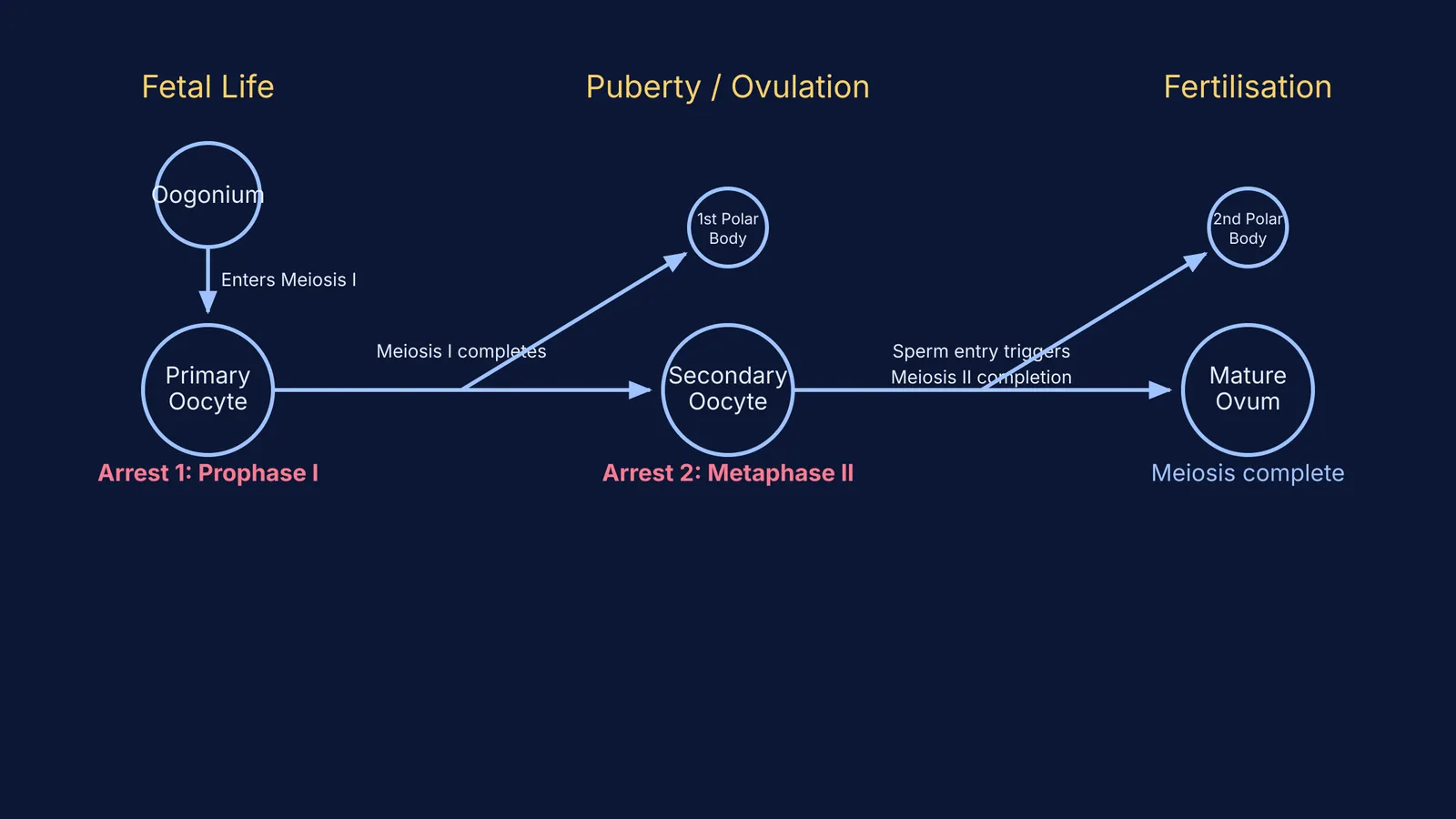
The secondary oocyte immediately begins the second stage of cell division, Meiosis II. However, it does not finish the process. Instead, it gets arrested at Metaphase II. This is the exact state of the egg when it is released from the ovary during ovulation and travels into the fallopian tube, waiting for a sperm.
Why does oogenesis produce polar bodies?
You might wonder why cell division in oogenesis is unequal, unlike spermatogenesis which produces four equal sperm cells. The primary purpose of oogenesis is to create a single gamete containing all the materials necessary to initiate and maintain early embryonic development.
Unlike a sperm cell, which essentially just delivers DNA, the egg must provide the initial machinery for life. By dividing asymmetrically, the developing egg hoards enzymes, messenger RNAs, organelles, and metabolic substrates in one exceptionally large cell. The polar bodies simply provide a way for the cell to discard the extra sets of chromosomes, ensuring the final ovum has the correct haploid number without losing precious cytoplasm. The tiny polar bodies eventually degenerate.
If you have gaps in your understanding of cell division, the Fermi Concept Library can help you review every concept in biology, each with its own lesson and its place in the map.
When does oogenesis complete meiosis?
The second meiotic division is only completed if a sperm successfully enters the egg.
When fertilisation occurs, the entry of the sperm triggers the secondary oocyte to break its Metaphase II arrest. It quickly finishes Meiosis II, resulting in another unequal division. This final step produces the large mature ovum (or ootid) and a second polar body. The sperm and egg nuclei then fuse.
If fertilisation does not happen, the secondary oocyte breaks down. It is eventually shed during menstruation without ever completing meiosis.
A timeline of human oogenesis
When studying this topic, it helps to map the cell types to the life stages of the female. Use this framework to track the meiotic status:
Fetal life: Oogonia divide and enter Meiosis I. They are now primary oocytes, arrested in Prophase I.
Birth to puberty: No new eggs are formed. The primary oocytes remain arrested in Prophase I inside primordial follicles, while many degenerate.
Just before ovulation: One primary oocyte completes Meiosis I, becoming a secondary oocyte. It starts Meiosis II but arrests at Metaphase II.
Fertilisation: Sperm entry breaks the arrest. Meiosis II completes, yielding a mature ovum.
Read more about how these cells develop before and after this process in our guides to microsporogenesis and pollen grains and from fertilisation to implantation.


