On this page
Freshly ejaculated sperm can swim, but they cannot yet fertilise an egg. They first have to spend time in the female reproductive tract and change there. That change is called capacitation, and it is an easy step to leave out when you write the sequence from insemination to zygote.
What is capacitation of sperm?
Capacitation is the set of changes that ejaculated sperm undergo in the female reproductive tract that make them able to fertilise an egg, as described in a 2018 review of the molecular basis of human sperm capacitation. The same review notes that in the early 1950s two researchers using rabbits as a model, C. R. Austin and M. C. Chang, independently described these changes.
Chang's report on the fertilising capacity of sperm placed in the Fallopian tubes appeared in Nature in 1951. Austin gave the process its name in a 1952 Nature paper titled "The 'capacitation' of the mammalian sperm". For the rest of Chang's story, read our profile of how Min Chueh Chang pioneered IVF and the pill.
What happens to sperm during capacitation?
The 2018 review by Puga Molina and colleagues lists the main events, in rough order.
Cholesterol is removed from the sperm's plasma membrane, taken up by acceptor proteins such as albumin.
Bicarbonate switches on an enzyme that raises cAMP inside the cell, which activates protein kinase A.
More and more proteins gain phosphate groups on the amino acid tyrosine as time passes.
The membrane becomes more negative inside: in human sperm it shifts from about -40 mV to about -58 mV.
The inside of the sperm becomes more alkaline, and calcium flows in through channels called CatSper.
The tail switches to a stronger beating pattern called hyperactivation, and the head becomes able to undergo the acrosome reaction.
Why does none of this happen before ejaculation? The review reports that seminal plasma holds it back. Free cholesterol was the main inhibitor in human seminal plasma, and the high zinc level in seminal plasma blocks a proton channel that helps make the inside of the sperm alkaline, until zinc is diluted and removed in the female tract.
Where and when does capacitation happen?
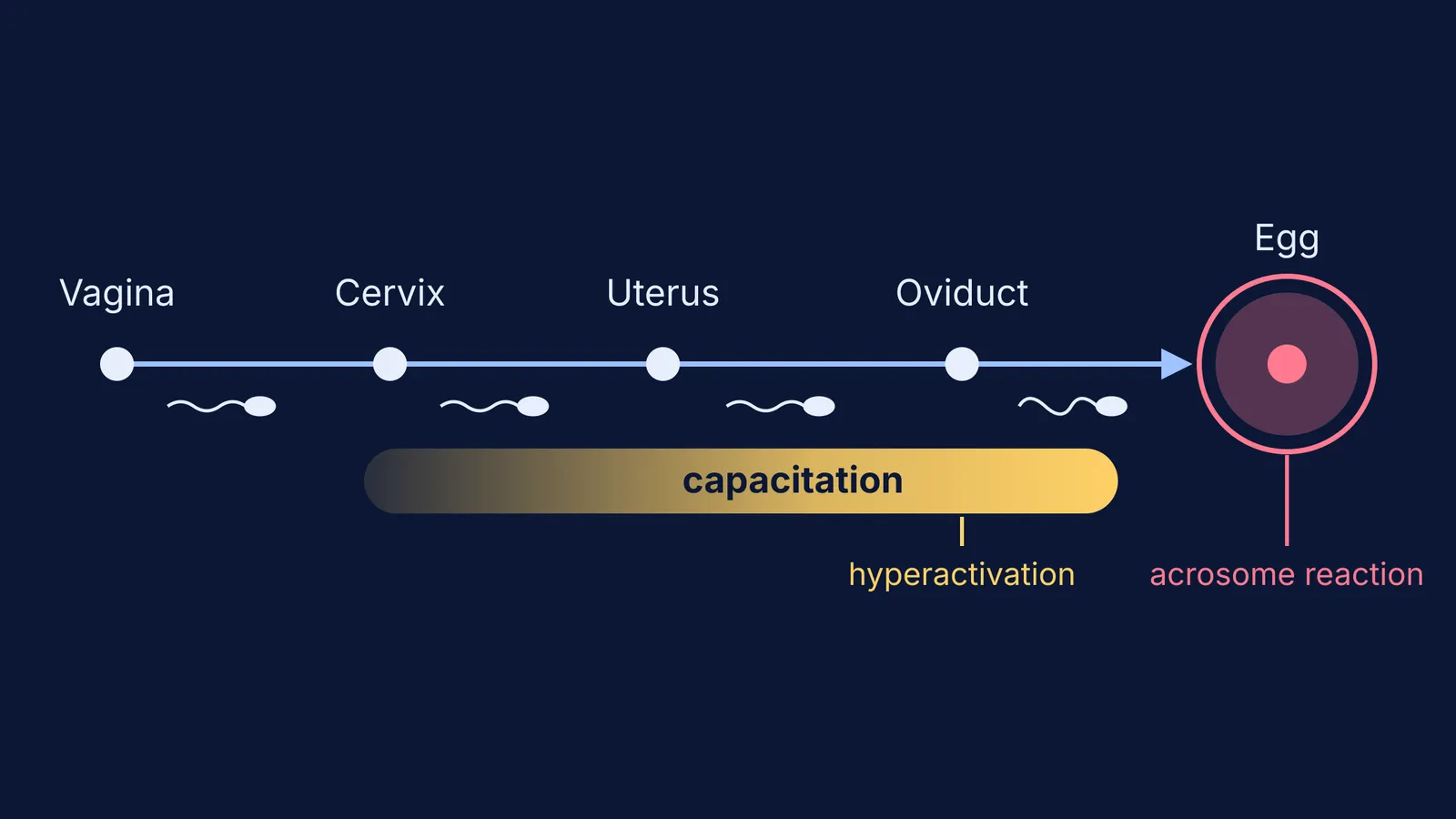
A review of sperm transport in the female reproductive tract by Suarez and Pacey describes the journey. Human sperm are deposited in the anterior vagina and quickly enter cervical mucus, which filters them. A few thousand sperm swim through the uterotubal junctions into the Fallopian tubes, where they interact with the lining. As ovulation approaches, they become capacitated and hyperactivated, which helps them move on towards the egg.
So the short answer is: in the female reproductive tract, mainly the oviduct (Fallopian tube).
On timing, the 2018 review reports that lab studies incubate human sperm under capacitating conditions for anywhere from 3 to 24 hours, while most mouse studies use about 1 to 1.5 hours. Treat this as a lab figure, not an exact clock for the body.
Where does capacitation fit between ejaculation and fertilisation?
Here is the sequence to write in a long answer. A memory line: travel, change, swim hard, react, fuse.
Ejaculation and insemination: semen is deposited in the vagina.
Transport: sperm pass through the cervix and uterus and cross the uterotubal junction into the oviduct.
Capacitation: cholesterol leaves the membrane and calcium enters, mainly in the oviduct.
Hyperactivation: as part of capacitation, the tail beats more strongly.
Acrosome reaction: the acrosome releases its contents so the sperm can get through the layers around the egg.
Fertilisation: sperm and egg fuse in the oviduct, and the zygote begins its journey, which we cover in from fertilisation to implantation.
How do exam questions test capacitation?
Assertion: Sperm collected straight after ejaculation cannot fertilise an egg at once. Reason: Sperm must undergo capacitation in the female reproductive tract.
Is the assertion true? Yes: freshly ejaculated sperm are not yet able to fertilise. Is the reason true? Yes. Does the reason explain the assertion? Yes, because capacitation is exactly the change they are missing. Answer: both true, and the reason is the correct explanation.
Now the common traps, each with the fix:
"Capacitation happens in the epididymis." False. It happens in the female tract. For what happens in the male ducts, see our guide to the path of sperm from testis to urethra.
"Capacitation and the acrosome reaction are the same." False. Capacitation comes first and makes the acrosome reaction possible.
"Seminal plasma speeds up capacitation." False. Seminal plasma contains factors that hold it back.
If the order of these steps still blurs, the Fermi Concept Library covers every concept in biology, each with its own lesson and its place in the map, so you can see how the topics before and after fertilisation connect. When you move to practice questions, the Fermi Problem Library has worked problems with a step-by-step solver that explains the reasoning rather than printing an answer.
Next time you write the sequence from insemination to zygote, put capacitation between transport and the acrosome reaction, and you will not lose that mark.