

On this page
The male reproductive system relies on a continuous, highly coordinated pathway of ducts to produce, mature, and transport sperm. Whether you are studying for your board exams or revising for medical entrances like NEET, mapping this route is essential.
Sperm do not simply appear ready to go. They begin as immotile cells and undergo physical and chemical changes as they are pushed through a series of specialised tubes.
Where does the path of sperm begin?
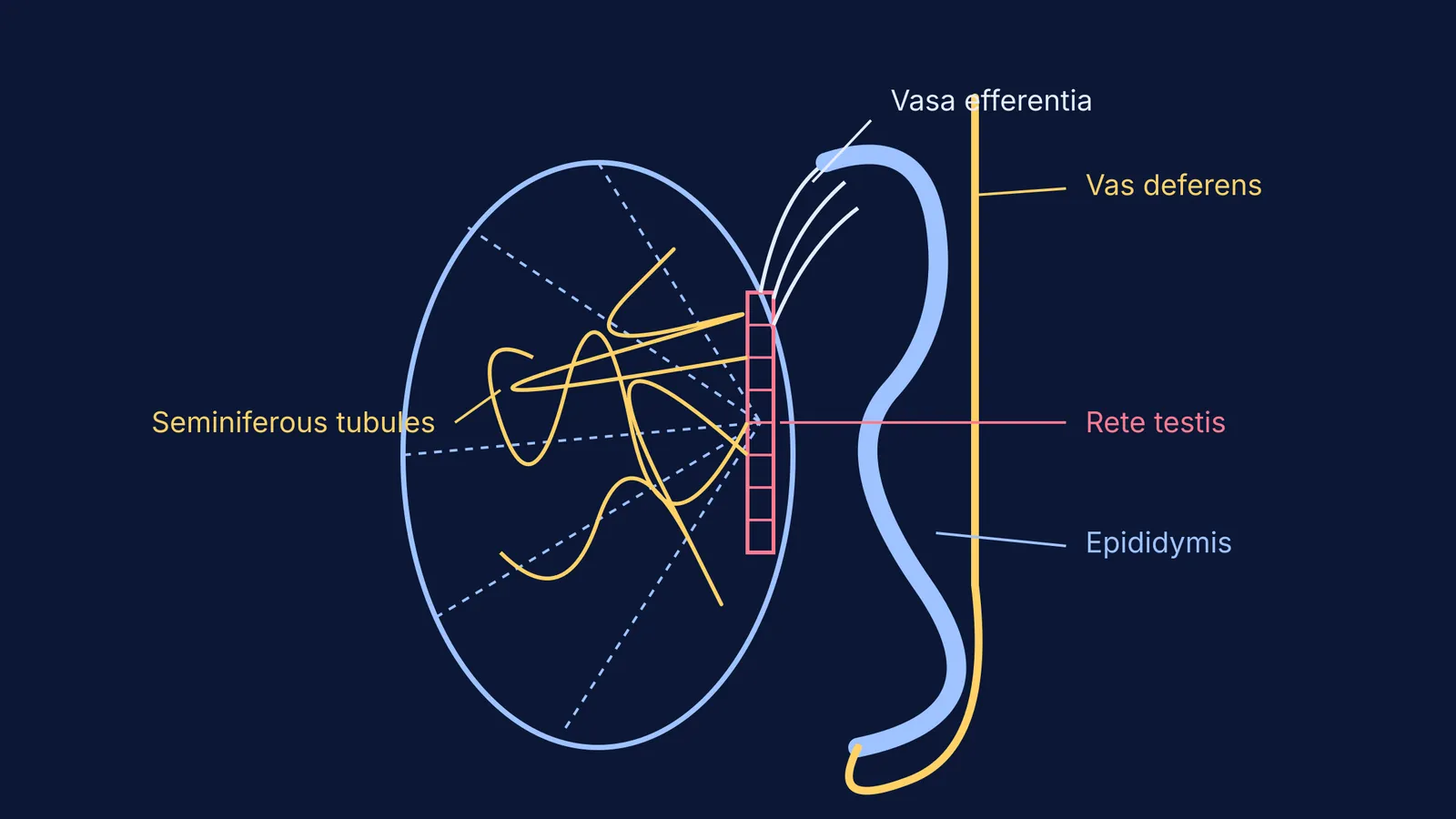
The journey starts inside the testes, specifically in the seminiferous tubules. Spermatogenesis (the production of sperm) begins in the germ cells located near the basement membrane of these tubules. As the cells mature into spermatozoa, they move toward the tubule's central space (the lumen). At this stage, the sperm cannot swim on their own.
From the seminiferous tubules, the sperm are swept into a network of connected channels called the rete testis. This central hub collects the newly formed sperm and directs them out of the testis through several small ducts called the vasa efferentia (or efferent ductules).
How does the epididymis mature sperm?
The vasa efferentia carry the sperm into the epididymis, a tightly coiled structure attached to the back of each testis. Although it fits into a very small space, the epididymis is very long. If you were to uncoil the single tube of the human epididymis, it would measure approximately 6 meters (20 feet) in length.
This length is necessary because maturation takes time. Sperm require approximately 12 days to travel through the epididymis. During this transit, they undergo critical biochemical changes that grant them motility (the ability to swim) and the potential to fertilise an egg. Once mature, the sperm are stored in the final section, the tail of the epididymis, until ejaculation.
What happens in the vas deferens and ejaculatory duct?
During sexual arousal and ejaculation, rhythmic smooth muscle contractions propel the mature sperm from the tail of the epididymis into the vas deferens (ductus deferens). This muscular tube travels up from the scrotum, through the spermatic cord, and into the pelvic cavity.
Behind the bladder, the vas deferens meets the duct from the seminal vesicle. These two tubes merge to form the ejaculatory duct. This is a crucial junction because the seminal vesicles contribute fructose and other fluids that provide energy for the sperm. The mixture of sperm and glandular fluids is what we call semen.
How does sperm exit through the urethra?
The short ejaculatory duct empties directly into the urethra. As the semen travels through the portion of the urethra surrounded by the prostate gland, the prostate adds alkaline secretions that protect the sperm from the acidic environment of the female reproductive tract.
Further down, the bulbourethral glands (Cowper's glands) release a clear mucus that lubricates the urethra and neutralises any leftover acidic urine. Finally, the semen travels through the spongy urethra running the length of the penis and exits the body.
How to remember the path of sperm for exams
Many students use the popular mnemonic SEVEN UP (Seminiferous tubules, Epididymis, Vas deferens, Ejaculatory duct, Nothing, Urethra, Penis). However, this shortcut skips two vital steps: the rete testis and the vasa efferentia. In exams like NEET, questions often test your knowledge of these very structures.
If you have concept gaps or keep getting the sequence mixed up, the Fermi Concept Library breaks down the entire male reproductive system step by step. When you understand why a structure exists—like the 6-meter epididymis being necessary for a 12-day maturation period—the order becomes logical rather than just a list to memorise.
Similarly, if you make mistakes on tricky sequence questions in mock tests, the step-by-step solver in the Fermi Problem Library explains the reasoning behind the correct path instead of just printing the answer.
Once you master the male reproductive ducts, the next logical step in human reproduction is understanding what happens after the sperm reaches its destination. You can explore how this process continues in From fertilisation to implantation: the first week of pregnancy, or read about the hormonal changes that follow in Parturition and lactation: the hormones behind birth and milk.


