

On this page
Min Chueh Chang (1908–1991) was a reproductive biologist whose work shaped the modern world in two opposite directions. He developed the foundational science that allows people to prevent pregnancy, and he proved the technique that helps people conceive when they cannot do so naturally.
Who was Min Chueh Chang?
Born in China, Chang studied at Tsinghua University and later earned his PhD at Cambridge University under the guidance of Arthur Walton. In 1945, he moved to the United States to work at the Worcester Foundation for Experimental Biology in Massachusetts, where he would spend decades studying mammalian reproduction.
His first major breakthrough came in 1951 when he and Australian biologist Colin Austin independently discovered capacitation. When sperm enter the female reproductive tract, they are not immediately ready to fertilise an egg. They must undergo a biochemical maturation process—capacitation—which alters the sperm's membrane. Understanding this process was the missing piece for laboratory fertilisation, because earlier scientists had failed by putting "unprepared" sperm in a dish. Once Chang understood that sperm needed to be chemically primed, he could mimic those conditions in the lab. If you are studying how fertilisation to implantation works for your biology exams, understanding capacitation is the crucial first step.
What was the 1959 rabbit experiment?
By the late 1950s, a few scientists had claimed to achieve in vitro fertilisation (IVF) in mammals, but their results could not be reliably reproduced. The scientific community remained deeply skeptical, arguing that the eggs might have been activated without sperm (parthenogenesis) or that the surrogate mother's own eggs were somehow fertilised.
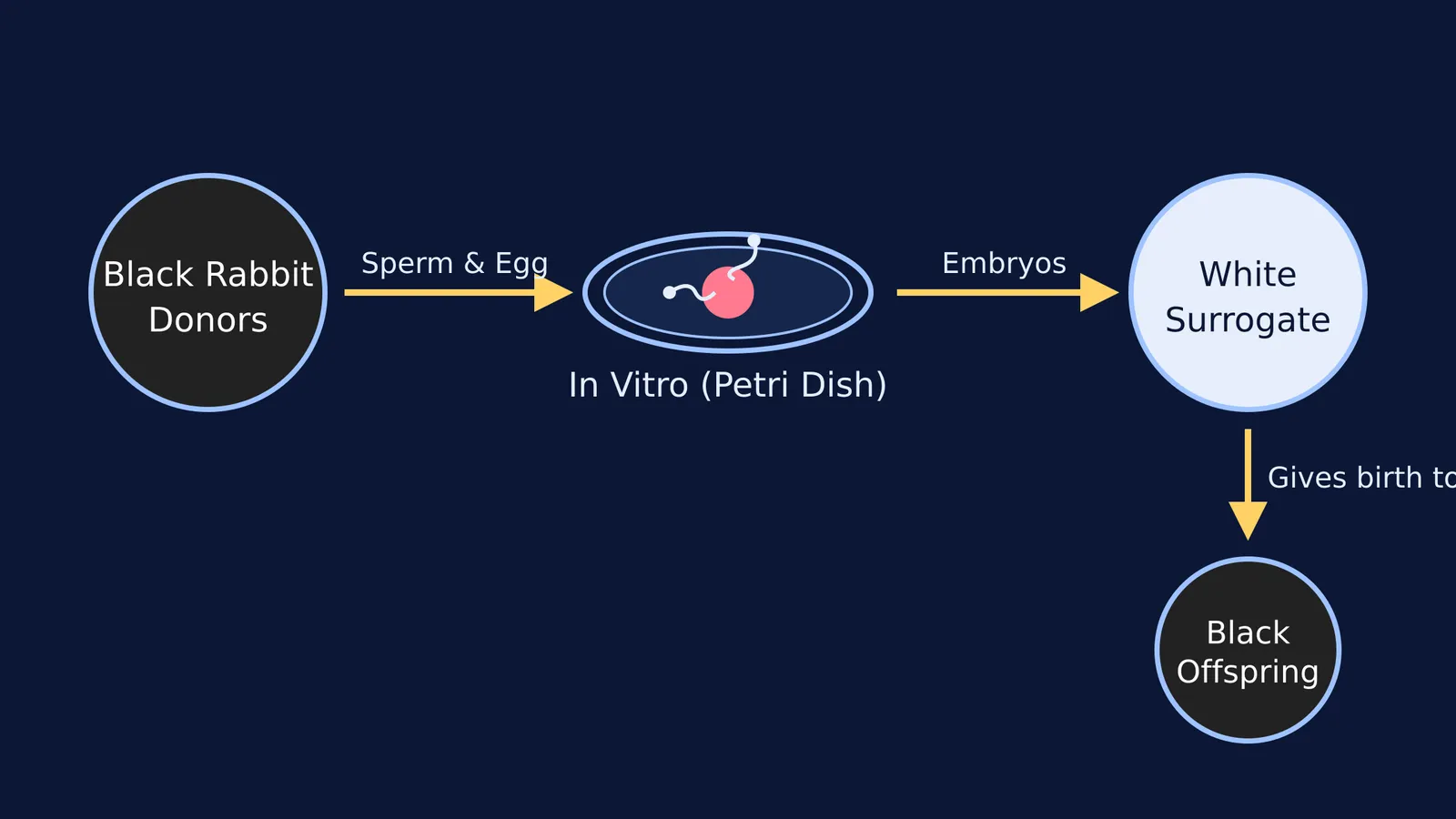
In 1959, Chang published a landmark paper in *Nature* titled "Fertilization of Rabbit Ova in Vitro" that provided unequivocal proof. To silence the critics, he used a genetic marker. He took sperm and eggs from black rabbits and fertilised them in a petri dish. Once the embryos began to develop, he transferred them into a white surrogate rabbit.
The white rabbit gave birth to a litter of completely black offspring. Because the babies shared the physical traits of the egg and sperm donors rather than the surrogate, Chang proved that the genetic material was successfully combined outside the body. This is a classic demonstration of how two nuclei become one to pass on traits. This experiment established the biological blueprint for human IVF, leading directly to the birth of the first human IVF baby in 1978.
How did his work lead to the contraceptive pill?
While perfecting IVF, Chang was simultaneously working on the opposite problem. In the early 1950s, birth control advocate Margaret Sanger approached Gregory Pincus with a plea to create a reliable, oral contraceptive. Pincus tasked Chang with the biological testing.
The team needed to find a synthetic hormone that would trick the body into halting ovulation. Between 1951 and 1956, Chang methodically tested nearly 200 chemical compounds on laboratory animals. At the time, it was widely believed that steroid hormones would be destroyed by stomach acids if taken orally.
Chang's rigorous animal trials proved this assumption wrong. He demonstrated that a synthetic progestin called norethynodrel successfully halted ovulation when given orally. His comprehensive data gave Pincus and John Rock the scientific confidence to move to human clinical trials. This massive effort led to the FDA announcing it would approve Enovid—the first oral contraceptive—in May 1960.
If you have gaps in your understanding of how hormones regulate the menstrual cycle or how ovulation can be paused, Fermi Concept Library has a lesson for every concept in physics, chemistry, biology, mathematics and computing.
A framework for proving experimental claims
Chang's 1959 rabbit experiment is a brilliant example of rigorous scientific design. When you need to prove a cause-and-effect relationship in an experiment, you can use his framework:
Identify the doubt: Chang knew skeptics would argue the white surrogate had somehow fertilised her own eggs.
Choose a visible marker: He used black rabbit donors so the offspring's fur colour would act as an undeniable genetic tag.
Eliminate other variables: By using an incubator mother of a different trait, he completely separated the environment (the womb) from the genetics (the parents).
This approach of tagging inputs to track outputs is a fundamental skill in biology, whether you are tracking radioactive isotopes in DNA or breeding fruit flies.


