

On this page
NCERT states it in one line: the haploid nucleus of the sperm and that of the ovum fuse to form a diploid zygote. In the early 1870s this was not known. Observers had seen two nuclei in freshly fertilised eggs but could not tell where they came from. Oscar Hertwig settled the question by watching it happen in sea urchin eggs. This post covers his life, the experiment, a short calculation on chromosome numbers, common mistakes, and what you can learn from how he worked.
Who was Oscar Hertwig?
The Deutsche Biographie records that Oscar Hertwig was born in Friedberg (Hesse) on 21 April 1849 and died in Berlin on 25 October 1922. He studied medicine at Jena, Zurich and Bonn, took his doctorate in Bonn in 1872, and qualified as a lecturer in anatomy at Jena in 1875. He became professor of anatomy at Jena in 1881, and from 1888 to 1921 directed an anatomy institute in Berlin built for him. Encouraged by Ernst Haeckel, he did much early work with his brother Richard, also a zoologist.
Why sea urchin eggs?
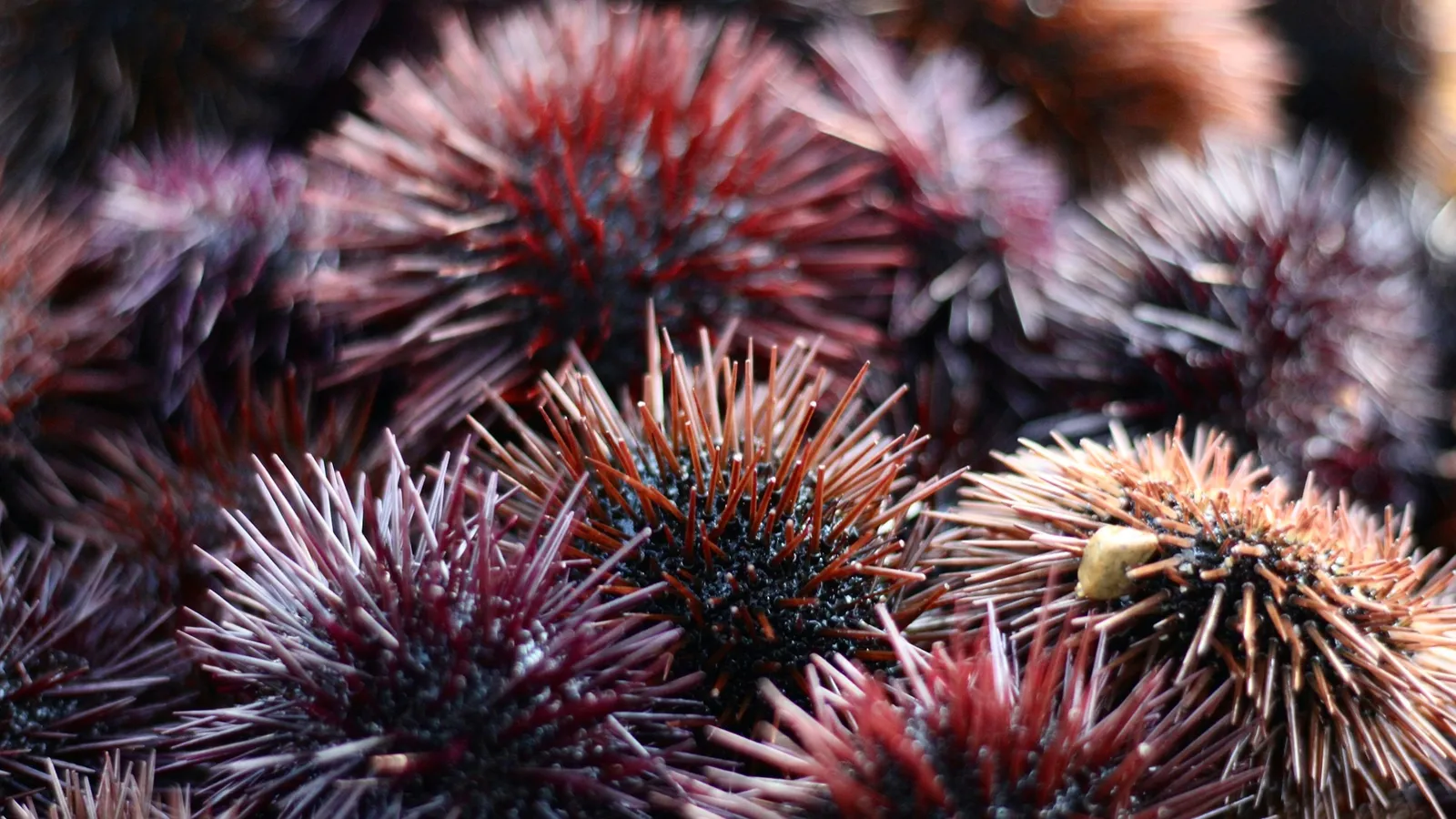
The egg had to be watched before, during and after fertilisation, and that meant fertilising it at a moment the observer chose. In his 1877 follow-up paper in the Morphologisches Jahrbuch, volume 3, Hertwig explained that earlier workers had used animals in which artificial fertilisation was impossible, so the origin of the two nuclei they saw stayed unclear. In our translation: "Far more favourable conditions were offered to me by the egg of Toxopneustes lividus". With a sea urchin you can mix eggs and sperm in a dish and start the clock yourself.
What did he see?
The NDB says that in his classic 1875 habilitation study, Beiträge zur Kenntniss der Bildung, Befruchtung und Theilung des thierischen Eies (On the formation, fertilisation and division of the animal egg), he was the first to interpret fertilisation correctly, as the fusion of egg and sperm nuclei.
His 1877 paper restates the result. A few minutes after artificial fertilisation, 5 to 10 minutes in his account, a small radiating figure appears near the egg surface with a tiny nucleus at its centre, which he called the sperm nucleus (Spermakern). It moves inward and meets the nucleus that was already in the egg, which he called the egg nucleus (Eikern). In our translation, he proposed that "the most important event in fertilisation is the fusion of two nuclei, one female and one male." From several observations he also made it "highly probable" that the sperm nucleus comes from a sperm that had entered the egg, so that only one sperm takes part.
Worked example: counting chromosomes and DNA
Hertwig did not count chromosomes; that came later. But his result is what makes these sums work. Use human numbers from NCERT's Human Reproduction chapter, which says spermatogonia are diploid with 46 chromosomes.
Gametes. Meiosis halves the number: sperm and ovum each carry 46 ÷ 2 = 23 chromosomes (n).
Zygote. Fusion of two nuclei: 23 + 23 = 46 (2n). This answers NCERT's in-text question "How many chromosomes will be there in the zygote?"
DNA content. If a gamete nucleus holds 1C of DNA, the zygote holds 1C + 1C = 2C. Before its first mitosis, S phase doubles this to 4C while the chromosome number stays 2n, as NCERT's Cell Cycle chapter explains.
Why one sperm matters. If two sperm nuclei joined one egg nucleus, the count would be 23 × 3 = 69, not 46. Hertwig's finding that a single sperm acts is the normal case.
What mistakes do students make with fertilisation?
Confusing entry with fusion. The sperm entering the egg and the two nuclei fusing are separate steps, minutes apart in Hertwig's eggs.
Mixing up n and C. n counts chromosome sets; C counts DNA amount. They change at different steps.
Forgetting the sex is set at fertilisation. NCERT notes that the sex of the baby is decided at this stage, by whether the sperm carries X or Y.
Thinking nuclei form from scratch. The NDB notes that Hertwig's later work backed the view that nuclei arise only from earlier nuclei (omnis nucleus e nucleo).
Our post on human reproduction for NEET covers gametogenesis, and Walther Flemming covers how dividing nuclei were first described. If n, 2n, C and 4C keep blurring, the Fermi Concept Library covers every concept in physics, chemistry, biology, mathematics and computing.
What did he do next?
The NDB lists later firsts. In 1890, working on the roundworm Ascaris, he described the reduction division of sperm cells and showed that chromosomes behave in parallel ways in egg and sperm formation. He argued that the stainable substance of the nucleus carries the hereditary material. From 1909 to 1913, with his children Günther and Paula, he studied how radium radiation affects animal germ cells.
What can you take from how he worked?
Pick the right organism. An egg you can fertilise on demand turned a guess into an observation.
Watch the timing. Recording minutes after fertilisation let him put events in order.
Say how sure you are. He called the single-sperm origin "highly probable", not certain, until more evidence came.
Next step: draw the chromosome number and DNA content (n and C) at each step from spermatogonium to two-cell embryo.


