

On this page
The debate of DNA versus RNA as genetic material comes down to a trade-off between chemical stability and reactivity. While life likely began in an "RNA world" where a single molecule handled both information storage and catalysis, DNA eventually took over as the primary archive for almost all living things. The reasons for this shift are built directly into its molecular structure: the loss of one oxygen atom and the addition of one methyl group make DNA far more stable than RNA.
Here is why DNA is a better genetic material than RNA for long-term storage, and why RNA is still kept around for the fast, transient work of the cell.
Why is RNA more reactive than DNA?
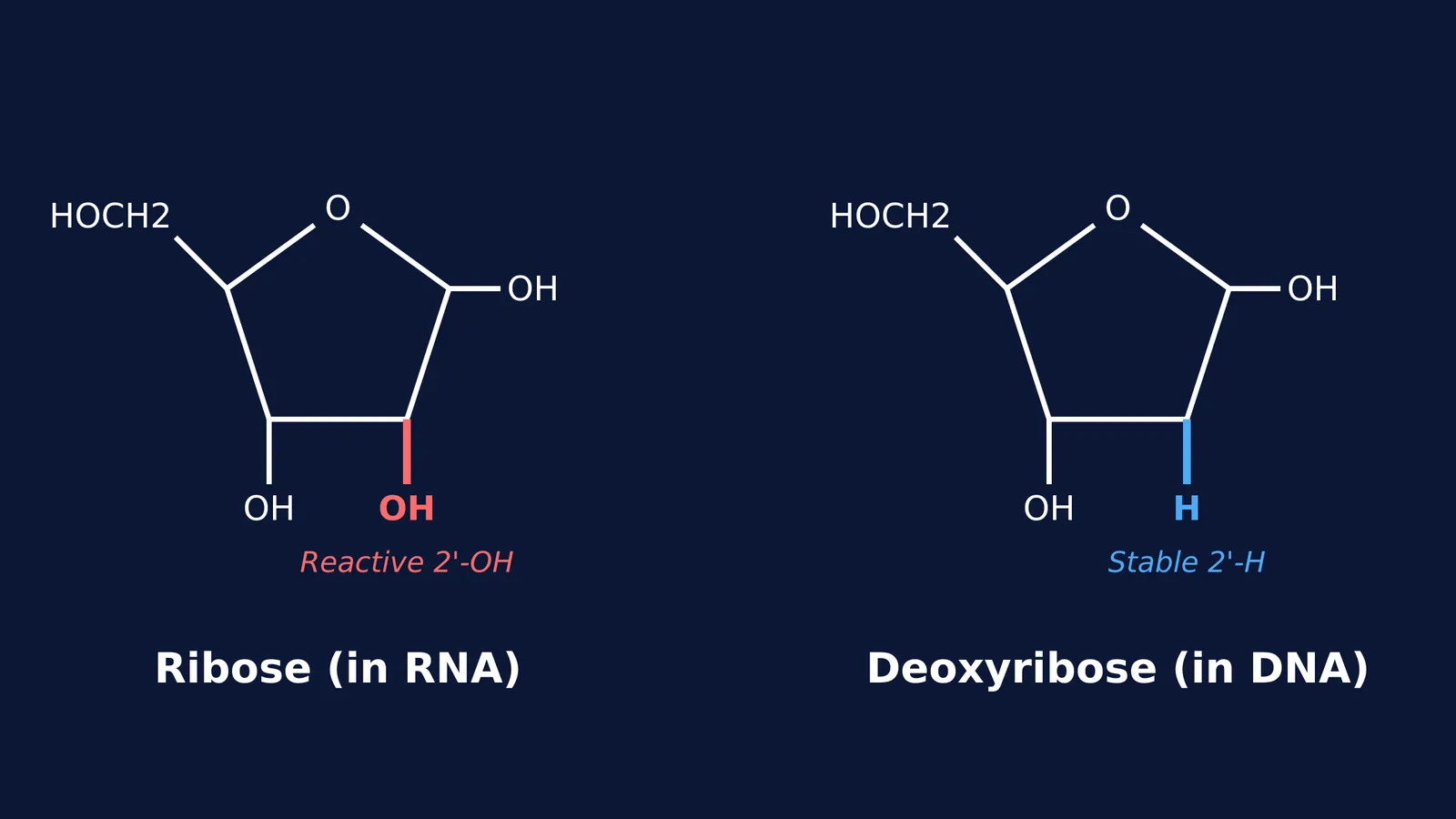
The most striking difference between the two molecules is right in their names: RNA is built on ribose, while DNA is built on deoxyribose.
Ribose has a hydroxyl group (-OH) attached to its 2' carbon. In the slightly alkaline environment of certain cellular compartments, this 2'-OH group becomes a structural liability. It can lose its proton and act as a nucleophile, attacking the adjacent phosphate group in the RNA backbone. This process, called alkaline hydrolysis, physically cuts the RNA strand in half.
Because DNA lacks this oxygen atom (it has a simple hydrogen atom at the 2' position instead), it cannot perform this self-cleavage. This small chemical change gives DNA long-term stability, making it a highly reliable archive that can be safely passed down through generations. RNA, by contrast, is fragile and easily broken down in water.
Why does DNA use thymine instead of uracil?
Both molecules share three of their nitrogenous bases: adenine, guanine, and cytosine. But while RNA pairs adenine with uracil (U), DNA uses thymine (T). To understand why this matters for genetic stability, you have to look at how cytosine degrades over time.
In a human cell, cytosine spontaneously reacts with water and turns into uracil between 100 and 500 times per day (NIH). This process, known as cytosine deamination, is a constant threat to genomic integrity.
If DNA used uracil naturally, the cell's repair machinery would face an impossible problem. When it found a U-G base pair, it would not know if the U was originally supposed to be there, or if it was a mutated C. Left uncorrected, the error would become a permanent mutation during the next round of cell division.
To solve this, evolution "tagged" the correct base. Thymine is chemically identical to uracil, except for an added methyl group (making it 5-methyluracil). Because DNA uses thymine exclusively, any uracil found in a DNA strand is instantly recognised as a mutation. Repair enzymes scan the genome, spot the bare uracil rings, and remove them so the correct cytosine can be restored. The resulting long-term stability of DNA is what allows scientists to read ancient history, such as when researchers sequenced the Neanderthal genome from tens of thousands of years ago.
If concept gaps make these mechanisms hard to remember, the Fermi Concept Library holds every concept in physics, chemistry, biology, mathematics and computing, each with its own lesson and its place in the map.
Why do some viruses still use RNA?
DNA is the undisputed winner for long-term storage, but RNA's inherent instability is actually a feature when it comes to short-term work. Its chemical flexibility allows it to perform roles that DNA cannot.
First, that same reactive 2'-OH group allows RNA to fold into complex three-dimensional shapes and drive chemical reactions. These RNA enzymes, known as ribozymes, are crucial for processes like protein synthesis inside the ribosome.
Second, when a cell needs to make a specific protein, it copies the DNA instructions into a short-lived messenger RNA (mRNA). Because RNA breaks down quickly, the cell can tightly control how much protein is made by simply stopping the supply of mRNA. If the messenger was as stable as DNA, the cell would continue producing the protein long after it was needed.
Finally, many fast-changing viruses, such as HIV and influenza, use RNA as their primary genetic material. Their high mutation rates help them rapidly evolve and evade the host's immune system, turning RNA's lack of stability into a survival advantage. To understand how the individual bases string together, read our guide on the chemistry of nucleosides and nucleotides.
DNA vs RNA checklist
When preparing for board exams or competitive tests, keeping the differences straight is essential. Here is a practical checklist of how DNA and RNA compare (for a guide on how their bases pair up numerically, see Chargaff's rule numericals):
Sugar backbone: DNA uses deoxyribose (lacks the 2'-OH group); RNA uses ribose (contains the 2'-OH group).
Unique nitrogenous base: DNA uses thymine; RNA uses uracil.
Resistance to hydrolysis: DNA is highly stable and resists self-cleavage; RNA is easily degraded by alkaline conditions.
Mutation detection: DNA's use of thymine allows repair enzymes to catch and fix cytosine deamination; RNA cannot easily correct these errors.
Primary biological role: DNA stores genetic information long-term; RNA acts as a short-lived messenger, a structural building block, and a chemical catalyst.
Understanding these chemical differences shows that life's choice of genetic material was not a random accident, but a careful balancing act between the need for enduring stability and dynamic reactivity.


