

On this page
You test whether a plant needs carbon dioxide to make starch, and the leaf shows little starch. Was that the missing carbon dioxide, or a weak plant, a cloudy day or old iodine? With one set-up, you cannot tell. The second set-up that settles it is the control.
What is a control group in a biology experiment?
A control is the part of an experiment that does not get the change you are testing, so it shows what would have happened anyway. The free textbook Concepts of Biology from OpenStax defines a variable as “any part of the experiment that can vary or change during the experiment” and a control as “a part of the experiment that does not change.”
In its pond example, ponds given phosphate are the treatment cases, while the control ponds get “something inert added, such as the salt” (OpenStax). A good control means “everything the same except the one thing”, not “do nothing”.
Why do experiments need a control group?
Because a result means little until you compare it with something. Living things vary, and light, temperature and timing all shift at once. The control set goes through all of that too. If the treated and control sets end up different, the one thing that separated them is the explanation left standing.
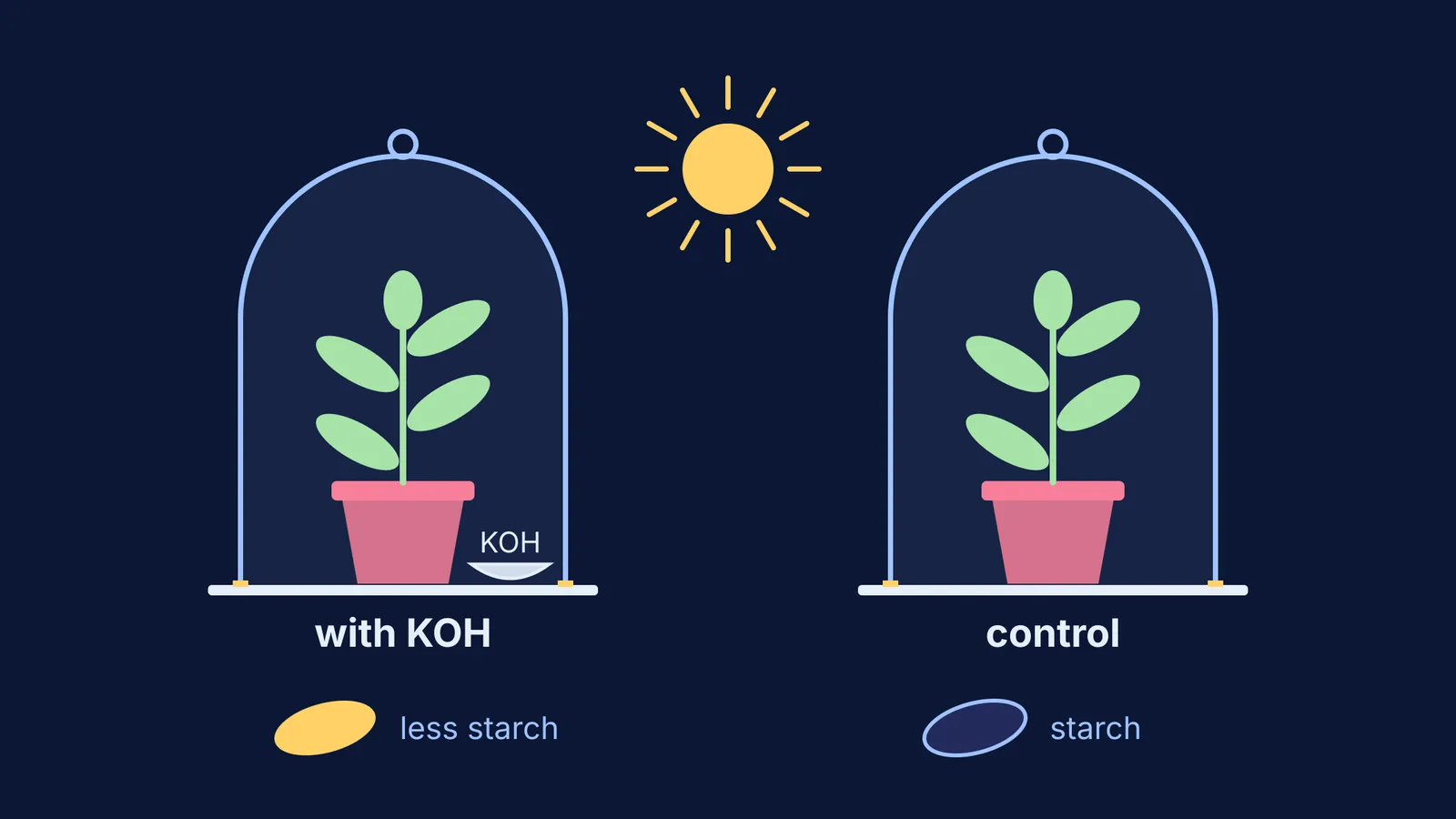
NCERT builds this into Activity 5.2 of the Class 10 science chapter Life Processes. Two healthy potted plants of nearly the same size spend three days in a dark room. Each then goes on a glass plate under a bell jar sealed with Vaseline, and a watch-glass of potassium hydroxide, which absorbs carbon dioxide, sits beside one plant only. After about two hours in sunlight, a leaf from each plant is tested for starch.
Everything else is matched: the plants, the days in the dark, the jars, the sunlight, the starch test. So if the leaf from the potassium hydroxide jar has less starch, missing carbon dioxide is the likely explanation. The control plant sits in a sealed jar too; otherwise someone could argue the jar itself made the difference.
The logic is old. NCERT's Class 12 chapter on Evolution describes how Louis Pasteur showed that in pre-sterilised flasks, life did not come from killed yeast, while in another flask open to air, new organisms arose.
How do you spot a missing control in a practical question?
Practical questions often describe one set-up and ask what is missing. Run four checks:
Name the claim. What does the student say is needed, or causes the effect?
Find the comparison. Is there a second set-up without that factor? If not, the control is missing.
Count the differences. List every way the second set-up differs. More than one means the control is flawed.
Check the measurement. Both sets must be tested the same way, at the same time.
Worked example 1, sunlight and starch: a student keeps a destarched plant in sunlight, tests a leaf with iodine and sees blue-black. The student writes: “Sunlight is essential for photosynthesis.”
Missing: a matching leaf kept in the dark for the same time. Blue-black only proves starch is there now, not that light put it there. NCERT asks you to design this experiment yourself, right after Activity 5.2.
Worked example 2, water and germination: seeds on wet cotton sprout after a few days. Conclusion: seeds need water to germinate.
Missing: identical seeds on dry cotton, in the same kind of dish, in the same place, for the same days. Without that set, warmth or the seeds themselves could explain the sprouting.
Worked example 3, a control with too many differences: Set A is a plant in a sealed bell jar with potassium hydroxide, in sunlight. Set B is a plant with no jar and no potassium hydroxide, on a windowsill.
There is a control, but it differs in three ways: no potassium hydroxide, no jar and a different spot. Fix it: an identical sealed jar beside A, minus the potassium hydroxide.
What should you write about the control in an exam answer?
Name the control and give the reason. A sentence you can adapt:
“Set-up B is the control. It is identical to set-up A except that [the variable] is absent, so any difference in [the result] can be attributed to [the variable].”
Then list what you kept the same. Naming these controlled variables shows you understand the design rather than remembering it.
If a question hides a flaw and you cannot see why your answer is wrong, the Fermi Problem Library has worked problems with a step-by-step solver that explains the reasoning rather than printing an answer. If the gap is the idea itself, the Fermi Concept Library gives each biology concept its own lesson.
For practice, the potato osmosis experiment is a clean treated-versus-control set-up, and the two-week seed germination plan lets a younger sibling build a control at home. If practical marks have already slipped, read what you can check and do about low practical marks in boards.
Next time you read any experiment, ask one question first: compared with what?


