On this page
A handful of rajma or moong, four small pots, a plate and a notebook are enough for a real experiment. Over two weeks, your child changes one condition at a time, predicts, counts sprouts and explains the pattern, as in their Class 6 textbook.
What do you need for a seed germination experiment at home?
In NCERT's Class 6 textbook *Curiosity* (Activity 10.2), students sow four bean seeds in each of four identical pots of garden soil and keep the pots in different conditions for 15 days (NCERT Curiosity, Class 6, Chapter 10). We add a fifth setup to test soil.
25 seeds of one kind: rajma, chana or moong (do not mix kinds)
4 small pots or yoghurt cups with a drainage hole, filled with garden soil
1 plate with a thick layer of cotton wool or folded paper towel
A cupboard or box that keeps out all light
A notebook, a ruler and a phone camera
How do you set up the two-week experiment?
Put five seeds in each setup. Each sprout then counts as 20%, so the maths stays easy.
Pot A, dry: soil, no water, in sunlight.
Pot B, flooded: keep water standing above the soil, in sunlight.
Pot C, dark: keep the soil slightly moist, inside the cupboard.
Pot D, control: keep the soil slightly moist, in sunlight.
Plate E, no soil: seeds on damp cotton wool, in sunlight.
Pots A to D follow NCERT's Activity 10.2, which has students observe the pots for 7 to 10 days. Plate E borrows the "ragdoll" seed test, where seeds sprout in a damp paper towel with no soil (UC Davis International Programs fact sheet). That sheet recommends a warm spot of 21 to 30 °C and an optional soak of about 8 hours, never more than 12, warns that too much water can rot seeds, and counts sprouts after 4 to 7 days.
Day 0: soak and sow. Your child writes a prediction for each setup.
Days 1 to 14: check daily at the same time. Water C, D and E lightly, top up B, take one photo.
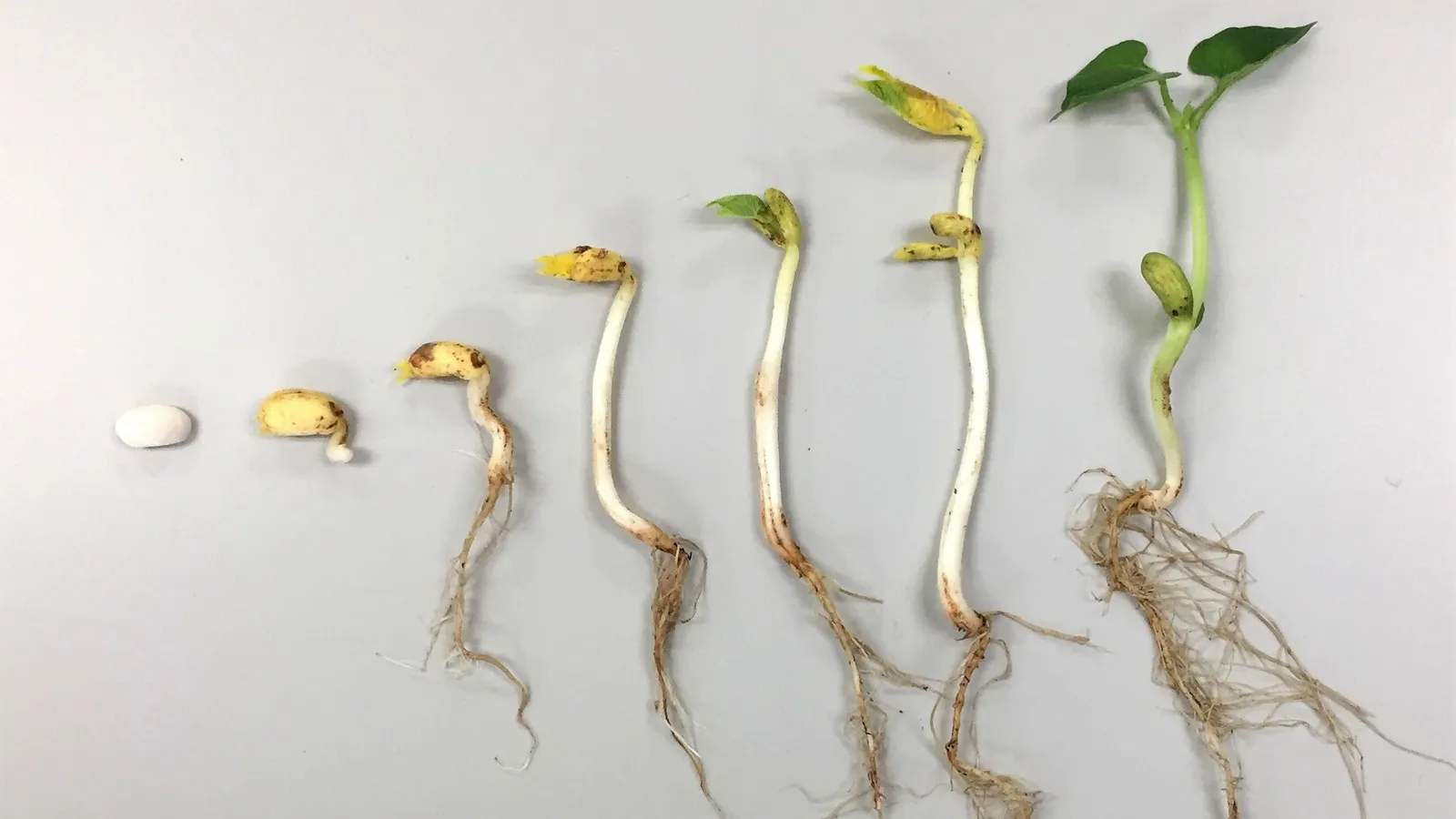
Days 4 to 10: look closely; both sources expect sprouts by then.
Day 14: final count; measure the tallest seedling in each setup and note its colour.
What should the results table look like?
NCERT's Table 10.2 records, for each pot, whether it had air, sunlight and water, then a prediction, an observation and a possible reason (NCERT Curiosity, Class 6, Chapter 10). Copy those columns and add three more:
Day of the first sprout
Number sprouted out of 5, and the percentage
Height and colour of the tallest seedling on Day 14
For the percentage, divide sprouts by seeds sown and multiply by 100: if 4 of 5 seeds in Pot D sprout, that is 80%. The UC Davis ragdoll fact sheet uses samples of 50 or 100 seeds; with 100, the count is the percentage.
What do the findings mean?
NCERT says that bean seeds need the right amount of water and air to germinate (NCERT Curiosity, Class 6, Chapter 10). Here is what each setup tests:
Pot A (dry): water softens the seed coat and helps the embryo inside develop into a plant, so dry seeds should not sprout.
Pot B (flooded): seeds use the air in the spaces between soil particles, and standing water fills those spaces.
Pots C and D: NCERT states that light is not essential for bean seeds to germinate, but seedlings need sunlight to keep growing.
Plate E (no soil): if these sprout like Pot D, soil is not needed for germination itself. It matters later: the spaces between soil particles let roots grow easily.
Seedlings grown in the dark are called etiolated: they have non-green plastids where green chloroplasts would normally be. A review in the Journal of Experimental Botany describes how, once light arrives, these turn into chloroplasts and the seedling switches to light-grown growth. Move Pot C into the light for a few days and watch. Our explainer on why seedlings grown in the dark are tall and yellow goes further.
How do you talk about the experiment with your child?
Ask, don't tell:
Day 0: "Which setup will sprout first, and why?"
Halfway: "What is the only difference between Pot C and Pot D?"
Day 14: "Which prediction was wrong? What would you test next?"
To test air and cold as well, try the virtual four-tube germination experiment. Our guide to epigeal and hypogeal germination shows how a bean seedling's hooked stem lifts its seed leaves out of the soil. In the Fermi Concept Library, each biology concept has its own lesson, so a curious student can read up on the ideas behind it.
Pin the finished table on the fridge and repeat the experiment with a different seed next month.