

On this page
Seeds are survival capsules. They contain a dormant embryonic plant and a packed lunch of stored food (the endosperm or cotyledons), waiting for the environment to signal that it is safe to grow. To break dormancy, seeds need three environmental triggers: water, oxygen and warmth.
Water is the primary trigger. It softens the hard seed coat and activates the enzymes inside. A potting mix temperature of 18°C to 24°C (65°F to 75°F) is recommended for germinating most vegetable seeds (University of Maryland). Oxygen is required because the seed must perform aerobic respiration to release energy from its food stores before it has leaves to photosynthesise.
Notice what is missing from this list: light and soil. Most seeds do not need light to germinate; in fact, they are usually buried underground. They only need light once the seedling emerges. Similarly, soil is just a medium to hold water and nutrients; seeds can germinate perfectly well on a wet paper towel.
What is the classic four-tube experiment setup?
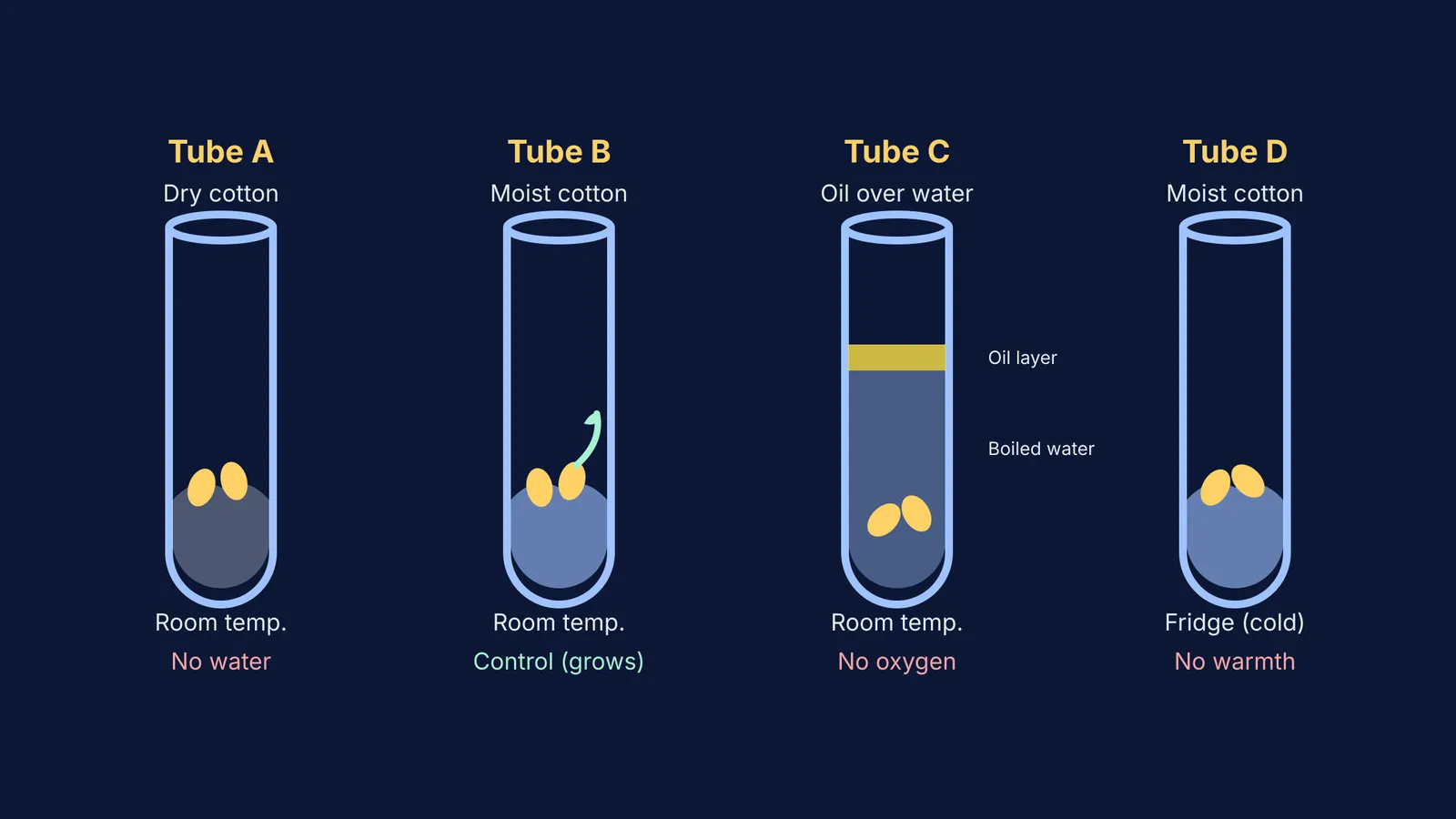
To prove these three factors are necessary, biologists rely on a classic test-tube experiment. By setting up four identical test tubes with seeds (such as beans, peas or gram) and systematically removing one factor at a time, you can isolate exactly what causes germination.
Tube A (Dry): Seeds are placed on dry cotton wool at room temperature. This tube lacks water. Even with air and warmth, the enzymes remain inactive.
Tube B (Control): Seeds are placed on moist cotton wool at room temperature, open to the air. This is the baseline condition. It proves that the seeds are viable and healthy.
Tube C (No oxygen): Seeds are submerged in boiled water and covered with a layer of cooking oil. Boiling the water drives out any dissolved oxygen, and the oil prevents new oxygen from the air from entering. This tube lacks air.
Tube D (Cold): Seeds are placed on moist cotton wool, but the tube is kept in a refrigerator. This tube lacks warmth. The low temperature slows the chemical reactions so much that the seed cannot sprout.
Why run a virtual seed simulation?
In a physical laboratory, you have to wait several days, checking the tubes daily to see which seeds sprout and which rot or remain dormant. A virtual experiment accelerates this process. It lets you predict the outcome, set the conditions, and run the simulation in seconds.
Testing one variable at a time—keeping all other factors constant—is the foundation of a fair test in the scientific method. By isolating water, oxygen and temperature, you prove without doubt which missing factor stopped the seed from growing. If you want to see how this experimental design works in practice, the Fermi Simulation Lab offers interactive simulations for ideas that are easier to see than to read, letting you adjust water, air and temperature to instantly see their effects.
How do you answer exam questions on germination?
School board exams and competitive tests often feature this exact four-tube setup to test your understanding of experimental design and plant physiology. Here is a reliable framework for structuring your answers:
State the missing factor clearly: When asked why a specific tube failed, identify exactly what Tube A, C or D lacks. Do not just say "the conditions were wrong."
Explain the biological mechanism: Connect the missing factor to the seed's internal processes. Water activates enzymes and bursts the seed coat. Oxygen is necessary for aerobic respiration to convert stored starch into usable energy. Warmth provides the kinetic energy for these metabolic reactions to happen at a viable speed.
Compare with the control: Always mention Tube B in your answer to show that the failure in the other tubes was due to the missing factor, not because the seeds were dead to begin with.
This understanding applies beyond the test tube. If a question asks why a seed planted in heavily waterlogged clay soil dies, you can point straight to the logic of Tube C: the excess water displaced the oxygen in the soil pores, and the seed simply could not breathe.
Once you have mastered the environmental conditions for germination, you can explore the earlier reproductive stages of plant life, such as how the embryo sac forms inside the flower, or the fascinating cases of seeds without fertilisation.


