

On this page
If you have ever left a germinating seed in a dark cupboard, you will have seen it shoot out a pale, spindly stalk. This dramatic transformation is not a mistake but an emergency response.
When seedlings germinate deep underground, they are in total darkness. They cannot waste energy growing large leaves because, without sunlight, photosynthesis is impossible. Instead, they shift all their resources into one goal: stretching upwards to find the surface before their seed's stored food runs out.
Why are plants grown in the dark tall and yellow?
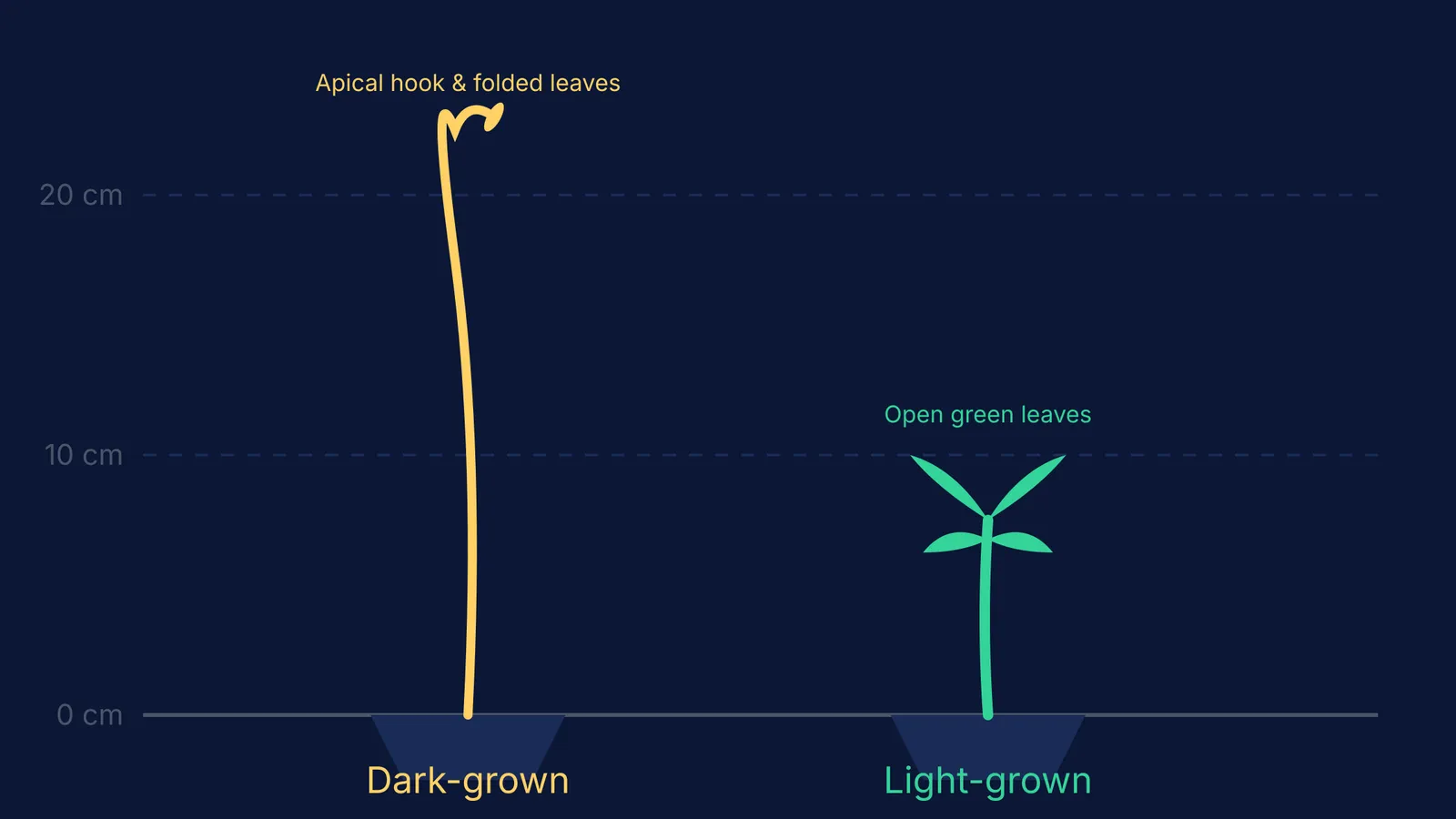
When a plant is deprived of light, it triggers a developmental programme called skotomorphogenesis (dark-mode growth). In 2008, a review by Josse and Halliday in *Current Biology* (10.1016/j.cub.2008.10.034) explained that proteins called phytochrome interacting factors (PIFs) maintain the skotomorphogenic state by suppressing light-driven development in the dark. These master regulators ensure that the plant maintains its skotomorphogenic state, forcing the stem (hypocotyl) to elongate rapidly. At the same time, the leaves remain tiny and folded, protected by an "apical hook" at the top of the shoot to avoid mechanical damage as it pushes forcefully through the soil.
The yellow colour comes from a deliberate pause in pigment production. Making green chlorophyll is an expensive process, and in flowering plants, the final chemical step requires light. A 2010 paper in *Photosynthesis Research* (10.1007/s11120-010-9568-2) details how, in the dark, plastids become "etioplasts" rather than functional chloroplasts. Etioplasts store a precursor pigment called protochlorophyllide, which is naturally pale yellow.
The enzyme needed to convert this precursor into chlorophyll only works when struck by a photon of light. The moment the seedling breaks through the soil and senses light, the stored pigment rapidly turns green, the PIF proteins break down, the stem stops stretching, and the leaves open up. This transition from dark growth to light growth is called de-etiolation.
What is etiolation in seedlings?
Etiolation is exactly this combination of traits: rapid stem elongation, failure to produce chlorophyll (chlorosis), and poor leaf development due to a lack of light. It is a critical adaptation for survival in the crucial early days of a plant's life. If you are struggling to picture how plant hormones and photoreceptors manage these sudden changes, the Fermi Concept Library has every concept in physics, chemistry, biology, mathematics and computing, each with its own lesson and its place in the map, so you can trace the signalling pathways from the first photon to the unfolding leaf.
These responses tie closely to the broader rules of plant development that you will encounter in school, such as the tropisms covered in Phototropism, geotropism and other tropic movements in Class 10 and the mathematics of populations and physical structures in Arithmetic vs geometric growth in plants: the growth equations. The study of etiolation shows how tightly growth is regulated by external signals.
How do you run the etiolation experiment?
You can watch skotomorphogenesis and de-etiolation happen in real time with a simple experiment at home or in the lab. This hands-on practical is often the best way to understand the stark contrast between light and dark growth modes.
Soak a handful of beans (such as mung or kidney beans) in water overnight to speed up germination.
Plant them in two identical small pots filled with moist potting soil.
Place one pot on a sunny windowsill. This is your control group.
Seal the other pot inside a dark cardboard box. Ensure no light can leak in.
After five days, open the box and measure the heights of both sets of plants. The dark-grown seedlings will be much taller, pale yellow, and will have an arched hook at the top instead of open, green leaves.
Move the dark-grown pot into the sun alongside the control group.
Check the dark-grown pot every few hours after moving it into the light. You will see the hook begin to straighten and the pale leaves rapidly turn green as the light triggers the enzymes responsible for chlorophyll production. Within a few days, the once-etiolated plant will begin to look like a normal, light-grown seedling, having successfully completed its race for the sun.


