On this page
A question might ask for "the component of F along the line 3î + 4ĵ" or "the projection of a on b". Both ask the same thing: how much of one vector points along another. One formula answers it, and one small slip ruins the answer.
What is the component of a vector along another vector?
NCERT's Class 12 Mathematics textbook gives the projection of a vector a on a vector b as a·b̂, which equals (1/|b|)(a·b) (NCERT, Vector Algebra, section 10.6.2). That number is the scalar component: a length with a sign.
It comes straight from the dot product. OpenStax University Physics defines A·B = AB cos φ and reads it as one vector's magnitude times the other vector's projection onto its direction. Divide both sides by B and you are left with A cos φ = A·B/|B|.
The sign carries meaning. The same NCERT section says the projection vector points along the line when cos θ is positive, against it when cos θ is negative, and is the zero vector when the two are at 90°.
So there are two answers, and questions ask for either:
Scalar component (projection): A·B/|B|. A number, in the units of A.
Vector component (projection vector): (A·B/|B|) B̂, which is the same as (A·B/|B|²) B. A vector lying along B.
How do you find the component of a force along a direction?
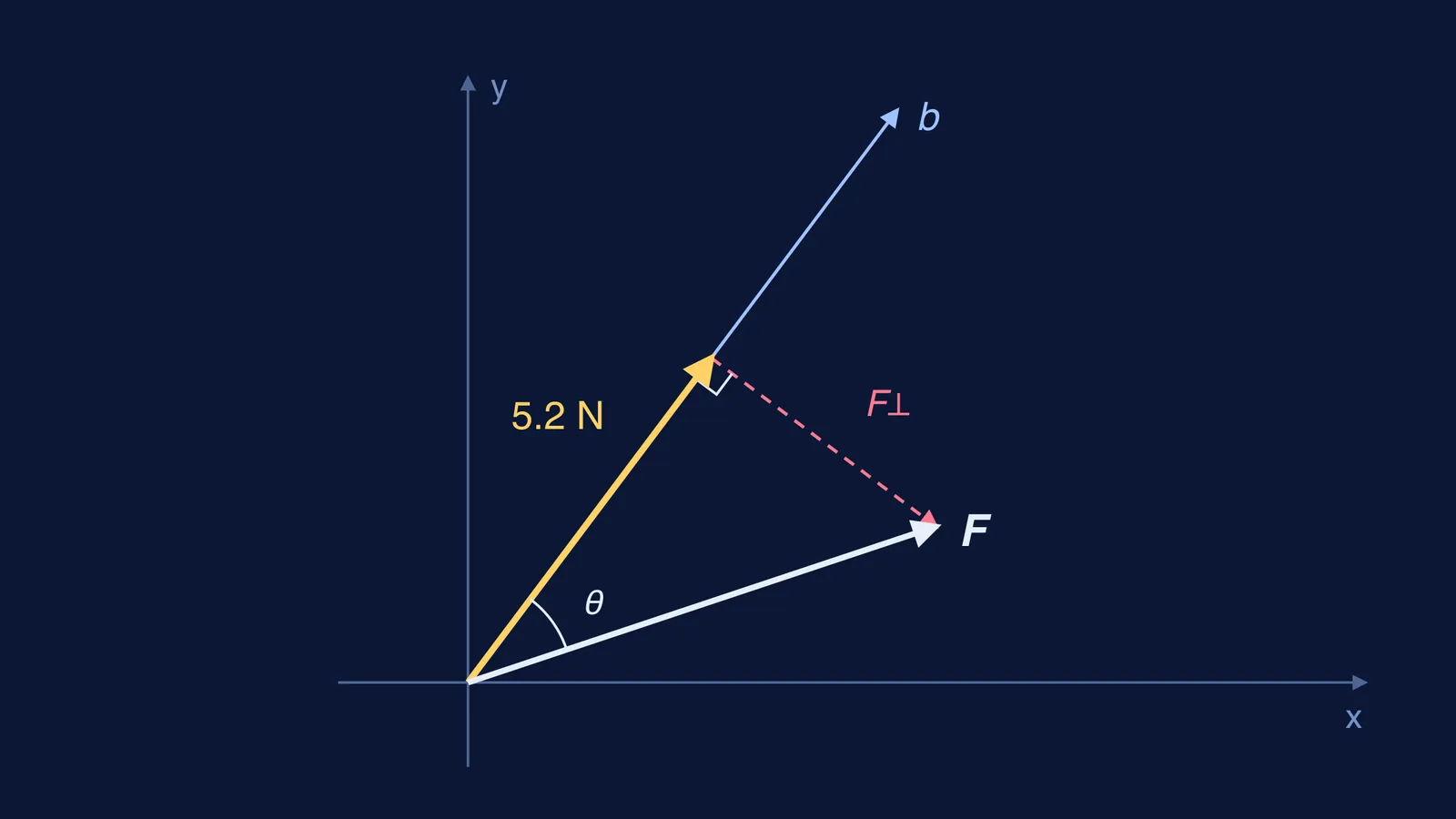
A block can slide only along a straight groove pointing in the direction b = 3î + 4ĵ. A force F = (6î + 2ĵ) N acts on it. How much of F pushes along the groove?
Dot product, using a₁b₁ + a₂b₂ + a₃b₃ from the NCERT chapter: F·b = 6×3 + 2×4 = 26.
Length of the direction vector: |b| = √(9 + 16) = 5.
Scalar component: 26/5 = 5.2 N.
Unit vector: b̂ = (3î + 4ĵ)/5 = 0.6î + 0.8ĵ.
Vector component: 5.2 × (0.6î + 0.8ĵ) = (3.12î + 4.16ĵ) N.
Check: F minus that is 2.88î − 2.16ĵ, and its dot product with b is 8.64 − 8.64 = 0. The leftover part is perpendicular to the groove, as it must be.
Notice that b only supplies a direction. Write it as 6î + 8ĵ instead and you get 52/10, still 5.2 N.
OpenStax defines the work done by a force as the scalar product of the force with the displacement, F·d (OpenStax, section 2.4). If the block slides 2 m along the groove, d = 2b̂ = 1.2î + 1.6ĵ m, and F·d = 7.2 + 3.2 = 10.4 J. That is exactly 5.2 N × 2 m: only the component along the motion does work. Our post on work done by a force at an angle works through what happens at 0°, 60° and 90°.
What is the common unit-vector slip?
The same numbers give three tempting wrong answers:
Forgetting to divide: 26 N. That is F·b, and it still carries the length of b. Double b and it doubles, but a real component cannot depend on how you wrote the direction.
Multiplying by b instead of b̂: 5.2(3î + 4ĵ) = 15.6î + 20.8ĵ, with magnitude 26 N. That is longer than F itself, which is only √40 ≈ 6.3 N.
Dividing by |b|² and stopping: 26/25 = 1.04. That is the number you multiply b by in the vector form, not the component.
The rule that stops all three: divide by |b| once to get the number. To get the vector, multiply that number by b̂, which divides by |b| a second time. If you need a refresher on building b̂, see how to find a unit vector along a sum of vectors.
If the steps make sense but marks keep slipping on the last line, practise a few in the Fermi Problem Library, where a step-by-step solver explains the reasoning rather than printing an answer.
Where else does the projection formula show up?
The NCERT chapter notes that the ordinary components a₁, a₂, a₃ of a vector are its projections along the x, y and z axes, so "the x-component" is just a·î. Resolving a force along any direction in mechanics uses the same formula with a convenient unit vector.
Inclines: the component of the weight along the slope is mg dotted with the unit vector down the slope. Our guide to resolving forces on an inclined plane shows how to avoid swapping sin and cos.
Work and power: F·d and F·v both keep only the part of the force along the motion.
If the dot product itself feels shaky, the Fermi Concept Library gives each concept in physics and mathematics its own lesson. Then pick a textbook question, find one component by hand, and run the two checks before you look at the answer.