

On this page
You are dragging a heavy carton of books across the floor with a rope. You pull just as hard each time: flat along the floor, then at 60° to the floor, then straight up. Does the rope do the same work each time? Write your three guesses down before you read on. Guessing first is not a gimmick. In a study of classroom physics demonstrations,Crouch, Fagen, Callan and Mazur (American Journal of Physics, 2004) found that students who only watched a demonstration understood the idea no better than students who never saw it, while students who predicted the outcome first understood it significantly better.
What is the formula for work done by a force at an angle?
For a constant force, work is the dot product of force and displacement: W = F·d = Fd cos θ, where θ is the angle between the force and the displacement (OpenStax University Physics, section 7.1). The unit of work is the newton-metre, called the joule (J), according to the same OpenStax section.
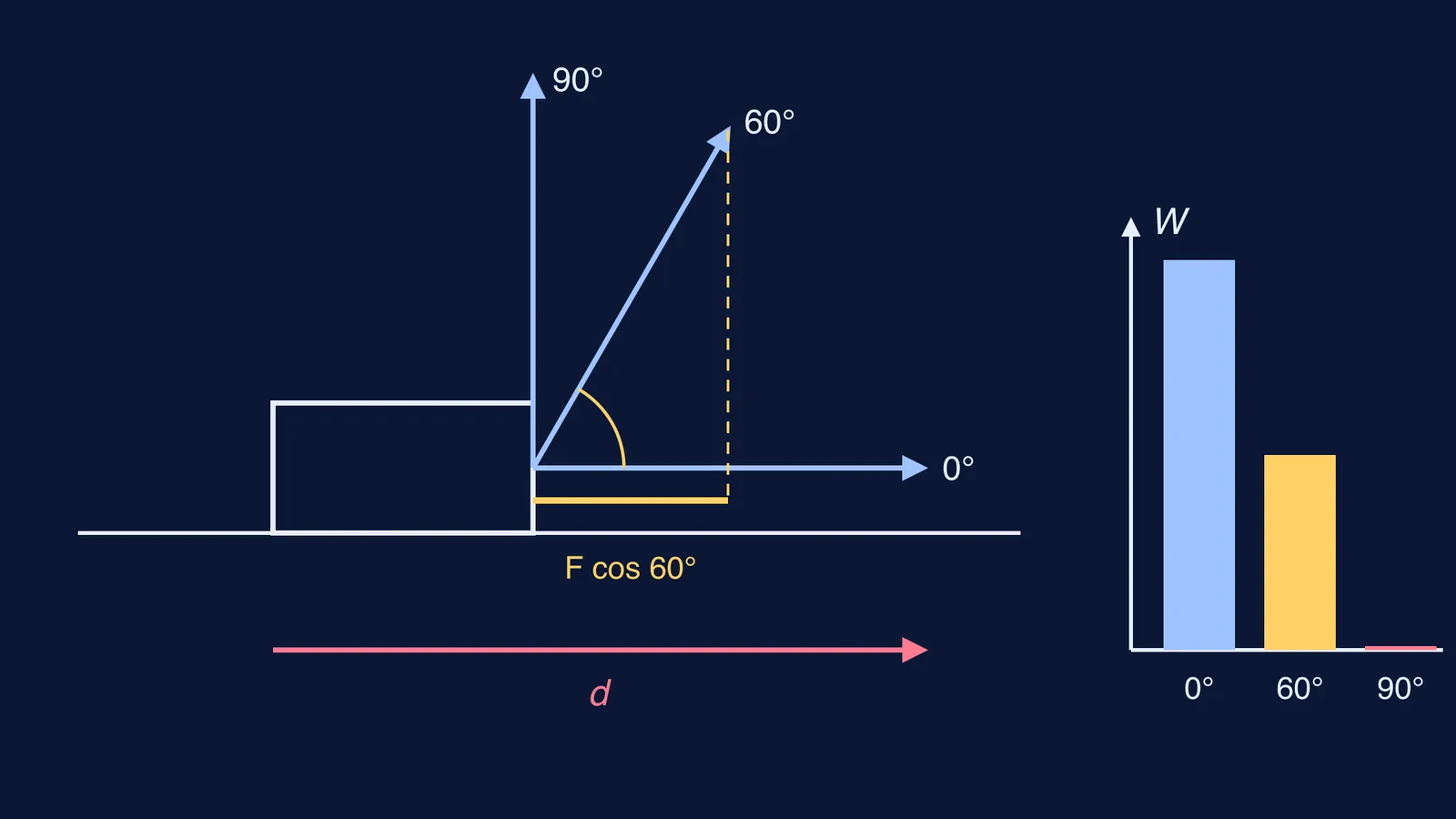
Split the rope's pull into two parts: F cos θ along the floor and F sin θ straight up. Only the part along the motion does work.
Worked example: what work does the rope do at 0°, 60° and 90°?
Take a pull of F = 50 N and say the box moves d = 4 m along the floor in every case. At 90° your vertical rope cannot drag the box along by itself, so imagine a friend pushing it the same 4 m while you hold the rope straight up. We are asking only about the work done by your rope.
At 0°: W = 50 × 4 × cos 0° = 50 × 4 × 1 = 200 J.
At 60°: W = 50 × 4 × cos 60° = 50 × 4 × 0.5 = 100 J.
At 90°: W = 50 × 4 × cos 90° = 50 × 4 × 0 = 0 J.
Now check the same answers with vector components, the way JEE problems often set them up. Put the floor along x. The displacement is d = (4, 0) m. At 60° the force is F = (50 cos 60°, 50 sin 60°) = (25, 43.3) N. The dot product multiplies matching components and adds them: 25 × 4 + 43.3 × 0 = 100 J. The 43.3 N upward part is multiplied by zero displacement upward, so it drops out. That is the same answer as Fd cos θ, and it is why the two forms are one idea.
How did your predictions match?
Mark each guess against the answers above and name the reason for any miss. Most wrong guesses fall into one of three patterns:
Same work every time. You counted how hard you pulled, not which way. Work cares about direction.
More work at 60°. It can feel harder, but a pull that feels harder is not the same as more work by the rope. Only the 25 N along the floor counts.
Some work at 90°. Your arm gets tired holding the rope, but the force is perpendicular to the motion, and OpenStax states plainly that zero work is done when cos θ = 0 (section 7.1).
That last one is worth a whole list of its own, and our guide to when work done is zero, including the school bag goes through five such cases.
How can you test it yourself?
You can see the cos θ at home with a light box, a rope and a luggage scale hooked between them so you can keep the reading roughly the same.
Pull with the rope nearly flat: almost all of your pull points along the floor.
Keep the same reading and raise the rope to about 60°: only half, F cos 60°, points along the floor.
Raise the rope almost vertical: almost none does, and a light box may simply lift.
The upward part of the pull also presses the box less hard into the floor, which changes friction. That is why pulling at an angle can still be easier, as our post on why it is easier to pull a lawn roller than push it explains. It does not change the work your rope does, which is still Fd cos θ.
If you would rather see the arrows move than imagine them, the Fermi Simulation Lab has interactive simulations for ideas that are easier to see than to read. If you keep getting the sign or the angle wrong in longer problems, the Fermi Problem Library has worked problems with a step-by-step solver that explains the reasoning rather than printing an answer.
Next, try the three mistakes that quietly cost marks in work-energy problems, and predict each one before you read it.


