

On this page
You can carry a heavy bag for ten minutes, feel exhausted, and still be told you did zero work. Physics uses the word more strictly, and once you see why, these exam questions get easy.
What does zero work mean in physics?
In OpenStax University Physics, section 7.1, the work done by a force is the dot product of force and displacement: W = F·d = Fd cos θ, where θ is the angle between them.
That formula gives you exactly three ways to get zero:
There is no force (F = 0).
The object does not move (d = 0).
The force is perpendicular to the displacement (θ = 90°, so cos θ = 0).
The dot product counts only the part of the force along the motion; our explainer on why work is a scalar shows how.
When is work done zero? Five cases to know
1. Holding something still. A person holding a briefcase still exerts a force, but the displacement is zero, so the work is zero (OpenStax 7.1).
2. Carrying something horizontally. Walk on level ground with the briefcase and your upward force is at 90° to the motion, so it does zero work (same section). The normal force on a block sliding along a floor is zero work for the same reason.
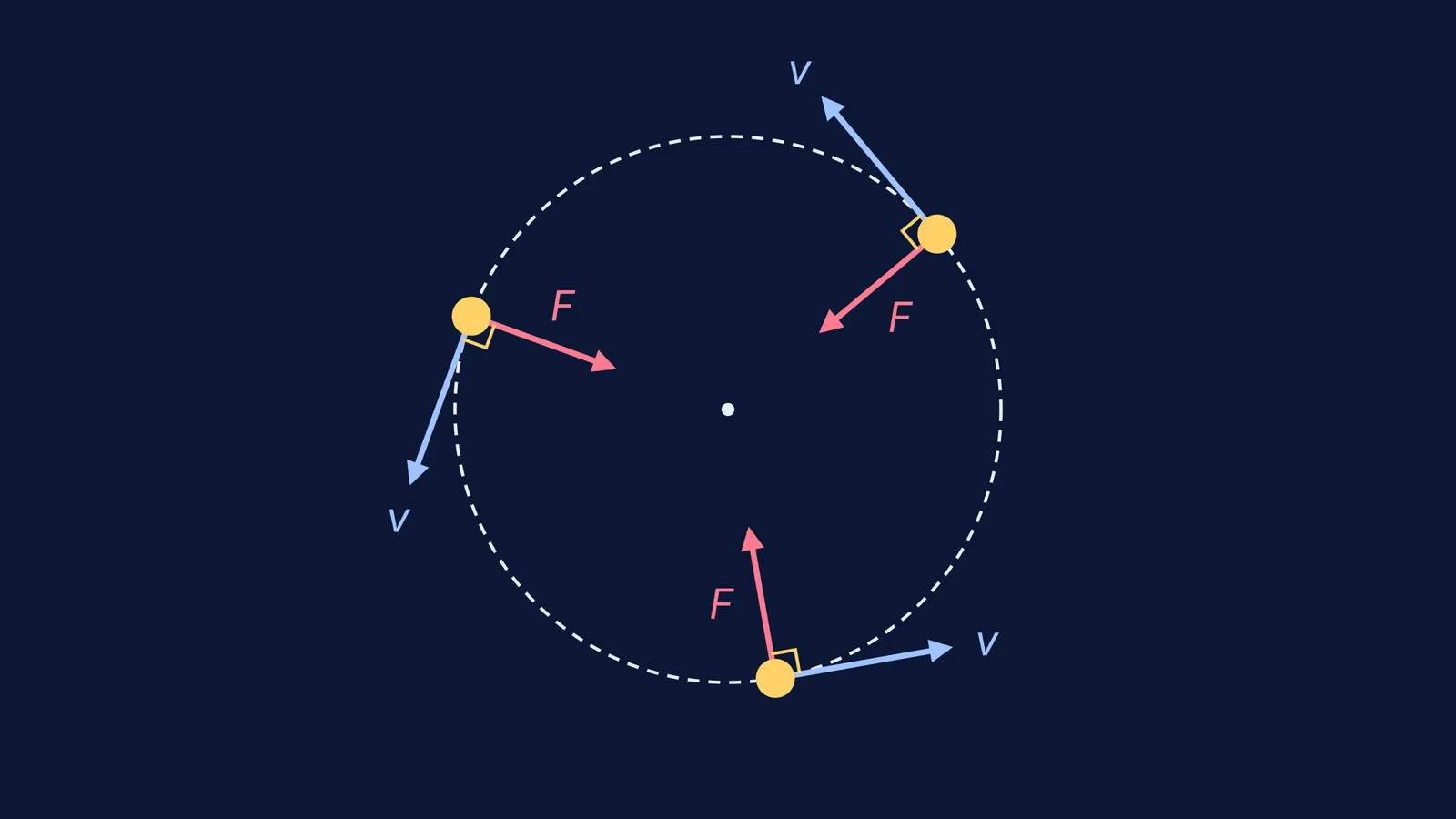
3. Uniform circular motion. The centripetal force is always perpendicular to the path and points to the centre (OpenStax 6.3), so it changes the direction of motion but not the speed. The work-energy theorem agrees: net work equals the change in kinetic energy (OpenStax 7.3), and constant speed means no change. The direction keeps turning, which is why centripetal acceleration is not constant even though its size is.
4. Magnetic force on a moving charge. OpenStax notes that the magnetic force is always perpendicular to velocity, so it does no work on a charged particle and its speed stays constant (OpenStax Volume 2, 11.3).
5. Gravity on a round trip. A ball thrown up and caught at the same height: gravity does negative work on the way up and equal positive work on the way down. The total is zero, even though it was not zero at each moment (OpenStax 7.1).
How do you answer the Class 9 bag and hay-bundle questions?
The NCERT Class 9 Work and Energy exercises include a donkey carrying a load on its back, a person who holds a bundle of hay over their head for 30 minutes and gets tired, the work done by gravity on a satellite going round the Earth, and an object thrown at an angle that lands at the same height. You can see the questions reproduced by Orchids International School. All four are cases 1, 2, 3 and 5 above.
A worked example for your notes: you carry a 6 kg school bag at steady speed, taking g = 9.8 m/s².
You lift it 1 m from the floor onto your shoulder. Work by you = mgh = 6 × 9.8 × 1 = 58.8 J. Work by gravity = −58.8 J.
You walk 50 m along a level corridor. Both your upward force and gravity are perpendicular to the motion, so each does 0 J.
You climb stairs that rise 3 m. Work by you against gravity = 6 × 9.8 × 3 = 176.4 J. Work by gravity = −176.4 J.
Total work by you on the bag = 58.8 + 0 + 176.4 = 235.2 J. Only the height gained counts, not the 50 m walked.
In an exam, answer in three lines: name the force, state the angle between force and displacement, then give W = Fd cos θ and the result. For the hay bundle, add that tiredness is real, but the bundle's displacement is zero, so no work is done on it.
If you keep getting these wrong because you pick the wrong angle or the wrong force, the Fermi Problem Library has worked problems with a step-by-step solver that explains the reasoning rather than printing an answer.
What are the common traps?
Elliptical orbits. In an ellipse the speed changes, so gravity is not perpendicular to the velocity everywhere and does work over parts of the orbit.
Moving surfaces. On a sliding wedge the normal force can do work; see work done by the normal force on a moving wedge.
Starting and stopping. As you speed up from rest, your hand pushes the bag forward and does a little positive work. "Zero" assumes steady speed.
Zero net work is not zero work. Lift a bag at constant speed and you do positive work while gravity does equal negative work. They add to zero.
If the right angle in circular motion still feels abstract, the Fermi Simulation Lab has interactive simulations for ideas that are easier to see than to read.


