

On this page
Why is centripetal acceleration not constant?
It comes down to the difference between a scalar and a vector.
Acceleration is a vector quantity, meaning it has two parts:
Magnitude (its size)
Direction (where it points)
For a vector to be truly constant, both its magnitude and its direction must remain exactly the same. In uniform circular motion, the magnitude of the centripetal acceleration is constant. According to OpenStax University Physics, the magnitude is given by a = v² / r, where v is the constant speed and r is the constant radius.
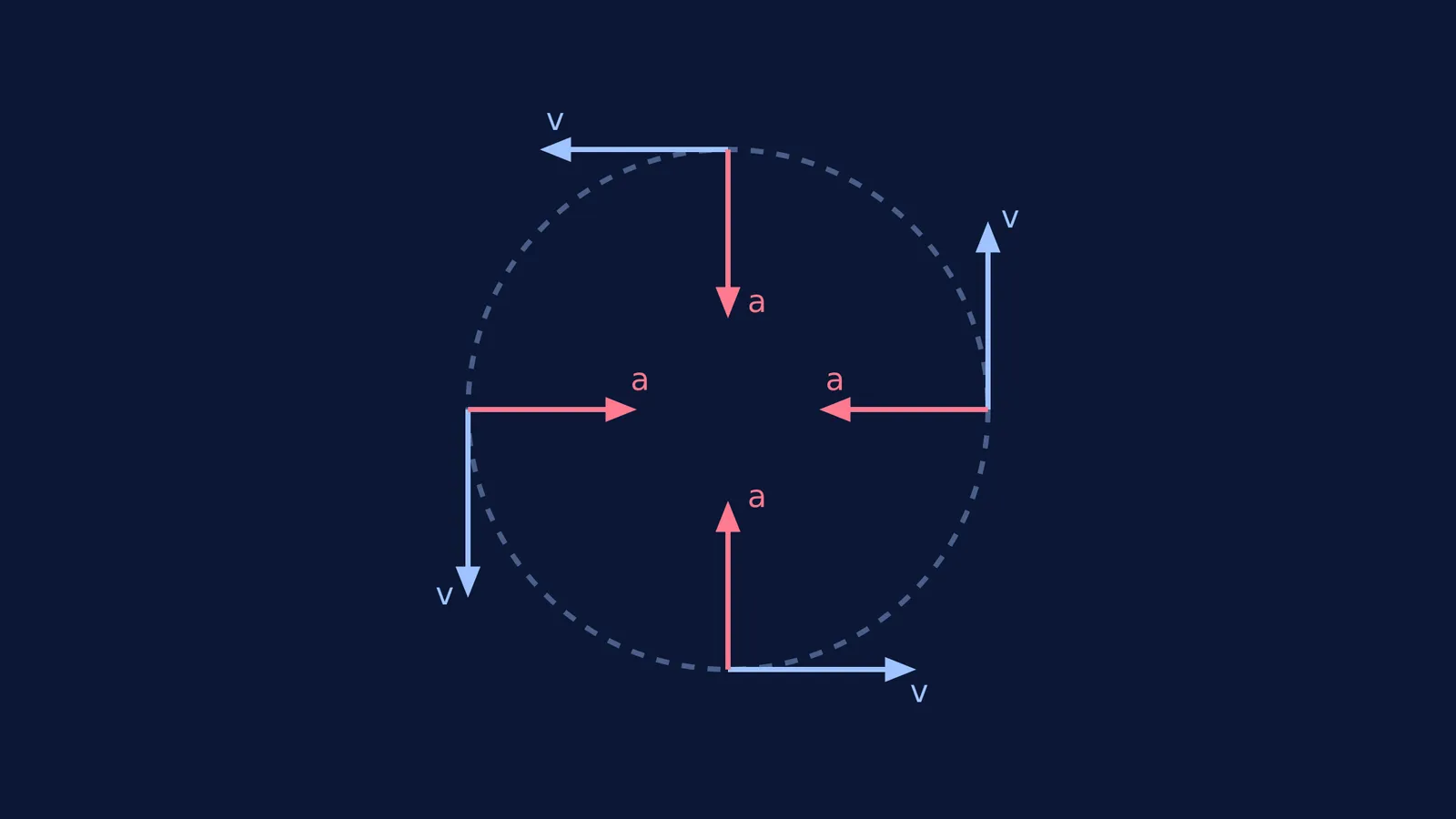
However, the direction of this acceleration always points towards the centre of the circle. As the object travels along its circular path, the centre is always in a different direction relative to the object's current position. Because the direction is continuously rotating, the centripetal acceleration vector is not constant.
Is velocity constant in uniform circular motion?
No, for the exact same reason.
The word "uniform" in uniform circular motion means the speed is constant. But velocity, like acceleration, is a vector. The velocity vector is always tangent to the circle. As you round a curve, the direction you are facing is constantly shifting. Because its direction changes, the velocity vector is not constant.
When you learn to calculate motion in a plane from velocity and acceleration vectors, you will see that any change in a velocity vector—whether it is speeding up, slowing down, or just turning—requires an acceleration.
How do you find the magnitude of centripetal acceleration?
While the vector changes, the size of the acceleration is steady and predictable. According to OpenStax University Physics, you can find it using the speed and the radius. The formula is:
a = v² / r
Let's look at a practical example. Imagine a car travelling at a steady speed of 20 m/s around a circular roundabout with a radius of 50 metres.
v = 20 m/s
r = 50 m
The magnitude of the centripetal acceleration is 20² / 50 = 400 / 50 = 8 m/s².
This magnitude is constant the whole way around the roundabout. It means that to maintain that turn, the car's tyres must provide enough friction to give the car an inward acceleration of 8 m/s². If the driver speeds up to 40 m/s (twice the original speed), the acceleration required becomes 40² / 50 = 1600 / 50 = 32 m/s². Squaring the doubled speed means the required centripetal acceleration increases by a factor of four.
If you are dealing with a situation where the speed itself is changing, the motion is no longer uniform. In those cases, you would have both a centripetal acceleration and a tangential acceleration, and you might need to look into integrating acceleration given as a function of velocity to find the total change. But in uniform circular motion, you only have the inward radial pull.
What provides the centripetal acceleration?
Centripetal acceleration is not a new type of force or a magical property of circles. It is simply the name we give to the net acceleration pointing towards the centre. Something real in the physical world must provide the force that causes this acceleration.
For a satellite in orbit: Gravity provides the centripetal acceleration, keeping the satellite falling in a curve around the Earth.
For a car turning a corner: The friction between the tyres and the road provides the inward pull.
For a ball swung on a string: The tension in the string pulls the ball towards your hand.
In every case, if that force disappears—if gravity vanishes, the car hits a patch of ice, or the string snaps—the centripetal acceleration drops to zero. According to Newton's first law, the object will instantly stop turning and move off in a straight line at a constant velocity, following the tangent of the circle.
How does the Fermi Concept Library help with vectors?
When you first meet vectors in physics, keeping track of what is a scalar (like speed) and what is a vector (like velocity) can be the hardest part of the topic. If you lose track of the direction, it is easy to assume that a steady speed means zero acceleration.
The Fermi Concept Library breaks down the difference between scalars and vectors visually. Because the AI tutor can draw on a digital whiteboard, it can show you the velocity arrow turning as a particle moves, helping you see why a changing direction means the acceleration cannot be zero and cannot be constant. Instead of just memorising the v² / r formula, you can sit with the tutor to explore the geometry that makes the equation work, asking questions until the concept clicks.
A checklist for circular motion questions
When you are faced with a multiple-choice question about uniform circular motion, run through this quick checklist before you answer. Examiners love to test whether you know the difference between the magnitude and the vector.
Read the word carefully: Did they ask about speed or velocity? Speed is a scalar and is constant; velocity is a vector and is not constant because it turns.
Check for vectors: Did they ask if centripetal acceleration is constant, or just its magnitude? The magnitude is constant; the vector itself is not.
Find the direction: Remember that velocity is always tangent to the path, and centripetal acceleration is always radial (pointing to the centre). They are always at a right angle to each other.
By slowing down and checking whether a question is asking about the scalar size or the full vector, you can avoid the most common trap in circular motion tests and confidently choose the right answer.


