

On this page
Can normal force do work on a block?
Yes. We are often taught that the normal force does zero work because it acts perpendicularly to the surface. If the surface is stationary—like a floor or a fixed ramp—the object's displacement is exactly 90 degrees to the normal force, meaning no work is done. Work is the dot product of force and displacement, and the cosine of 90 degrees is zero.
However, if the surface itself moves in a direction that isn't perpendicular to the force, the angle between the normal force and the object's absolute path changes. In this scenario, the normal force does work. A classic everyday example is standing in a rising elevator. The floor pushes you up (the normal force), and you move upward parallel to that force. Because the angle between the force and your displacement is zero, the normal force does positive work on you, transferring energy to lift your mass against gravity. If the elevator is descending, the floor still pushes up, but you move down; the angle is 180 degrees, and the normal force does negative work.
What happens with a block on a moving wedge?
A more complex and famous problem in mechanics—often seen in JEE preparation—involves a block sliding down a smooth wedge that is free to recoil on a frictionless horizontal floor.
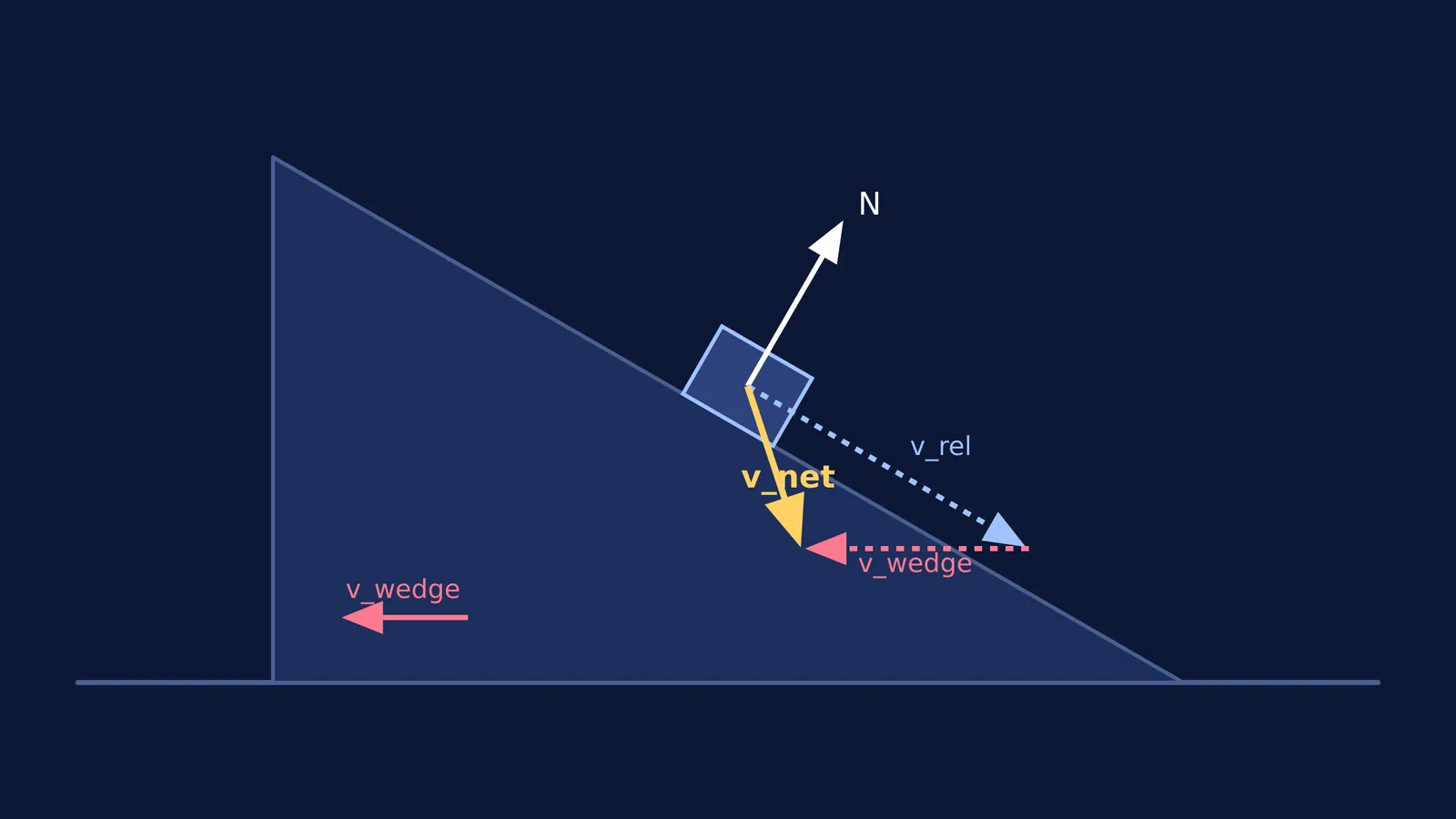
As the block slides down and to the right, it pushes the wedge to the left. In 2004, physicist P. C. Peters published an analysis in the *American Journal of Physics*, using this exact system to clarify the work done by a normal force (Crossref, DOI 10.1119/1.16878). He showed that in the ground frame, the normal force does work on both the block and the wedge.
Because the wedge recoils backward to the left, the block's absolute displacement in the laboratory frame is steeper than the incline. As a result, the angle between the upward-pointing normal force (which is perpendicular to the incline) and the block's downward-right true displacement becomes strictly greater than 90 degrees. Because the cosine of an angle larger than 90 degrees is negative, this means the normal force does negative work on the sliding block. It is actively taking kinetic energy away from the block.
Conversely, the block exerts an equal and opposite normal force down and to the left against the wedge. Because the wedge accelerates horizontally to the left—in the same general direction as the push—the angle is less than 90 degrees. Therefore, the normal force does positive work on the wedge.
How do you approach these problems in exams?
When solving moving wedge mechanics for competitive exams, setting up the right constraints and energy equations is half the battle. Here is a framework to keep your vectors and signs straight:
Draw the velocity vectors: Remember that the block has two distinct velocity components—its motion relative to the wedge (down the incline) and the motion of the wedge itself (horizontal recoil).
Use conservation of momentum: Because there are no external horizontal forces acting on the entire system, the centre of mass of the block-wedge system does not move horizontally. If the wedge has mass M and the block has mass m, their horizontal displacements are tied together: M × X = m × (x - X), where X is the wedge's shift to the left and x is the block's horizontal shift relative to the wedge.
Conserve mechanical energy: As the block loses gravitational potential energy, it converts into the kinetic energy of both the block and the moving wedge.
Link the frames: If a problem asks you to calculate internal forces, you can choose to work in the non-inertial frame of the accelerating wedge by applying a horizontal pseudo-force to the block.
Getting the geometry right is often where students stumble. If you are struggling to picture the constraint equations—how the block's horizontal and vertical speeds lock to the wedge's speed—the Fermi Concept Library maps out relative motion visually. And if you keep dropping signs or losing factors of cosine when setting up the work-energy theorem, feeding the question to the Fermi Problem Library will walk you through the step-by-step solver to see exactly where the vectors shifted.
For more practice with related setups, review our guides on wedge constraint problems and how to calculate work from force-displacement graphs.


