

On this page
When you first learn physics, you are told that force and displacement are vectors—they have both a magnitude (size) and a direction. But when you multiply them to find work, the result is a scalar, a quantity with only a magnitude.
Why does combining two directional quantities give you a number without a direction?
The answer lies in how work is calculated and what it physically represents in the universe. According to the University Physics textbook from OpenStax/Map%3A_University_Physics_I_-_Mechanics_Sound_Oscillations_and_Waves_(OpenStax)/07%3A_Work_and_Kinetic_Energy/7.02%3A_Work), work is the energy transferred to or from an object. Because energy is a scalar (you can have 10 J of energy, but not "10 J North"), work must also be a scalar.
What is the dot product formula for work?
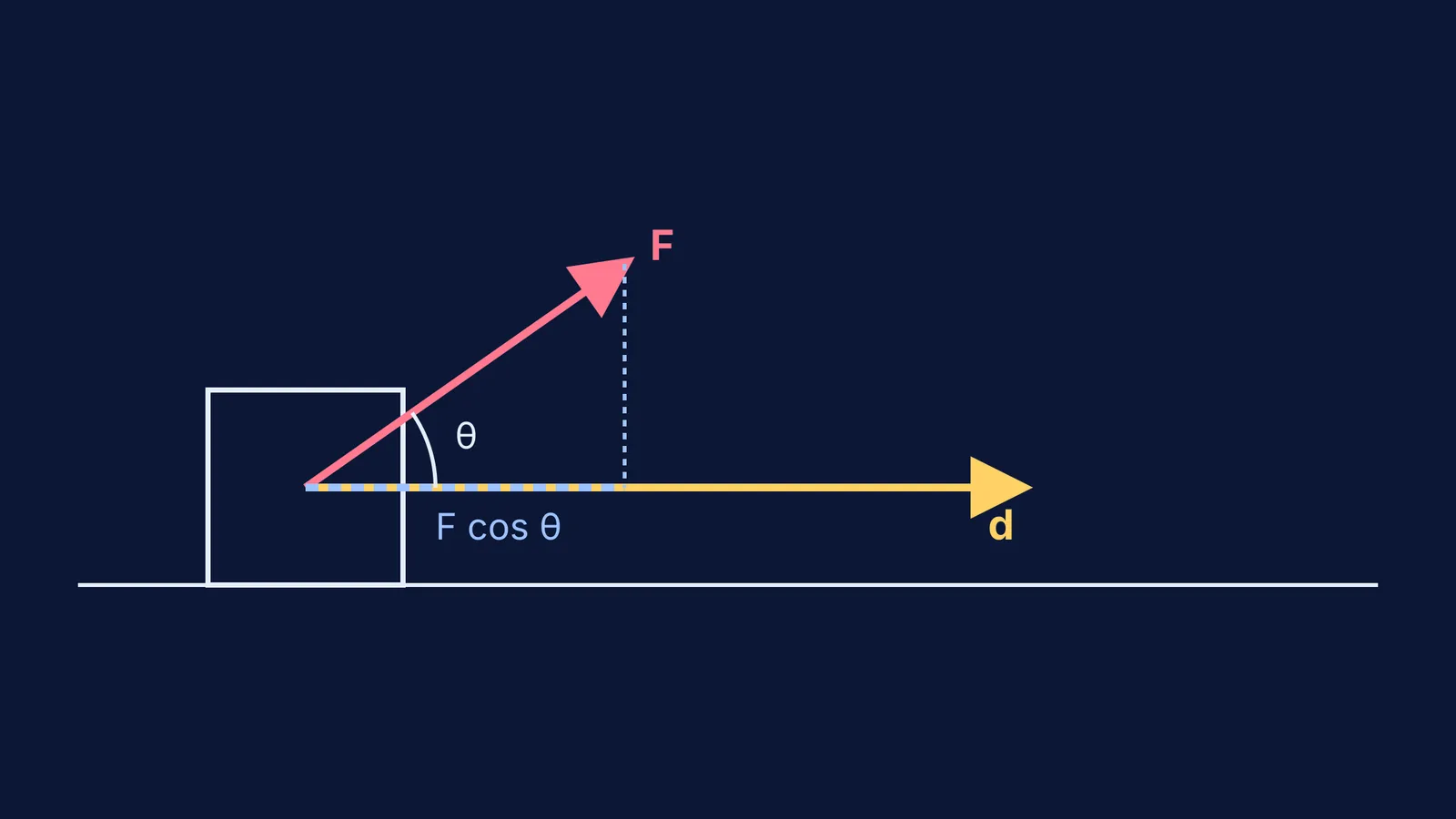
To get a scalar from two vectors, physicists use a mathematical operation called the dot product (or scalar product), as detailed in Wikipedia's summary of work). The formula for work is:
W = F · d = F d cos θ
Here is what those terms mean:
F is the magnitude of the force.
d is the magnitude of the displacement.
θ is the angle between the force and displacement vectors.
The dot product finds the overlap between the two vectors. It multiplies the displacement by only the component of the force that acts exactly along the path of motion (F cos θ). Any part of the force pushing sideways does no work. By definition, a dot product always yields a scalar number, stripping away the directional properties of the original vectors.
What do positive and negative work mean?
Even though work does not point in a direction like North or South, it can still be positive or negative. The University Physics OpenStax guide/Map%3A_University_Physics_I_-_Mechanics_Sound_Oscillations_and_Waves_(OpenStax)/07%3A_Work_and_Kinetic_Energy/7.02%3A_Work) shows that the sign tells you which way the energy is flowing.
Positive work: When the force and displacement point in roughly the same direction (an angle between 0° and 90°), the cosine is positive. The force gives energy to the object, speeding it up.
Negative work: When the force points opposite to the displacement (an angle between 90° and 180°), the cosine is negative. The force removes energy from the object, slowing it down. Friction is a common example of a force that does negative work.
How do you calculate work step by step?
Imagine you are pushing a lawn mower with a constant force of 75.0 N at an angle 35° below the horizontal, and you push it for 25.0 m on level ground. This calculation is a standard example in OpenStax mechanics problems/Map%3A_University_Physics_I_-_Mechanics_Sound_Oscillations_and_Waves_(OpenStax)/07%3A_Work_and_Kinetic_Energy/7.02%3A_Work).
Using the formula:
W = 75.0 × 25.0 × cos 35°
W = 1875 × 0.819 = 1536 J
You have done 1536 J (or 1.54 × 10³ J) of positive work. The downward part of your push only presses the mower into the ground, but the horizontal part is what actually transfers energy into moving it forward.
How to avoid sign mistakes in exams?
If you are preparing for exams like JEE or NEET, sign errors in work and energy problems are incredibly common. Many students memorise the formula but forget to check if the force is acting against the motion.
Here is a checklist for setting up work calculations:
Draw the force and the displacement as arrows starting from the same point.
Find the angle θ between them.
If the force helps the motion, expect a positive result. If it fights the motion, expect a negative result.
If a force is perpendicular to the motion (like the normal force on a flat floor), cross it out because it does zero work.
If you ever find yourself stuck on complex physics problems—like a block sliding down a rough inclined plane where multiple forces act at different angles—you can bring the problem to the Fermi Concept Library. Fermi's AI tutor works out what you already know, builds a plan for the session, and teaches through it—drawing the figure and checking your understanding of the angles as it goes.
Understanding why work is a scalar helps you see the physics clearly. It is not just a mathematical trick; it is the fundamental bookkeeping system for the universe's energy.
Read more about how vectors behave in physics with Torque as r × F: finding torque about a point with vectors, or see how work builds up across multiple charges in Work to assemble point charges: the pairwise kq₁q₂/r sum.


